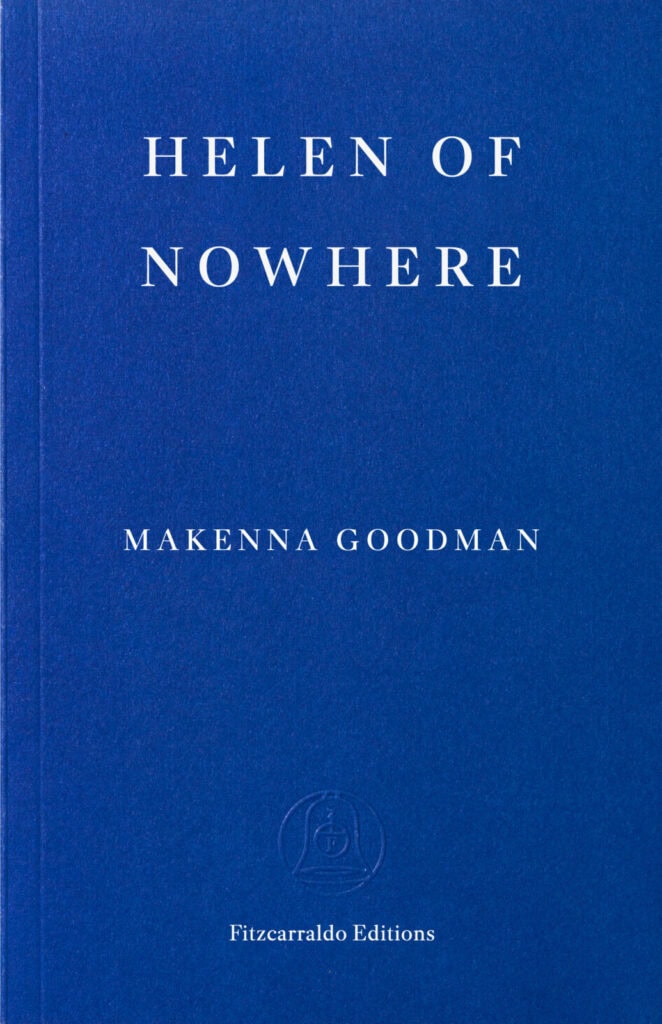
I spent the last several months talking with Makenna Goodman about her new novel, Helen on Nowhere, released with the cult publishing house Fitzcarraldo Editions.
During this time, we discussed her many influences: from bell hooks to Buddhism to French director Agnès Varda. An editor of books on agriculture, ecology and horticulture by day, Goodman shows herself to be a deeply philosophical writer with her sophomore publication.
Goodman’s first novel, The Shame, was an investigation of consumerism, social media and the performance of ethical living, featuring a protagonist who could be mistaken for Goodman herself – a woman who left New York City for Vermont, has a husband, two kids, and a homestead.
The protagonist of Helen of Nowhere, by contrast, is a man – a professor whose career is upended during the post-cis-male moment. His wife, a former student of his, is now an academic and writer too. “Marrying her,” the Man says, “was the greatest revenge against her brilliance.”
Now, “after years of resentment and fog,” the Wife is done. With both his marriage and career on the rocks, the Man considers moving to the country in search of a way to start over and find peace. When a realtor shows him a bucolic house owned by a woman named Helen, he gets more than he bargained for.
The Cold Magazine (CM): In your New York Review of Books essay “Who Gets to Live ‘the Good Life?”, you write about the hypocrisy of the back-to-the-land movement, the move towards self-sufficiency and living off the land that swepy across North America during the mid-1960s-1970s. You suggest that despite Helen and Scott Nearing’s (authors of Living the Good Life (1970)) homesteading success , they failed on the level of theory. Colonialism, racism, ableism, and eugenics are at the root of their vision of utopia. How much of Helen is about the failure of theory?
Makenna Goodman (MG): For me, the act of writing is a practice to better understand some elemental, essential feeling. A theory can be challenging and comforting at the same time because it provides a path to both follow and to argue with. The novel can be a space to really hack a theory apart and put it back together.
If there is a trap it is not that we aren’t living up to good enough theories, but that we think we need theories in order to live. And then, when change is necessary, we hold fast to our theories even when they stop making sense. A theory is only as good as our belief in it.
CM: This novel takes the form of a stage play, beginning with brief character descriptions and taking place in six acts. How did you land on this shape for Helen? Does a playwright have a different relationship to their characters than a novelist?
MG: The form came to me two times. First, because I was reading Plato’s Symposium when I wrote the book. I knew from the beginning I wanted the book to be a dialogue between the Man and other voices who were echoing his point of view, in refracted ways. At the time I was also reading Annie Baker and Caryl Churchill and was very excited by the form. I have no background in theatre and I have never written a play before, and maybe that’s why I find the form so interesting.
CM: When I saw in the front matter that each character is given their own act, I found myself looking forward to “Act 5: Wife.” I wanted to know what she had to say. “Say you were a woman…” Act 5 begins, and then the narrator course corrects to: “Say you were a man.” This seems like an important formal choice – to limit the voice of the Wife. Can you tell me more about your intentions in writing Act 5?
MG: I was just reading an interview with the filmmaker Agnàs Varda where she was asked about her film The Gleaners and I. The interviewer asked her what came first, the story about the gleaners or the story about herself? And Varda’s reply was very forthright: What does it matter what the intention was, she said, when the film as it is now is what matters.
I found that really interesting. How a writer intends something to work isn’t always how the reader experiences it. And if they don’t match up, does that change the experience? For example, I don’t see the voice of the Wife as particularly limited. I see the Wife as all-knowing, as the only really reliable narrator in the book. In creating Act 5, my intention was to shift power back to the Wife, narratively speaking.
CM: Your first novel The Shame has a first-person, female narrator who shares biographical terrain with you. Can you talk about your decision to write from multiple perspectives in Helen of Nowhere?
MG: I resist the term autofiction, because I’m not sure any writer’s story exists outside of their identity. The self is embedded there, like a code, whether or not the writer wants it to be seen.
I write as a study of the self in society and, as I am the self who is writing, naturally I am “in” it somehow. But not literally. In The Shame I was exploring the development of psychic self-awareness. In this book I was interested in what happens when a person is in relationship with someone else. So naturally there had to be more perspectives. Both books are about characters grappling with their own existence. I see them as part of the same project, in many ways. How are we storytellers of the world and of our own lives? And where do we get it wrong?
CM: The character of “Man” in Helen proclaims to love women, yet he’s not actually an ally. What’s more, he doesn’t trust theories; he longs “to be free from criticism, to just exist.” As the storyteller of his own life, he gets a lot wrong on the level of both theory and practice.
MG: A theory is a story. It is created and buttoned up, with all corners considered, swept clean of debris. Whereas living is messy. I’m writing this while on a camping trip, and my brain feels free of theory entirely. I am only the sea, the hammock, the fire, the act of heating water, the dish washing in the woods and the porcupine in the oak tree above my tent. It’s a lovely, if empty, feeling. But the emptiness is momentous – filled with the moment.
CM: The tension between country and city is present in all your work. Did you, like Helen, leave the city and never look back? What does an artist need to do their work, isolation or stimulation? What do you need, and has it changed?
MG: I wish I knew the answer to this question. I did leave the city 20 years ago, but I have gone back to visit, and I go back for work often. In the beginning, though, I really resisted it. I don’t know what an artist needs to do their work but I’m sure it’s different for everyone. For me, it’s quiet, it’s walking in the woods, but for many people it may be the din in a dark bar.
I guess the thing that matters is you’re living truthfully, or asking questions that propel your intrigue. Certainly, time and space help with creating, but I find my best work has come in spurts late at night when I have twenty minutes alone, before falling asleep with my pen in my hand.
CM: The character of the Wife in Helen of Nowhere does not have children, but the house is sort of like Helen’s child. A house must be looked after. Is caretaking at the heart of Helen, even without children in the equation?
MG: My guiding question in Helen is an exploration of love, and what must we give up in order to fully embrace someone else. It’s about sinking into the bodily experience of being. It is very anti-self, even though of course the self is the one experiencing it. Love fascinates me – we do everything to attain it, and yet it is such a hard journey for so many of us.
Makenna Goodman’s Helen of Nowhere, published by Fitzcarraldo Editions, was released on 29 January 2026.