
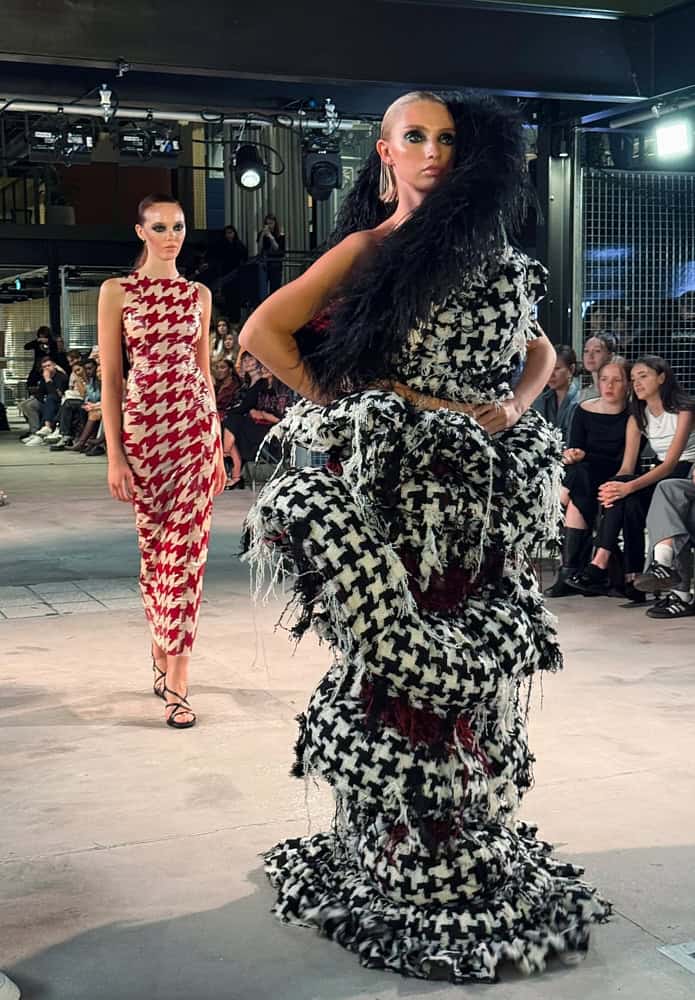
On September 9th, 2025, Manchester Fashion Week returned after a decade-long hiatus. Closing the first day on the Castlefield runway was Mariusz Malon, a Manchester-based designer whose creations fuse recycling, theatre and sustainability into garments that are both sculptural and alive.
While Malon has dressed stars like Doja Cat and SZA and shown work at Paris and London Fashion Week, his MFW debut felt intensely personal, a reclamation of a city and story.


“Fashion came naturally, all because I wanted to put my art on the body,” Malon explained. “I work without sketches or rigid plans. I let the materials guide me. Horror films, theatre, and my imagination shape the characters I envision.”

Sustainability threads through his process as impulse rather than agenda. “I don’t mass produce, and I rarely throw anything away. Everything can be reused. What I hope people take away is that it doesn’t take much to create something from nothing. Resourcefulness can be more powerful than money.”
This instinctual, immediate approach made the day one collection feel alive. Completed in just two weeks, it was a furious sprint to translate months of ideas into motion. “I work fast because I get bored, start doubting myself. But that’s the beauty of it. I never know the end result until it appears,” he says.

Malon’s narrative is inseparable from his journey. Born in Poland, raised in Ireland, and now based in Manchester, he credits small-town solitude with nurturing his imagination. “Manchester welcomed me with open arms,” he says. “The community is supportive, inspiring, and there’s so much room for growth. Six years later, it still excites me every day. This city gave birth to Malon Fashion – it will always have my heart.”
Malon’s work sits at the crossroads of art and social consciousness. Genderless and instinctive, each one-of-a-kind piece is crafted from reclaimed fabrics. “Many describe my work as theatrical and personal,” Malon notes. “It’s not just clothing – it’s characters, worlds, stories. I want audiences to feel the imagination and energy behind it, to understand that creativity doesn’t require wealth, just vision and courage.”
Through sustainability and a refusal to follow convention, Malon reasserts fashion’s power as both art and narrative. Manchester, long defined by its cycles of reinvention – from the industrial revolution to its music and cultural renaissance – feels primed to take the spotlight. As London’s dominance in UK fashion begins to feel overstated, Manchester offers a fresher, more grounded stage for designers like him.
His runway showed that imagination – unbound and fearless, can be fashion’s most sustainable resource. As Manchester Fashion Week came back from its own tossing to the wayside, much like the city itself so often discarded in the larger fashion cycle, Mariusz Malon revealed the beauty that can emerge from what others overlook.
