
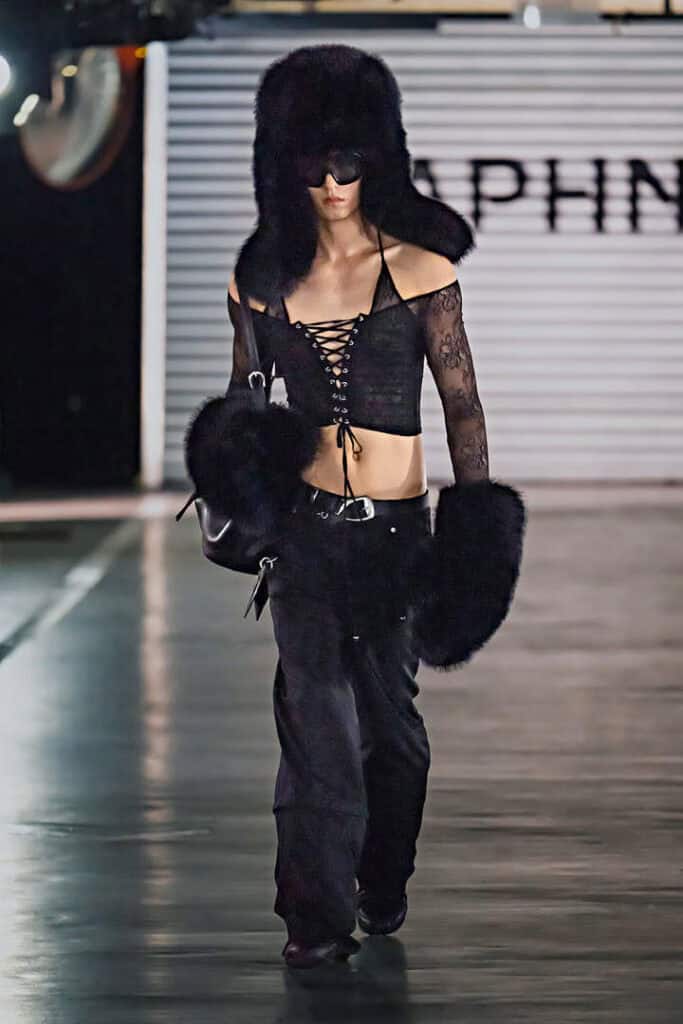
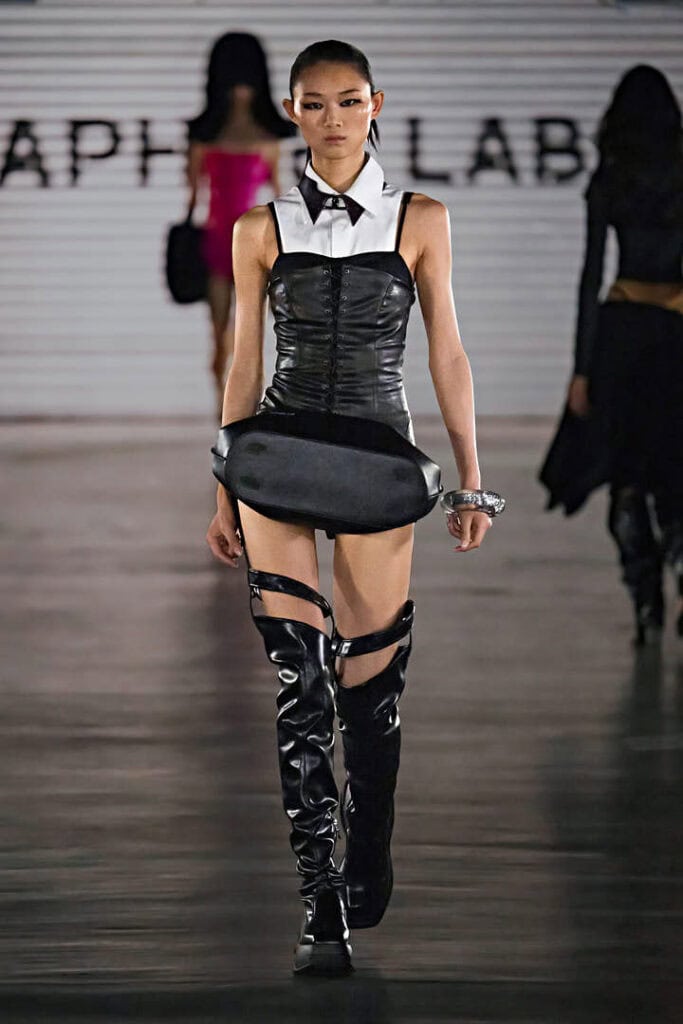
A swarm of people crossing busy streets in the hurly-burly of metropolitan Shanghai. The bangs, the slams and the clacking of heels on concrete become the perfectly-tuned instruments of cacophonous contemporary life. This urban hustle and bustle was translated sartorially into “In a hurry” by Daphne.lab and Marrknull, a collection revealed during Shanghai Fashion Week.
Daphne.lab, a brand deeply rooted in pop culture and beloved by Chinese celebrities and K-pop stars, joined forces with Marrknul l— who in 2023 was a semi-finalist for the prestigious LVMH Prize — to bring together their shared vision and commitment to innovation.
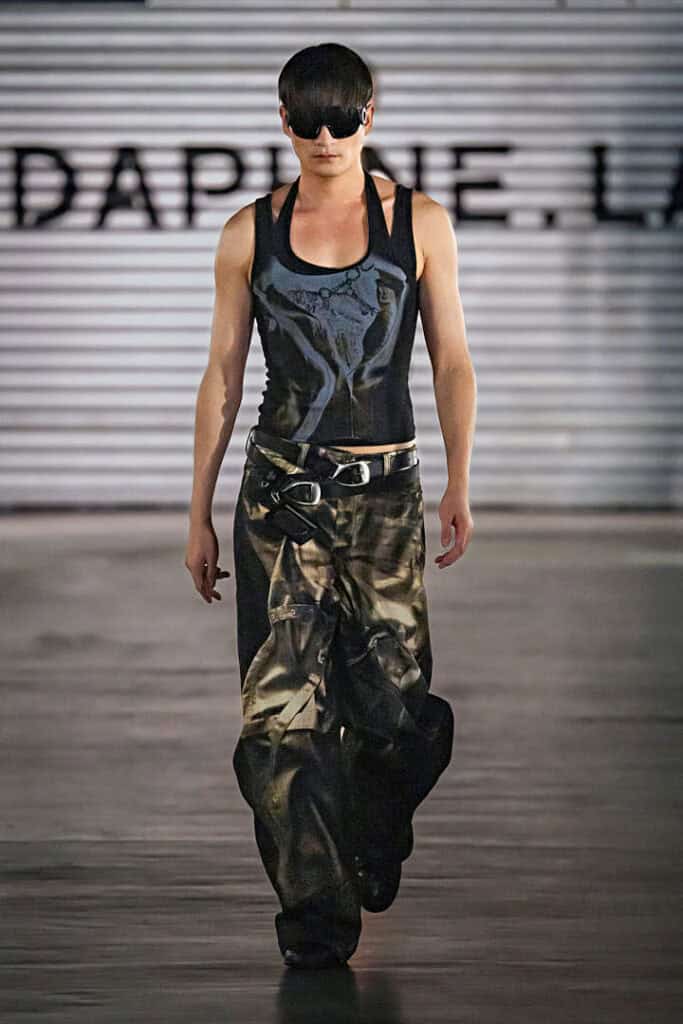
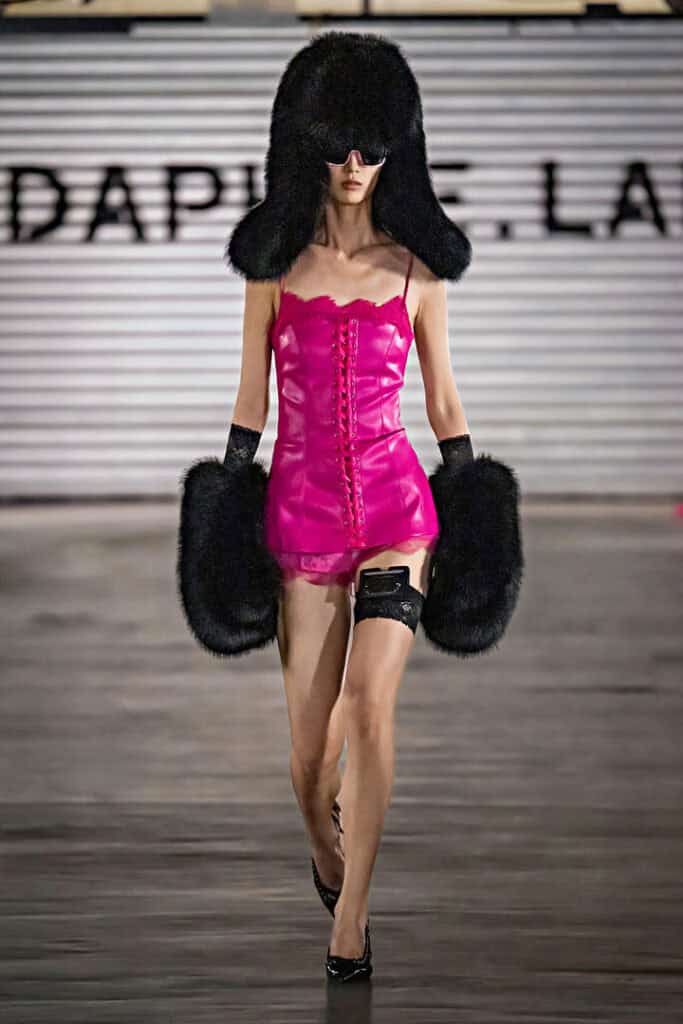
An industrial space served as the backdrop for the collection, where garments were stripped of gendered connotations, reflecting both internal and external shifts in the spectrum of gender identity in the modern-day world. Deconstructed pieces, unusual layerings and the mix-and- match of daily wear with lingerie-inspired elements infused the runway with a laissez-faire attitude, gifting the ensembles with the power of creation and destruction: pure chaos.
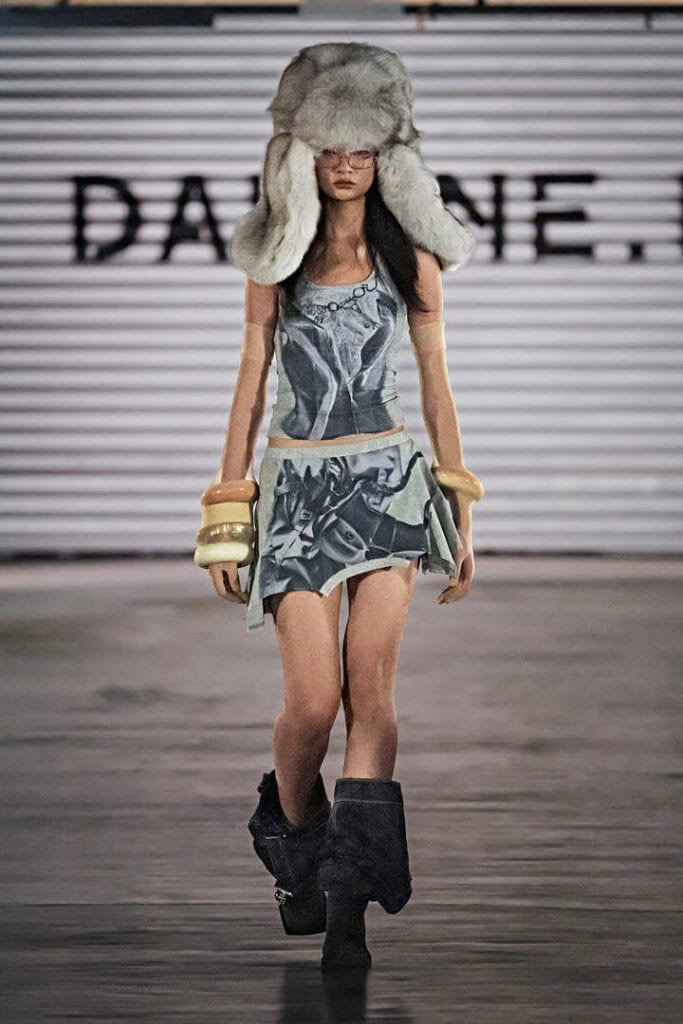
Chaos: the primordial force from which everything originates, from the omnipotent touch of the gods, and where one day reality as we know it will cease to exist, annihilated by the very hands that made it. However, it is in chaos that authenticity best thrives. That was Marrk and Shitian’s—Marrknull’s designers—main purpose when shaping the vision of the project, intersecting the independent muse of Daphne.lab with Marrknull’s innovative approach to fashion, one that looks to the past but isn’t afraid to experiment with new silhouettes and designs.
This aptitude for novelty positions this collaboration as a bulwark of things to come. It offers a beacon of possibility for young designers seeking new inspiring figures, especially at a time when former fashion giants have become little more than household names whose significance has been stripped away, substituted by the business acumen of wolves in suits.
A thong-like skirt, an ushanka-hat covered in fur or a touch of fuchsia amidst the pitch-black ensembles become antidotes to anonymity, counteracting the “fit in a box” culture. It is an undeniable truth that younger generations often feel obliged to fit into predefined archetypes to appear easily understood in the eyes of society. Nevertheless, the names we bestow upon ourselves are but mere words with mood-boards attached.
“In a hurry” is the feasible demonstration that an error — a glitch in the system, a shirt worn inside-out, a strand of hair falling down from a meticulously coiffed hairdo — are ways of disrupting the self-imposed order. What is usually perceived as prim and proper is nothing but the societal copy-and-paste mechanism. Through chaos, we find liberation, and life can finally start flowing back again in our clothes and veins; into cheeks flushed by running up and down the city, always in a hurry.
I spoke with Marrknull’s designer about their design process, an experimental journey into chaos and unrestrained creativity.
The Cold Magazine (CM): Could you please elaborate on why you decided to address the issue of this increasing ‘control mania’ among the younger generation? Is this based on your own experience living in a fast-paced world and system like the fashion industry?
Marrknull (M): Indeed, this largely stems from my personal experience in the fashion industry. This industry is like a perpetual motion machine, constantly chasing the next trend every season, every week, and even every day. Surrounded by terms like “trendy”, “efficient” and “precise”, many young people have widely fallen into a pattern of data-driven control over their lives, self-image and even emotional management. It is precisely this obsession with control that has eroded our tolerance for chaos and stifled the creativity that spontaneously emerges from disorder.
CM: If this is the case, does fashion represent a contributing factor or a solution to this seemingly unrelenting ‘constant motion’?
M: I think it is a double-edged sword. The fashion industry is undoubtedly a co-conspirator in perpetuating anxiety, constantly creating needs and amplifying insecurities. Yet on the other hand, fashion itself can also become a soft form of resistance, using visual language to narrate the beauty in disorder, allowing the raw, unadulterated vitality contained within to be fully unleashed.
CM: You have identified an antidote to a performance-driven way of dressing, using chaos as a silent weapon of revolution. So is it accurate to suggest that the only means of escaping the chaos of our lives is to embrace it?
M: Yes, I believe the only way forward is to embrace chaos. This is not a passive approach, but rather a conscious choice to coexist with disorder. Just like the rushed prints in our designs or the rule-breaking layering, these elements strip away the rigidity and pretence of everyday life, revealing the raw, unvarnished vitality within humanity. True freedom lies in maintaining ease and self-possession even amid disorder.

CM: It is crucial to remain authentic to oneself and not be led astray by contemporary standards of style and beauty. However, in today’s fast-paced environment, how can one truly listen to their inner voice when the cacophony of modern life is so loud?
M: We need to establish our own aesthetic system, refusing to remain trapped in the personalised feeds of our information cocoons or blindly follow every trend set by fashion influencers. The most unique aspects of ourselves are the most valuable, and they prove far more compelling than any fleeting trend.
CM: In ‘In a hurry’ chaos and creativity are one and the same. Did you adopt the same chaotically creative approach when you were creating this collection?
M: Yes, this collection is inherently experimental. From the initial mood-board, we intentionally incorporated dynamic and contradictory elements. This is evident in the final pieces—some utilise injection molding to freeze objects in time, while others employ draping techniques with panels randomly pinned on the mannequin. These seemingly “imperfect” designs collectively form the most authentic vitality.
CM: It is interesting to note the importance of the words used to describe Daphne.lab and Marrknull. The former is described as ‘independent’, while the latter is described as ‘innovative’. I would like to know whether this collaboration was just a creative outlet for both parties or a way to redefine the art of dressmaking?
M: Both. It is the collision between Daphne.lab’s “independent” spirit and Marrknull’s ‘innovative’ DNA – not merely for the sake of producing a show, but to restore it into a deeper, more candid dialogue, collectively narrating their understanding of fashion.
CM: If that is the case, would you say that the new generation is prepared to break free from the stagnation of the past?
M: They have already moved beyond mere discussion. Young people have grown tired of binary choices—complete resignation or relentless overexertion. They are actively seeking a third way: using disorder to break free from control, and expressing themselves with creativity. In this context, garments can precisely serve as vessels for this new attitude.