“I’m really in pursuit of greatness.” These words, uttered by Timothée Chalamet at the SAG Awards just last year, seemed to be a foreshadowing of arguably his most impressive and challenging role to date: Marty Mauser in Safdie’s latest and greatest, Marty Supreme.
It is no secret that the 29-year old star has been in pursuit of an Oscar, having been nominated at just 22 years of age for his breakout role in Call Me By Your Name (2017). His SAG award acceptance speech was met with mixed reception, with one half of the internet labelling him cocky while others admired the hustle. Having recently watched the film, it struck me as extremely apt that, at this pivotal moment in the young actor’s life, he assumes the persona of a supercilious ping-pong player prepared to go to great lengths in pursuit of a world championship.

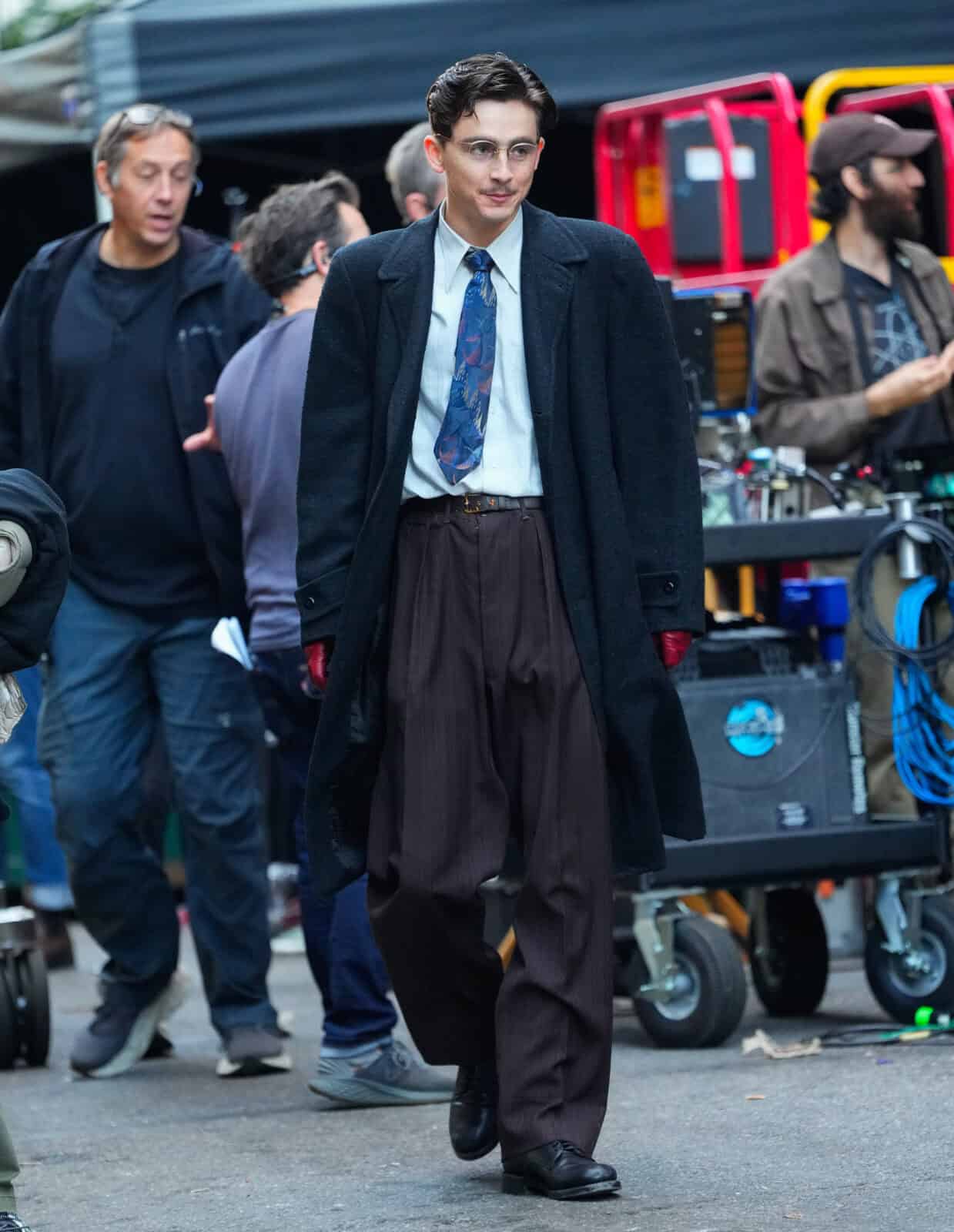
Jose Perez/Bauer-Griffin/GC Images
The slogan “Dream Big,” emblazoned in the film’s signature orange, has dominated Chalamet’s Instagram content for the past few months and is echoed throughout the film’s costume design. Safdie’s long-time collaborator, dating back to Uncut Gems (2019), costume designer Miyako Bellizzi, delivers the character of Marty Mauser to perfection. His unshakeable confidence is reflected in his impeccable style, which at times made me wonder how he could afford such beautifully tailored long coats and leather gloves.
One thing is certain about Mauser: he will always pull up to a competition fitted – we learn of his penchant for style when he picks up his gray suit in a plastic dry-cleaning bag, telling his fellow shoe salesman that he made this purchase specifically for a tournament abroad. Talk about dressing the part.
The billowing silhouettes of his suits serve as a perfect outward manifestation of Marty Supreme: a boisterous, overly confident young athlete living in New York City. There is nothing quiet or polite about his tailoring – Bellizzi leans into bold, statement-making sartorial choices, from oversized shoulderpads to baggy suit trousers and bright red leather gloves. The nerdy addition of his thick prescription glasses initially feels out of kilter with the ensemble, but ultimately injects a sense of youthful vulnerability and serves as a physical metaphor of his “visual impairment:” a deluded view of his own greatness long before he has earned it.
The sheer scale of research and labour invested in the film is, in itself, a testament to its greatness. Miyako Bellizzi collaborated closely with production designer Jack Fisk to create over 5,000 costumes, noting that certain pieces were so difficult to source it was easier to construct them from scratch. Drawing from her Japanese heritage, Bellizzi turned to family archives to conduct research for the costume in the Japan-set scenes, whilst the 1950s looks in New York were informed by a Ken Jacobs MoMa documentary (1952) which captured nearly every block of the Lower East Side. In doing so, she meticulously encapsulated the city’s cultural melting pot – particularly the immigrant communities that made up the LES.
All the more impressive were the press looks curated beyond the film set. A perfectly executed marketing ploy in the guise of a Zoom call saw Timothée listing variations of orange: “hardcore orange, corroded orange, falling apart orange, rusted orange,” in the search for the perfect hue to market the film. The colour, associated with Marty’s business incentive to sell orange ping-pong balls to improve visibility against white shirts, never reaches a satiated conclusion onscreen, yet is heavily leveraged off-screen.

From his custom Chrome Hearts red carpet look with Kylie Jenner at the LA premiere to a tactical tracksuit collaboration with streetwear brand Nahmias, Chalamet’s press wardrobe signalled modernity rather than the 50s silhouettes that dominate the film. In line with both Timothée Chalamet and Marty Supreme’s pursuit of greatness, the ubiquitous windbreaker — worn by several of the “greats” across sport, music and fashion, from Kid Cudi, to Michael Phelps, Tom Brady and Kendall Jenner — became a symbol of the film’s momentum, which, much like Marty’s dream, was big.