
When Belgian designer Matil Vanlint speaks to me about HEAD Genève, her voice softens – almost cracks. “It has done everything for me,” she says. After years of fighting to take up space–in life and in her art–she finally found an environment that insisted on it. A place where her aesthetic vision could grow monstrous and sculptural, inhabited by creatures with plaster-built humps, lumps, and bumps that prance (or plod) about in strange, joyful ways: here, Vanlint takes ownership of trauma and makes it hers.
Her graduate collection, V* (“Victim, Violence and Victory”), translates the physical memory of her suffering into garments that celebrate what we’re taught to hide: pain, deformation, shame. These become mischievous protectors. I found myself making mental links to fairy tale brownies and goblins – beings punished for their difference yet essential to the worlds they inhabit. Vanlint’s monsters step proudly into that lineage: survivors who refuse shame, walking with swagger (and the occasional exaggerated talon for a shoe). Spines curve into humps; their movements are awkward and funny, totally unashamed.
The wigs (made by Tommy Capiaux and Noeh Mamin), heighten this fiction, transforming skulls into alien crowns, with exposed seams mimicking physicalised psychological scars. The shoes, of course, are main characters in this distortion: hornlike, elongated, forcing a new gait. A childlike palette of cherry red and bubble-gum pink brings optimism to the outlandish. “I want to show my ugly feet,” she told me, laughing. A joy that really makes total sense once you meet Matil, who has learned to find delight in places where it may feel impossible.
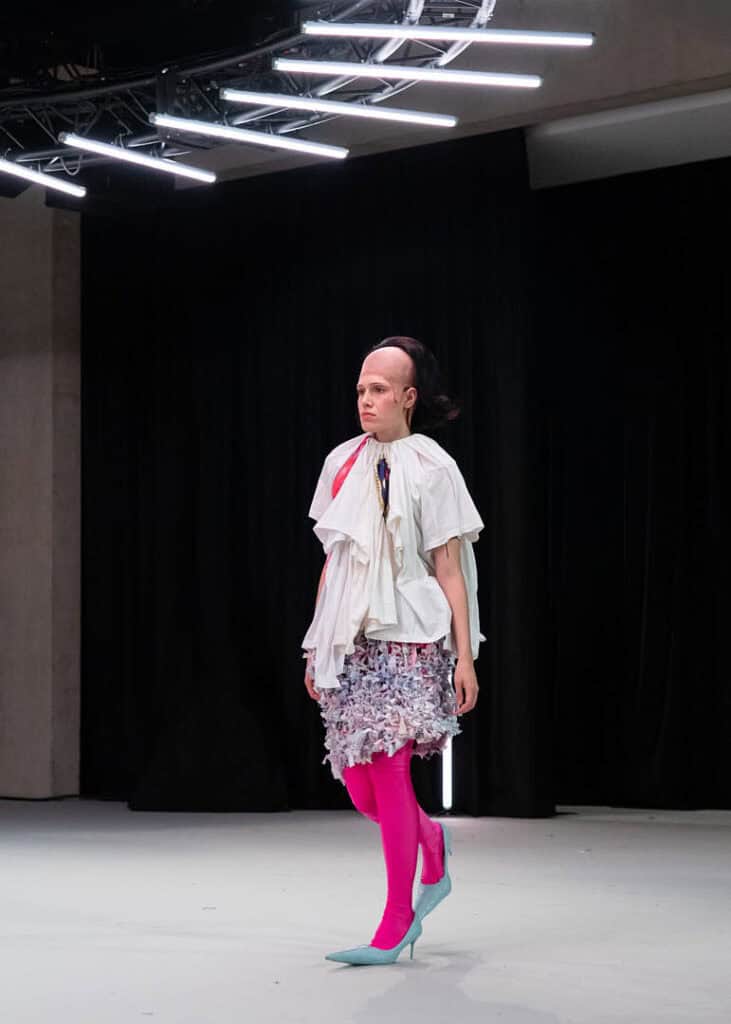
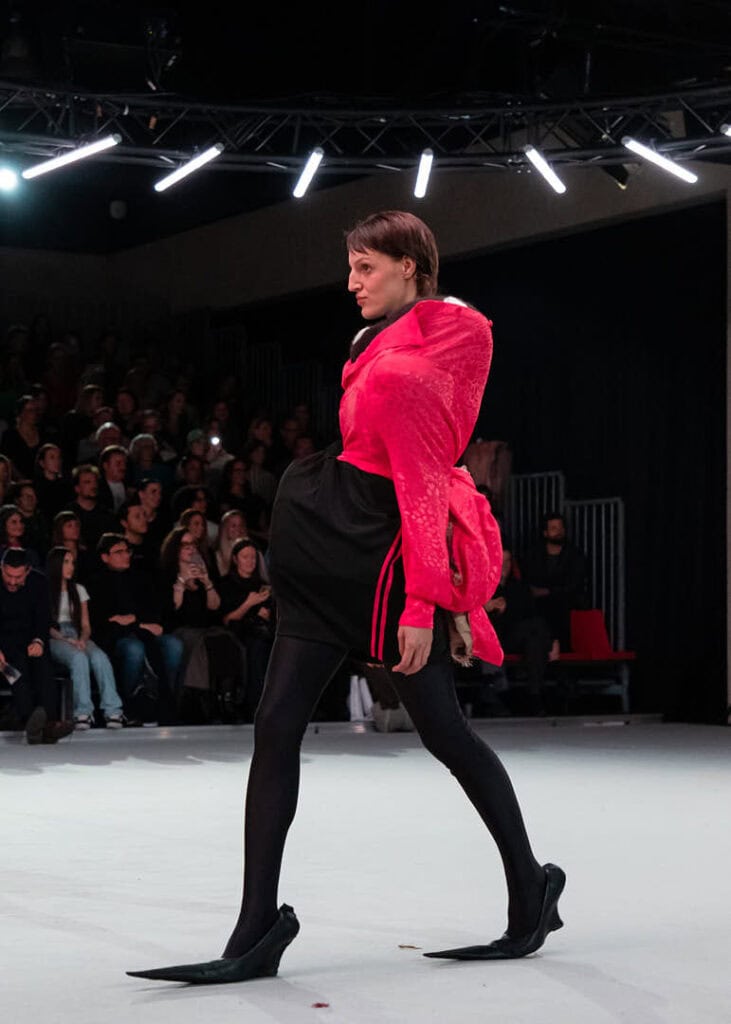
At HEAD Genève’s fashion show this season, that courage and craft were recognised with both the ASWE Prize (Association of Swiss Women and Empowerment) and the Fondation Vahabzadeh Prize, the evening’s highest honour. HEAD – Geneva University of Art and Design – has rapidly become one of Europe’s most exciting fashion schools. Founded in 2006, the school’s ethos is rooted in experimentation and respect for individuality; students are encouraged to build their own worlds rather than inherit an aesthetic tradition, so it’s quite easy to see how a designer like Vanlint could really thrive here.


This conversation took place the week after the show, as I picked Vanlint’s brain about distorted feet, queer joy, and the importance of stepping back to reflect.
The Cold Magazine (CM): Let’s start from the beginning – what first attracted you to fashion?
Matil Vanlint (MV): I wasn’t really into fashion as a kid, to be honest. When I turned 14, social services sent me to a host family in England, in a very small village near Banbury called Bloxham. School in England was so different from Belgium, and I had to choose artistic subjects, so I chose textiles. That was the first time I was introduced to art. That period was really complicated, and I wasn’t interested in anything, apart from partying. One evening, I was embroidering flowers onto lace – I had a house party that night. At 10pm, my friend knocked on my door like, “Where the fuck are you?” and I was still doing my embroidery. It really stayed in my mind that this was the first thing that managed to hold my attention for so long. That moment stayed with me: that one thing made me choose embroidery over going out when I was 14.
CM: Victim, Violence and Victory. This was your chosen title for this graduate collection. What first sparked this narrative? What inspired the collection as a whole?
MV: It all started with my Master’s thesis. I tried to explain how, through my practice and my own experience, I managed to find an alternative way to be happy. The idea was: yes, I’m a victim (I’m not going to be ashamed of that) but I’m also not going to be what you expect a victim to be. I’m not going to be quiet or discreet. Basically, it’s telling my story and how I found ways to be happy.
CM: You explored the idea that trauma could physically alter the body in some way…
MV: Exactly, yeah. All the shapes came from that idea: what if each of my traumas had actually left a physical distortion? That was the starting point for all the volume. I also used my own wardrobe for styling, because I was born into a quite bourgeois family, but I was in the streets very young. My wardrobe holds all these relics of the different backgrounds I’ve lived through: my wardrobe on these new bodies.
CM: I remember reading your collection statement and you mention this quote by Jack Halberstam – “There is an activism in being happy and celebrating forms of joy that persist when the only images of ourselves presented to us are those of misery.” Hannah Arendt also wrote that joy is not escapism, but a refusal to let despair be the final word, a way of insisting on meaning even in dark times. How did the idea of joy find its place in this project for you?
MV: I think that’s probably just part of my personality, it’s how I react to hard things. It’s how I’ve healed myself, probably: to love, to enjoy. I didn’t have any sense of the theory behind this before, so when I discovered those texts I was like, oh my god – this is it, this is what I’m doing! I’ve always felt like joy was my way of fighting against everything that’s happened – to say, yeah, but whatever, I’m happy and I’m going to have fun. Seeing authors express that idea perfectly, with the words I never could have found myself… It was healing. It was satisfying. It made me feel understood.
CM: Another interesting thing I wanted to ask regarding your statement was that you wrote “thanks to us, I found comfort.” Who is the “us” behind this collection?
MV: The queer community. I’ve made my own family in different places, so it’s always through a collective that I’ve managed to survive. But it’s within the queer collective that I finally found my chosen family, my place, and a way to exist and be happy. The collective is central to the project: the collaboration with Tommy and Noeh for the wigs, with Tommy for the music. I learned tailoring thanks to someone I met in a bar in Brussels – he was knitting, my friend needed help with knitting, and I said, we have to talk to that guy! He was a tailor. He taught me everything about ancient techniques. The hatmaking was through another person I met. I’m not someone who likes to work alone, I like to be with people. To be together.
CM: And in terms of inspiration and references, were there any specific designers, films, or artworks that inspired you?
MV: For me, it’s always Margiela. He’s my number one – especially his process. The idea of reusing, or rethinking a pattern… that’s what I really love about Margiela’s work. Often it starts with an idea, a fascination for clothing. So yes – Margiela, for sure.
CM: With the technique that you developed, merging hatmaking and tailoring to create volume (without reinforcement!), how did this idea come about? What was the process like?
MV: I had the volume in mind–I always knew I wanted this big volume–and I specialised in tailoring, but I didn’t want to have so many seams. Usually, if you want that volume, you have to. That was my first question: how am I going to do this? I was talking to my pattern-cutting teacher, François, and he said, “have you ever tried looking at hatmaking?” So I found a hatmaker, Laura. I went to her with the project and she said, “well, I have no idea if this is possible, but let’s try.” Normally in hatmaking you need wooden structures, and I couldn’t do that – it would have cost too much. But at HEAD we have plaster-moulding facilities, so I made all of the volume in plaster first, tested it, and it worked. Then it became a lot of research: keeping the codes of tailoring when the material is too thick for normal stitching and folding. I used leather techniques to thin the seam allowances. Every time I found a new solution, it was so satisfying.
CM: Me and a few other journalists came backstage pre-show (I don’t know if you remember) but you were talking about bows being a recurring motif in your work, and you mentioned that they mirror a tattoo you have on your wrist. What do the bows represent emotionally or symbolically?
MV: For me, they embody this idea that good and bad things are always going to shape our lives. But I’ve decided that no matter how bad it is, I’m going to turn it into something beautiful. It’s that disturbing thing: you wouldn’t be the person you are today without these experiences, but you can’t be thankful for them either. You’re stuck in this horrible in-between position. So I had to find a way to make it my own again. To accept that, yes, I’m going to enjoy the person that I am, even if it comes with all of this.
CM: That’s a really beautiful way of putting it, I really resonate with that. Moving onto upcycling, you mentioned using pieces from your wardrobe earlier. Obviously upcycling, sustainability… these are kind of buzzwords in the industry these days. What do they mean to you personally (and on a creative level)? Do you envision a future where fashion can become fully sustainable? And do emerging designers like you hold some of that hope?
MV: It’s one of my biggest fears, entering the fashion industry. It has also been a big battle within myself – wanting to work in an industry that goes against so many of my personal values. There are so many beautiful projects and I want to have hope for it. I’ve met amazing people and we need to trust in it, for sure. I don’t know if I’ll be alive to see it, but that’s another question [laughs]. For me, upcycling in my collection was something very natural. I’ve always found alternatives to survive, making things work with what I had in my hands. And it kind of links to the idea that fashion may also need upcycling as a way to survive. So yes, it’s all connected. For me it was natural, and very important as part of the process. But this collection is not 100% sustainable: unfortunately, I couldn’t do it everywhere.
CM: With the shoes (which were amazing – I was obsessed, I loved them)… what was the process of developing those?
MV: Well, basically it comes from my distorted feet. I’ve got a varus valgus – I don’t know if you can see [shows feet on Zoom]. They’re very distorted. So it was like using the distortion I created in the garments, but also embracing the real distortion I have. I saw my foot doctor and he told me that in 35 years, he had never seen feet like mine. He said, “What’s going to happen when you want to go to the beach with your friends and you’ll be too ashamed to show your feet?” And I was like: actually, I made shoes exaggerating this. I will not be ashamed – I’m going to show my ugly feet!
CM: They did sort of remind me of something a woodland creature would wear in a fairytale. Which then got me thinking about how your collection really feels like world-building – I could envision all these characters, with their wigs and bumps and shapes, in a world of their own… Did you ever imagine a specific universe or narrative these figures belong to?
MV: I’m always working through stories, so some of them have very specific names or whatever. It’s definitely my own universe. And that’s also what I liked about the shoes; they forced the models to walk very weirdly, that feeling of always being out of place. But I haven’t referenced it to a specific existing world or universe, it’s just what happens in my head, really.
CM: I got to see a bit around HEAD before the show and the night before, and I was really amazed at the facilities and the creativity that seems to come out of that environment. How did the programme there help shape your voice?
MV: It did everything. For me, it was the best year of my life. The programme was amazing. In the first year, we only had workshops with so many different people, dissecting all the different parts of what goes into making a collection. Working with so many people is so rich. And we were such a small group (only eight in the Master’s) – having two hours of fittings per week is really a luxury. Something very particular to HEAD is that they don’t really have a specific “HEAD aesthetic.” They really push you to find your own universe, to make it current and to go as far as you want, but they don’t try to shape you into a style. I really struggled with self-confidence, and HEAD helped me so much, honestly. All the teachers… they can be tough, but they’re never mean. If we want the fashion industry to change, we need to start from the schools. And HEAD is going in the right direction, in terms of inclusivity, everything. My name wasn’t even changed officially yet, and HEAD immediately changed my email address and everything. They’re so supportive. I’ve never been in a school like this.
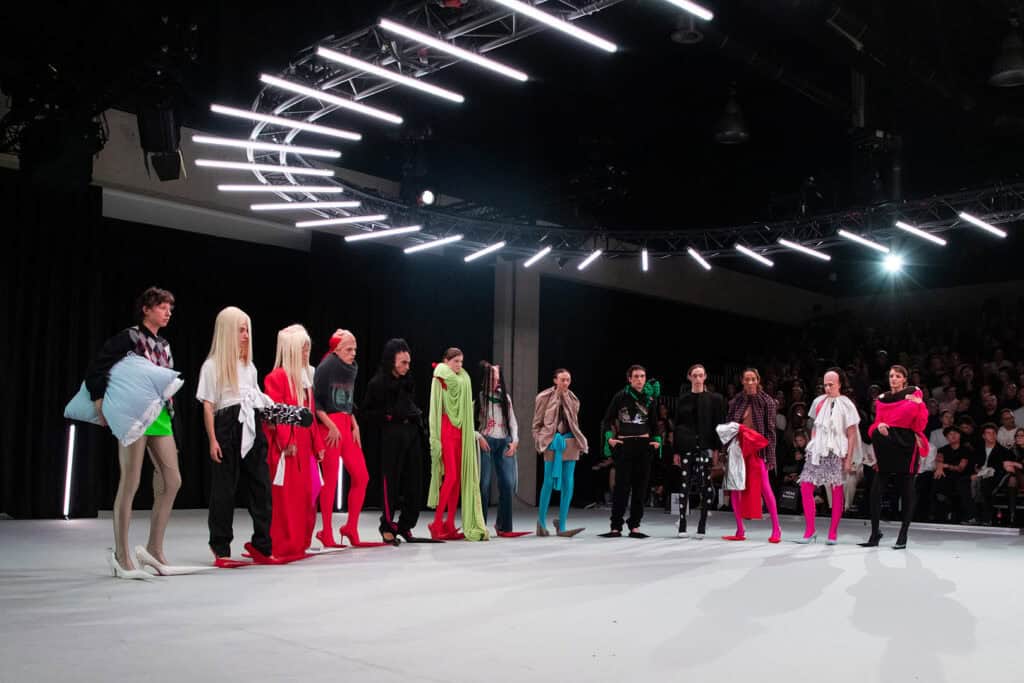
CM: It’s so true what you say about the aesthetics – what really came through in the show was that everyone had their own individual voice. Schools like CSM are great, but at times I do feel they try to push you into a specific box.
MV: Yes, totally. It’s a different statement and it’s interesting, too. But for me, that’s what’s really amazing about HEAD.
CM: It must obviously feel quite different researching and creating garments and seeing them daily versus then seeing them on the runway. Was there anything that surprised you about the collection once it was on the runway, rather than in the studio?
MV: At the beginning, for me, there was the idea of being monstrous. In the studio I saw these clothes again and again, and even with my teacher we were like, they kind of feel normal now. What really appeared on the runway was that the monstrous feeling came back to life. They were all walking weirdly and it was so satisfying seeing them all together. Sometimes I looked at the miniskirts and the colours in my face all the time and thought, is it too soft now? And also, the energy the models had between each other – this idea of the collective came from me, and the models I had in June for the presentation were all people close to me, all chosen. For the show, some of the models didn’t know me, they didn’t know each other, they had never seen the looks. But in a way, they kind of recreated that collective feeling, and I was so happy about that.
CM: You ended up receiving both the ASWE and Fondation Vahabzadeh prizes. What do you hope this support will allow you to do next? Did those awards shift anything in the way you see the work or your trajectory?
MV: At the moment, I’m really looking for internships, and honestly, the post-Master’s period is super hard. I’ve been working 24/7, and I was back in Brussels, with everything that brings back to me. It’s scary, because you’re suddenly alone in the middle of the big ocean. So yes, I really hope the awards will help me get internships, and help me keep learning within the industry. I really want to learn.
CM: And lastly, if you could give yourself one piece of advice at the start of your Master’s, what would it be?
MV: To take a step back more often. Sometimes I can be too obsessive – redoing things over and over again, obsessing over that one seam that isn’t clean enough that no one will ever see. Time flew so quickly – I wish I had let go of some details that in the moment don’t feel like details to me… but yes, to take a step back.