

Gran Partita, the debut poetry collection by Matthew McDonald, is a curatorial project in book form. McDonald is an Australian musician who serves as the principle double bassist of the Berliner Philharmoniker and is the founder and editor of the online poetry journal berlin lit. Here, he brings his dual life in music and literature into deliberate collision.
Named after Mozart’s 1781 Serenade No. 10, Gran Partita is structured like a score, with each section unfolding as a movement. But this isn’t just homage for homage’s sake. The Mozart reference becomes a compositional device and a way of thinking about the power of prestige, and how identity, like music, is performed. At times, history collapses, and Mozart lives alongside the mundane. In the book’s titular poem, “Gran Partitia,” McDonald writes,
In Salzburg I received
bad bad news
but I am highly professional
the following days I played Mozart
the requiem
the piece
that in the film Amadeus
tortured Mozart to compose
was torturing me to hear
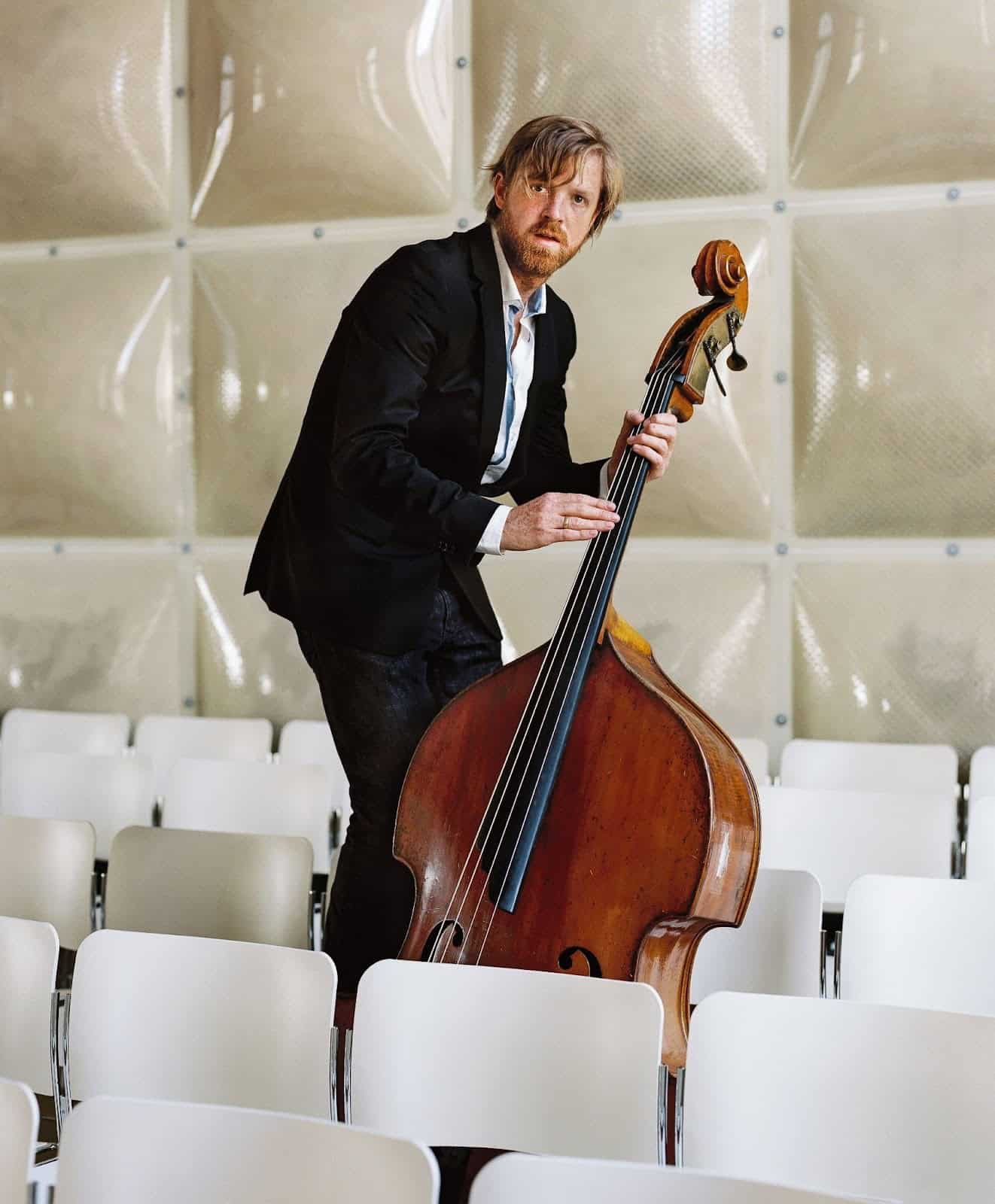
Photo by Emile Holba
McDonald approaches poetry as material culture. Instruments, concert halls, reviews, podcasts, postcards, and intimate memories become testimonial objects. Together, the materials help the poet construct what might be called the “professional self” – the musician as both artist and institution.
The book wants us to believe that music is not an abstract entity – an intangible thing that floats above our lives like a film score – but, instead, is a network of practices. Almost, one could say, a religion. McDonald pays extra close attention to objects, economies, and rituals: the concert as event, the score as artefact, the musician’s body as a disciplined surface.
In this sense, Gran Partita can be read as a reflection on performativity. Following in the footsteps of gender studies scholar, Judith Butler, who pioneered the theory of gender as a “doing” rather than a “being,” the musician gets the same treatment here. The musician emerges as a performative subject: an identity constructed through repeated gestures, institutional codes, and professional rituals.
McDonald exposes this performativity with irony, poking holes in the myth of prodigious excellence and singular genius. This book of poems is about how music helps us survive, and how the title “musician” is collectively constructed. Lists, fictional performance reviews, micro-essays, and diaristic fragments form a down-to-earth collage of life in the Philharmoniker, tackling themes of ambition, failure, and how it really feels to fit your life’s passion into the frame of professionalism. Again, in “Gran Partitia,” McDonald writes,
Our performance of Mozart’s Serenade Number 10 for winds
a.k.a Gran Partita
was praised by the reviewer
for high professionalism
it means we showed up
didn’t brawl on stage
I’d worn a brand-new suit
The book is a dispatch from what is, for many of us, a foreign world. McDonald deconstructs the aesthetic capital of famous musicians from history, like Mozart, Bach, and Schumann. Instead, he stages them as materials to be manipulated, remixed, and critically inhabited.
From this perspective, Gran Partita exposes the wires that hold up the Western canon, unpicking some of its ideological seams.
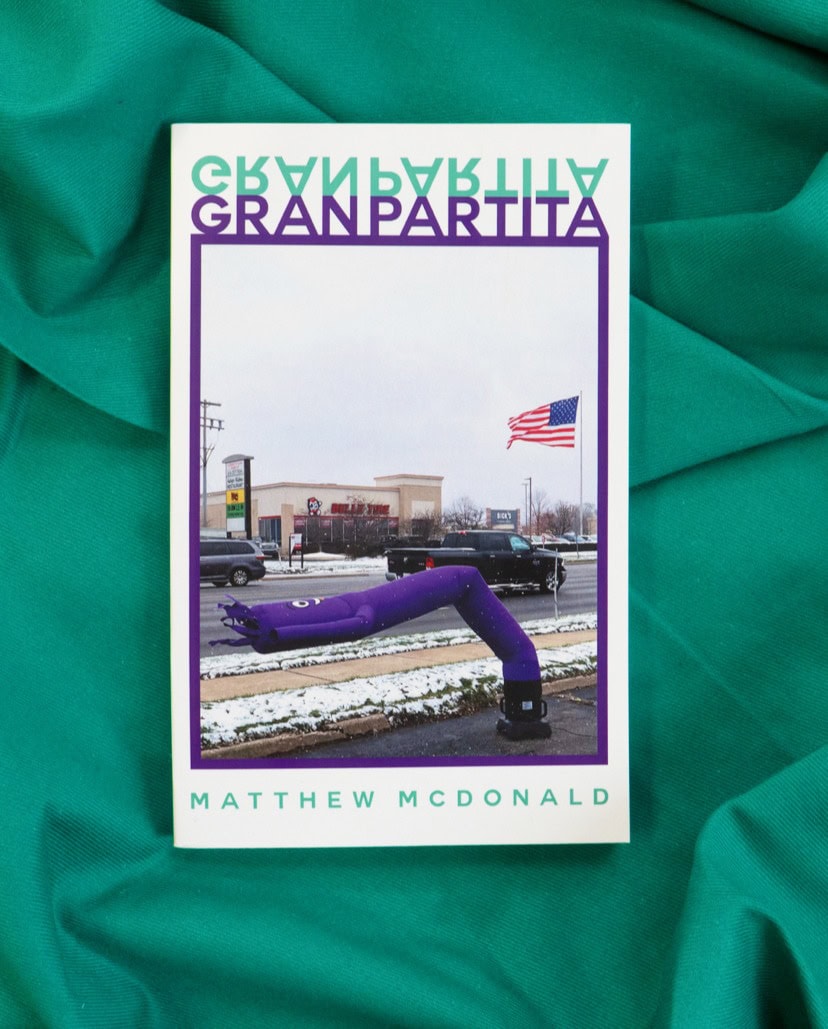
Ultimately, Gran Partita is a hybrid project that traverses poetry, theory, and cultural criticism. A book that does not simply represent music, but exposes it as a system of objects, bodies, and discourses. McDonald orchestrates a sensitive archive in which the personal and the canonical collapse, turning poetry into a practice of curation and music into a field of power, memory, and performance.
Matthew McDonald’s Gran Partitia, published by MOIST BOOKS, was released on 28 February 2026.