
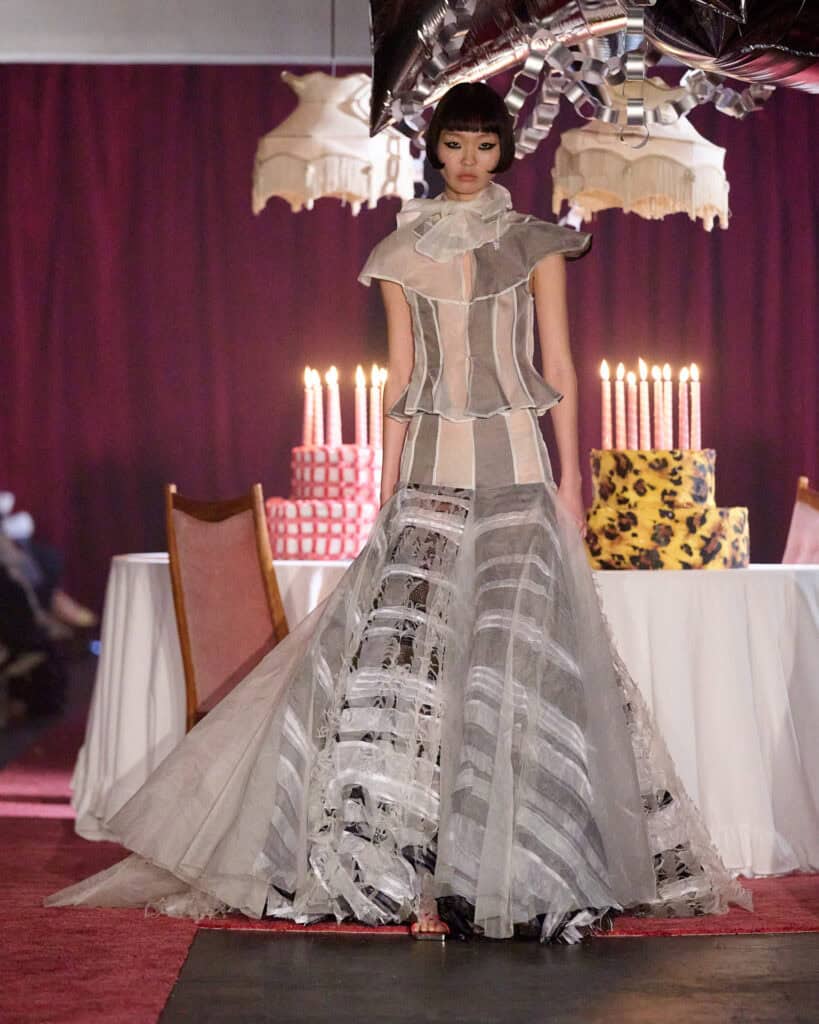
Although Maximilian Raynor titled his SS26 collection “I’ll Cry If I Want To,” the concept isn’t a plain sermon of sorrow. The phrase is a cue for something else, a blurry, dreamlike portrait of Derbyshire childhoods and the oddities that shaped a designer who has now spent nearly a decade in London. As the ten-year mark approached, Raynor looked backwards toward the life that led him to the city some nine years earlier, and those memories became the season’s bones.
London has tested him. The city’s late buses, rail strikes and endless churn have given Raynor a certain grit, yet they have not erased the small-handed artefacts of home. The Midlands still hum beneath his work: in the handmade houndstooth jackets his grandmother once sewed at the kitchen table, in the soldiering silhouettes that haunt family albums, in fabrics remembered more by touch than by name. These relics do not appear as pastiche; instead, they are translated into garments that carry both tenderness and an uneasy brightness, equal parts homage and haunting.

The Unlocked warehouse in Shoreditch was set like a strange domestic theatre. Parlour jazz threaded the air in crackling phrases, echoing gramophones and faded ballrooms. At the centre of the runway, a table bore two double-layered birthday cakes, candles unlit, as if waiting for a guest who never arrived. Above, tasselled pendant lamps swayed gently beside oversized silver balloons, their surfaces catching light as mist shimmered through the rafters. Plush blush carpets softened the floor, and an older couple, part of the staging, would occasionally rise to waltz, briefly collapsing the distance between performance and memory. The whole mise-en-scène read like a celebration half-recalled, equal parts intimate and uncanny, an atmosphere at once tender and off-kilter.

The collection itself functioned as memory made manifest. The show unfolded like a child’s fragmented recollection: a 1940s Air Force jacket brushed past the ghost of a 1920s flapper dress; gingham and bubble-gum elastic rubbed against pyjama trousers knotted at the waist. Leopard-print shirts and twinsets appeared with the faint glimmer of family photographs, their ordinariness transformed into something sacred. Raynor’s grandmother’s everyday tailoring registers here as a kind of working-class couture, not polished into glamour, but revered for its care, endurance, and ingenuity.

Every detail contributed to the sense of spectacle. Panavision lent the presentation its cinematic stillness, Toni & Guy sculpted hair into silhouettes that nodded toward both mod rebellion and domestic neatness, and Emma Miles’ makeup for Spectrum blurred the line between innocence and theatricality. The collaborative effort amplified Raynor’s vision without overpowering it, giving the runway the atmosphere of a film still, crystalline yet charged with emotion.

In the end, “I’ll Cry If I Want To” reads less like a seasonal statement than a compact, personal archive. It asks what celebration looks like when history is heavy, and what remembering feels like when joy is fragile. SS26 becomes a small, stubborn act of preservation: clothes as keepsakes, garments as family albums, fashion as memories made visible.
