
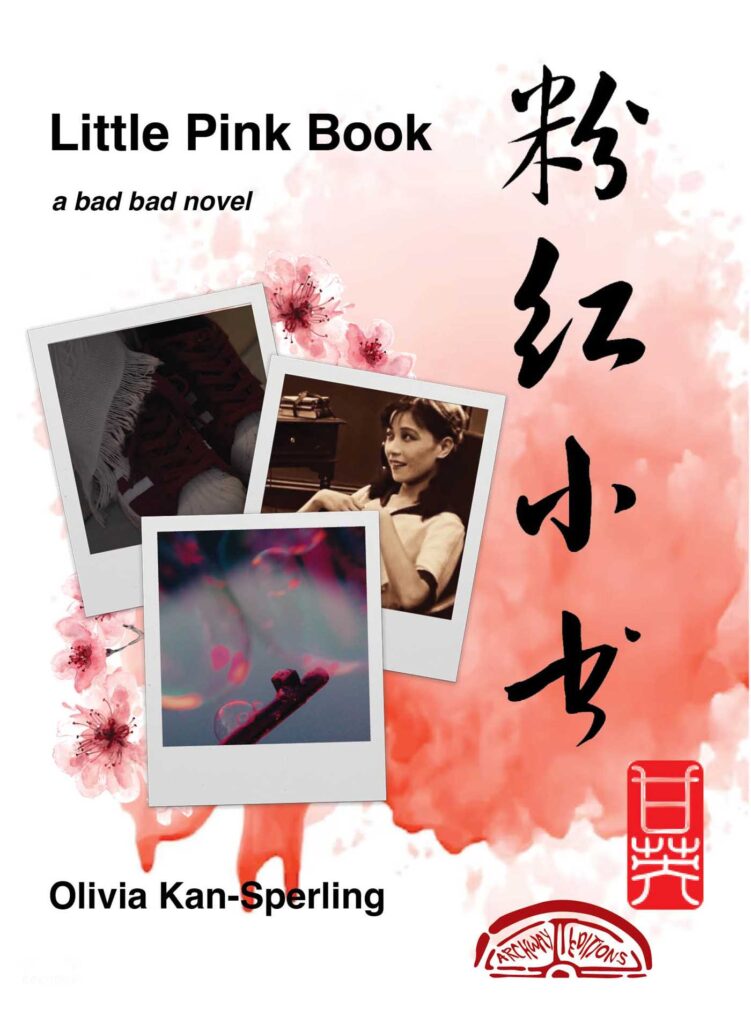
By day, Limei works in a coffee shop in Shanghai, where she’s the best latte artist, thanks to her “slender, delicate and nimble fingers.” She is also the most beloved, because her art is always beautiful. Limei is beautiful herself; she is sensitive, a dreamer, with hopes for a singing career as she sits in her bedroom, all alone, by night.
In Little Pink Book: A Bad Bad Novel, writer Olivia Kan-Sperling brings Limei’s internal world to life. The prose is sugary, feminine, and coy – a performance of a performance of femininity, echoing generations of ingénues awaiting love and recognition. When Limei meets a dark, handsome man who promises to make her dreams come true, her story seems to unfold just like the ones we’ve heard before. In a striking examination of romance not only as genre but as metaphysical way of life, Kan-Sperling unravels this familiar script to reveal something much darker lying beneath.
In conversation with The Cold Magazine, Kan-Sperling discusses fantasy, girlhood, and embracing a collage approach that deviates from conventional narrative.
The Cold Magazine (CM): Little Pink Book was originally commissioned to accompany Diane Severin Nguyen’s 2022 exhibition at the Rockbund Museum in Shanghai. In your author’s note, you describe it as a “perverse mistranslation.” Could you tell me more about what you mean by that, and how the novel grew out of that initial commission?
Olivia Kan-Sperling (OKS): Diane had read my first book, Island Time, a “fanfic” about Kendall Jenner and Lil Peep, and we decided to make her show text a fanfiction of the film she was showing in Shanghai, In Her Time, rather than typical criticism. Though I think fanfic is a form of criticism. In Her Time follows an actress cast in a movie about the Rape of Nanking; it deals with national trauma, re-enactment, and memory. I didn’t feel I could speak to any nation’s history, least of all China’s, and that whatever I’d write about this Chinese character would necessarily be from a foreign perspective. I wanted to exaggerate this disjuncture rather than conceal it, so I contorted or mistranslated Diane’s subject matter in maybe the most inappropriate way possible: the novel softens “rape” into the stuff of fantasy. The text got much longer, and can be read as a stand-alone book – but also, still, as an interpretation of Diane’s work.
CM: The novel is bilingual, moving between English and Mandarin. Why was it important for you to have both languages present on the page?
OKS: I actually don’t speak or write Mandarin; I hired a translator! The novel is about meanings getting lost in translation. So I wanted to foreground the otherness of all language, the inherent potential for miscommunication, as well as its decorative dimensions that exceed sense – to most readers, half of the book is merely ornamental. I also don’t want to take responsibility for “knowing” my characters; Limei is as illegible and opaque to me as to any other reader. I wanted to embed within the book this graphic material that is literally a blind spot for me.
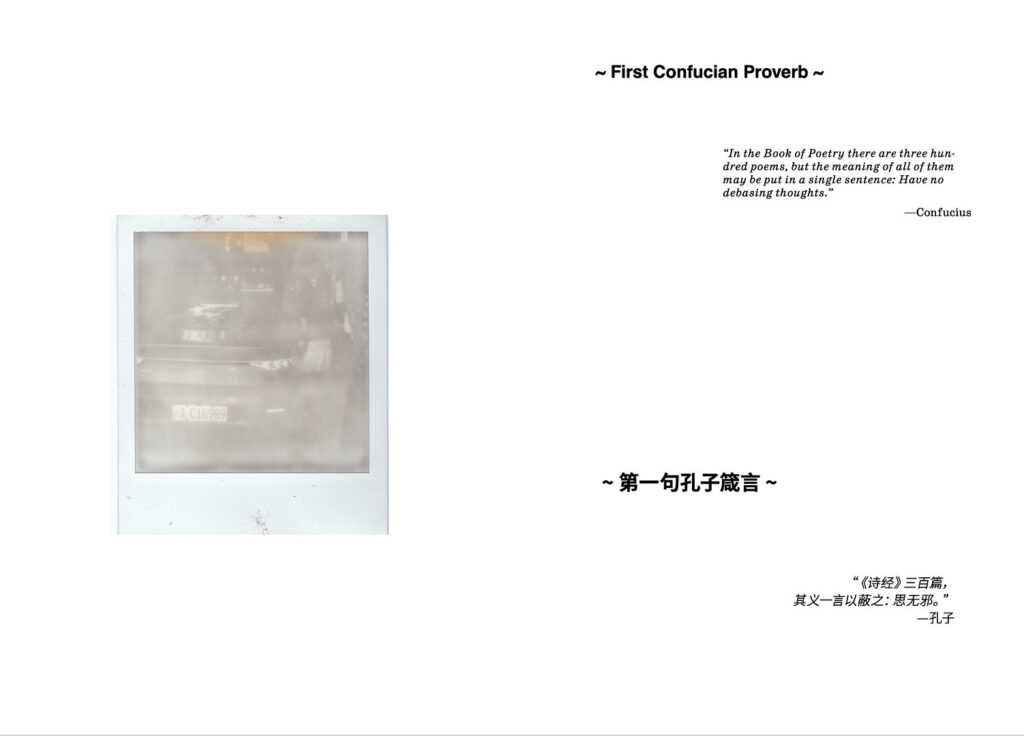
CM: The book is also engaged with many different media, including polaroids, Confucian proverbs and song lyrics, even visual motifs running through it. What role did you want these elements to play in shaping the texture of the novel?
OKS: I just don’t see why novels shouldn’t have different media in them. I try to write in a way that reflects how language is actually being used today: in our phones, text image and sound are married more closely than ever. With this book, which is so much about appropriation, I was interested in reblogging/moodboard platforms like Tumblr as these sites for multimedia text-language-sound collage that are simultaneously a kind of diary: a tool for crafting and publicizing a personal identity through material made by others. (In the book, Limei also has a blog.)
CM: Limei’s world, especially the one she builds inside her own mind, is so vivid in your prose. I kept noticing how she names and describes herself – “lovely Limei”– and how she moulds herself into this hyper feminine symbol. The effect is very dreamlike, almost like the writing itself is performing. How did you think about style as a way to capture that mixture of fantasy, self-mythology, and performance?
OKS: Yes, I always think of writing as performing! In this book, the prose itself is particularly character-like: coy and flirtatious, a winking and maybe even lying voice. I wanted to create this slippage in the narration where you’re not sure if the descriptions of Limei and her thoughts are genuinely her own, or are being imposed by an exterior force, or are being simulated by her for an audience. This indeterminacy is intrinsic to all writing. Even a secret diary is written for the outside.
CM: Then of course there are the romantic elements of the novel. I loved how you played with the romantic and erotic genre, only to then upend and subvert the narrative in often devastating ways. What drew you to examining romance in that way?
OKS: I’ve always been interested in romance novels because, other than religious texts, they’re the bestselling books in the world. They’re pretty formulaic and boring, but I think writers should confront the fact that this type of story is what readers (women, almost exclusively) want. I’m interested in the idea of writing texts that seem to intentionally construct themselves as the object of the reader’s desire, and then both lay bare and undermine that desire.
CM: Now that Little Pink Book is out in the world, what kinds of creative experiments or directions are inspiring you as you look toward your next project?
I think I want to do a poem/movie that you have to read inside a series of snowglobes. I went to a snowglobe manufacturer and was asking about how to put screens inside snowglobes but it seems difficult due to the aquatic element?