
A plaster hand sculpture gripping a textured, organic form resembling a cluster of teeth or coral, mounted onto a glossy black reflective surface.
Meeting artist and modern-day witch Olivia Strange at her solo exhibition, The Real Housewives of Apotropacia, I enter a world of entirely her making.
Apotropacia is an imagined name for a place, derived from the word apotropaic — something with the power to ward off evil. In ancient mythology, such symbols – like Medusa’s head – were used to avert danger. Yet, for Strange, these stories often reduce powerful, gender-marginalised figures into restrictive tropes. In her words, they become archetypes of the “fragile feminine” or the “evil temptress.”
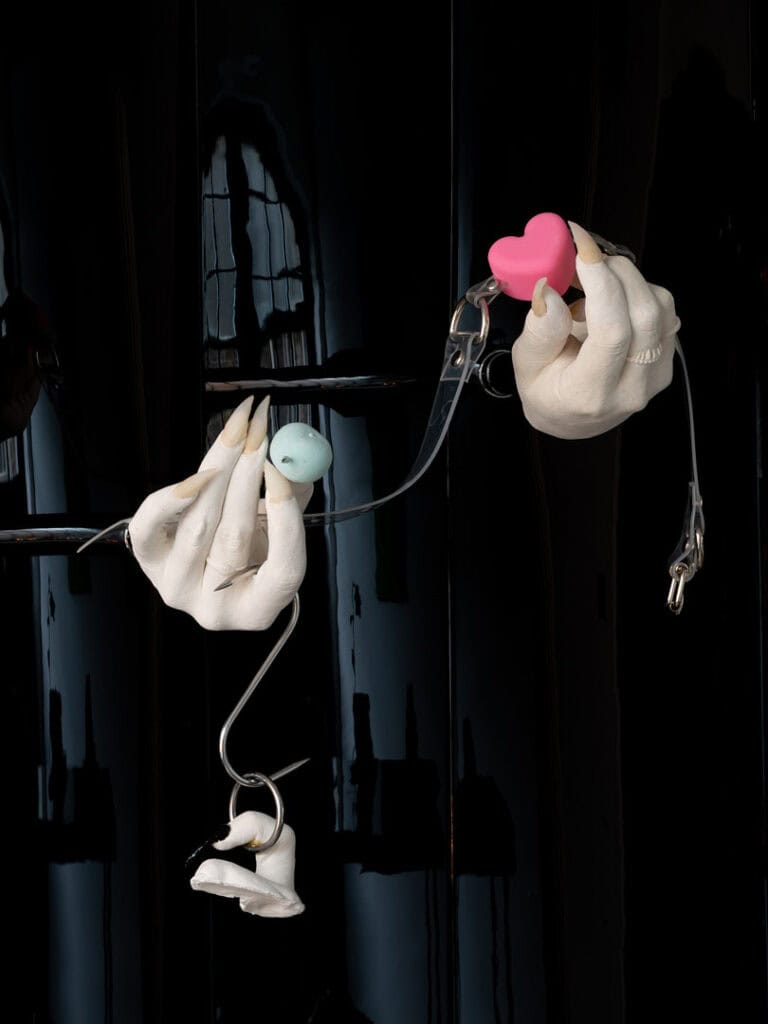
At The Second Act Gallery in London, Strange releases these feminine figures from the restrictions of distant observation. A semi-reflective wall returns to visitors a distorted reflection, an image of themselves perforated by art. Impaled atop their warped likenesses, a line of witchy, wall-mounted hands busy themselves in irreverent ritual. Cast in white plaster, they dig acrylic nails into a pomegranate – oozing, visceral, deliciously grotesque. One hand grasps a tit, the skin taut and pressured. Another holds a vape proudly as if a divine gesture. Here, in this gleeful collapse of the sacred and the profane, Strange blurs observer and artwork, antiquity and the present, transmuting these figures into something porous, perverse, and insistently alive.
The Real Housewives of Apotropacia can be traced to Strange’s rupture. After a relationship ended, she rebuilt herself from scratch, obsessing over the many variants of The Real Housewives. “I felt a resonance with them,” she says. “I’m obviously not a high-net-worth woman in Beverly Hills, but I saw something familiar – these women living as trophies in men’s worlds. Yet in the show, they’re pushing back: angry and alive. Half of them aren’t married anymore!”
Strange takes me to the side of the room, where an intricate arrangement of candles, memes, pomegranates, and Catholic memorabilia lie next to a window. “I looked at how Taylor Armstrong, from the show, became the ‘woman yelling at cat’ meme,” Strange continues. “Most of the memes are about quite flippant things. I don’t think people realise that they were reappropriating a scene where she was talking about domestic abuse. In a way, it ridiculed and minimised her pain.”
For Strange, the unfeeling spectacle of the present is nothing new. The divorcing of pain from its context to create a consumable – if tragic – image has roots in myth. “When you look at Persephone,” she says, “she’s always described as a fragile, feminine object. She’s taken by Hades, tricked into eating the pomegranate, condemned to the underworld. There’s another version where she falls in love with him. But what never gets told is her mother’s grief, or that Hades colluded with her father. Outside the male gaze, she was really abducted and assaulted.”
In the centre of the room there is an almost glowing structure: crystalline and pink alabaster with glass pomegranate seeds scattered across a transparent box. Strange tells me that Persephone’s mother sought the help of Hecate – goddess of witchcraft – to search for her daughter. “If you look here, there’s a subterranean level.” She motions to the sculpture. “I was thinking about the forces of the underworld, and mushrooms. I do a lot of healing with them – and Hecate is a deity I hold close in my witchcraft.”
She leads me to the other side of an almost Catholic arrangement, past the bright red seaside rock (“a very hard sweet from the coast!”) and toward a collection of photographs. “The reason my grandmother is relevant,” she says, motioning at a photo of a blonde woman frozen somewhere in the neon haze of the eighties, “is because she left her husband and moved to Torquay with four kids. That’s not something people really did back then. She was a single parent and refused to be part of that patriarchal structure again. She had nothing, worked and worked, and got herself to a place where she could support her kids. She was a complete powerhouse.”
Elsewhere, a plaster column is decorated with a neon zip, half undone to reveal an artificial palm tree sprouting from the top. I ask Strange where it comes from. “My nan’s house was full of fake eighties columns. And I was thinking about what those columns represent. They’ve always felt very patriarchal to me, so I wanted to reappropriate them. Partly because they remind me of her house – all disjointed, between Devon and Italy, gold gilded plastic furniture, probably my favourite place as a child – but also because of Torquay itself, the so-called English Riviera.”
Strange laughs. “Torquay is meant to be this utopia, but the reality was different. In the winter, everything shut down. Everyone left the party, and you were still out there. Even as a kid, I found it kind of depressing – beautiful, but heavy. The sky was always grey.”
I ask if there’s a specific “evil” Strange is trying to ward off in The Real Housewives of Apotropacia. She answers: “A refusal to accept difference and the attempts to destroy it.”
“I’ve been a practising witch for the past nine years,” she continues. “Witches have always been described as evil. Essentially, they’re people living on the margins – unmarried by choice, refusing the patriarchal system. Usually women, but not always. In the sixteenth century, Heinrich Kramer wrote Malleus Maleficarum, a treatise that sparked witch hunts across Europe and the UK. Thousands of innocent people were killed. They justified it by claiming witches worshipped the devil. The text described them as sexualised and insatiable — often lesbians, therefore demonic.” Flipping this evil on its head, Strange wields her witchcraft like a smirk.
In another painting, a witch’s hat is held squarely over the subject’s crotch — a devious, mocking phallus. “It’s taking the piss,” Strange laughs. “That whole idea of power through domination? It’s absurd. It comes from insecurity. People who are comfortable in themselves don’t feel the need to boss everyone else around.”
Strange finds a transformative energy in humour. “You know the wilting rose emoji?” she asks, pointing to an aluminium flower drooping over an alabaster bowl, glass teardrops glinting underneath. “I use it all the time – it’s quite goth! This is going to sound a bit lame, but in a way, we’re all in a state of perpetual heartbreak. The world is so fucked right now, and I always seem to be heartbroken. I was thinking about loss in different forms and trying to bring some levity to it.” A wilting flower, usually shorthand for fragile femininity, becomes something else. Its thorns are sharp and permanent: a heartbreak you can’t crush. In Strange’s world, pain is an energy to be transmuted, to be polished until it gleams: “I like that I shouldn’t discard it,” she says, smiling.
“Life throws heavy, horrible things at you,” Strange continues. “You take that weight, that content, and alchemise it into something positive. That’s magic – whether you’re making art or planting in the garden. You take the terrible and turn it into something that can change the world, even a bit.”
At first glance, The Real Housewives of Apotropacia feels like a spell mid-cast. Everything hums, symbols whisper to one another, pink light pools where meaning leaks out. It’s messy, funny, and subversive: a photograph of Pamela Anderson, adorned in Catholic memorabilia, watches visitors from the side, disarmed and intrigued. But linger long enough and the chaos starts to make sense.
Half exhibition, half incantation, the exhibition sees Strange turn reverence on its head. You leave spellbound — and in on the joke. Palm trees, vapes, pomegranates, phallic hats, and The Real Housewives of Beverly Hills align in a constellation of recontextualised symbols. Nothing stays fixed for long – and the rules are made to be playfully broken. In Apotropacia, the underworld sparkles, the tears are glass, it’s the eighties, baby (!), and even wilted roses refuse to die.