
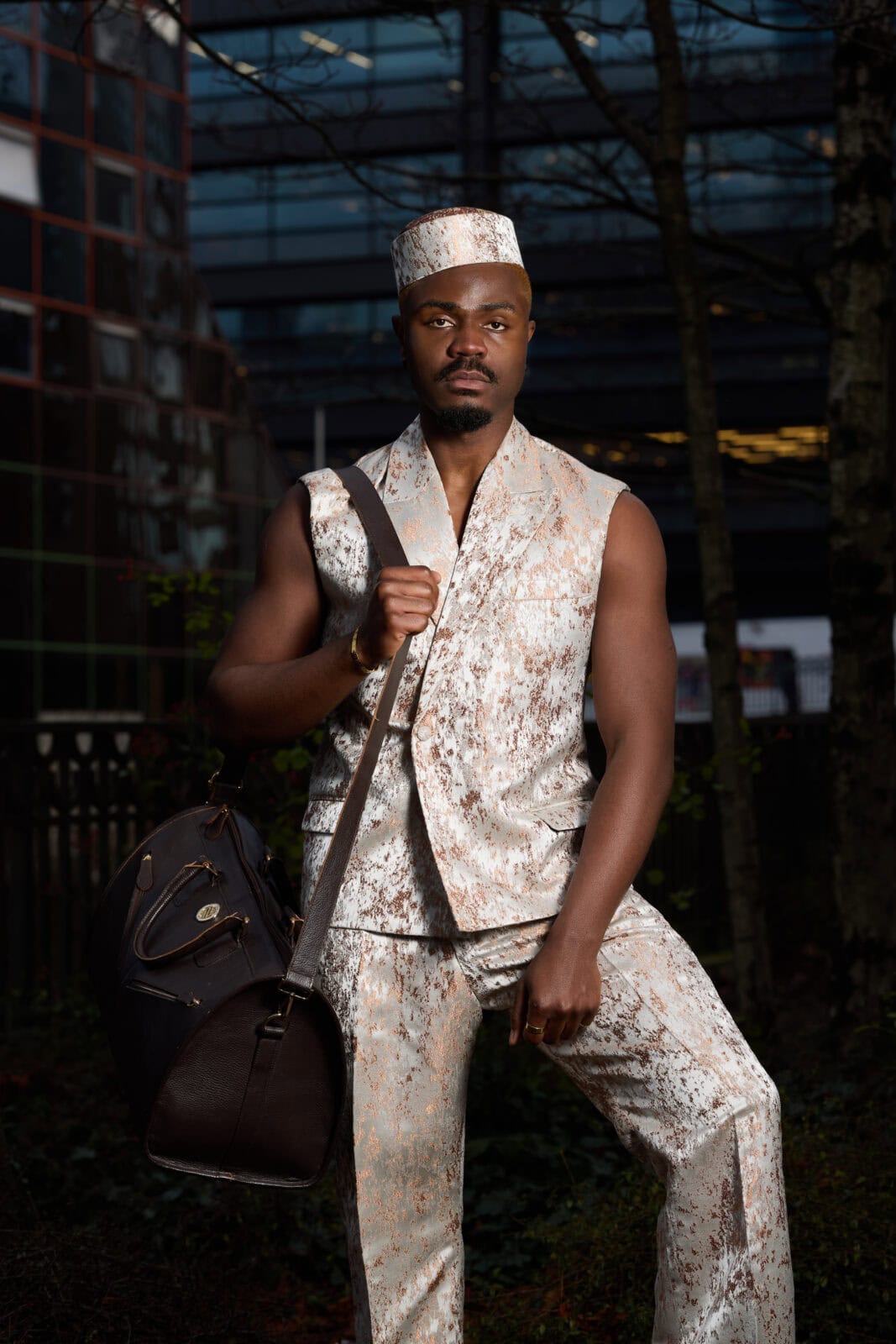
Distance is not only measured in miles. There is a more mercurial distance that forms between memories and reality – between the versions of yourself that you left behind and the ones you hope to become. Paul Williams’ AW26 collection explores this distance, treating it as something worth lingering on rather than to try and overcome.
Entitled Ìrìn Àjò – Between Here and Home, the collection explores Williams’ ideas about immigration, presenting it as a series of small decisions that slowly see you become someone new. There is no cinematic leap, you slowly let go of parts of your old self as you try to find a new one in this new setting. The process creates one of these moments of distance, between your departure and feeling as though you truly belong.

Williams draws from his experiences trying to build a life in the United Kingdom after leaving Nigeria. It is a collection centred around the constant motion of this period of discovery, a time full of sending applications, working shifts and chasing opportunity after opportunity whilst stability always seems just out of reach.
This is present in the pieces that make up the collection. There are elements of tailoring, but they seem softened and almost hesitant. The silhouettes move with the body, they deny stillness with every movement and nothing feels fixed. The textures feel worn-in, a reflection of time and use that speaks to the repetition, uncertainty and fatigue of daily life.
The colour palette inspires similar feelings. There are muted and neutral tones. Brightness is not entirely lacking though and occasionally peaks through, calling back to the ideas of distance the collection is centred around. There is a version of yourself who feels as though they belong, waiting, occasionally raising its head, but for now life often feels like a collection of days under unfamiliar skies.

The collection also feels though it is suggesting that the moment of arrival is similarly uneventful to the departure. There is no bright and blazing piece that suggests a sense of having ‘made it’. There is no clean and clear ending, Here comes to you slowly through moments you don’t recognise at the time – in the same way Home left you.
Williams’ work can be read as part of a long lineage of designers who have negotiated with their identities as they cross borders and evolve. Over the course of the last century, African fashion has often acted as a site for cultural assertion, as a way to articulate modern African identity on its own terms.
At the same time, Ìrìn Àjò sits within the evolving narrative of Nigerian diasporic fashion in Britain, which has long explored the complexities of hybridity. Designers of Nigerian descent are very much at the forefront of British fashion at the moment, with the likes of Tolu Coker and Priya Ahluwalia receiving global critical acclaim. Williams’ work adds to this conversation by focusing on the quieter, often overlooked realities of migration.

There is resistance in this approach. African fashion has often been framed through an external lens that prioritises vibrancy, maximalism or exoticism. Williams’ collection is almost pared back, and does not try to dramatise the experience of migration. It is an exploration of belonging – something that, in his experience, does not arrive in a blaze of glory but through consistency and persistence.
Where others might seek to amplify or dramatise these experiences, Williams refuses to simplify complex ideas into easily consumable aesthetics. He allows space for ambiguity, which emphasizes the unresolved nature of belonging. Rather than presenting migration as a narrative with a clear trajectory, he frames it as something ongoing. He pushes back against the pressure to put everything in a box, to make it easily definable. This leads to the work feeling open ended, and more grounded in reality than if these questions were definitely answered.
British design has long been associated with subcultural expression, tailoring traditions and a certain irreverence, but most importantly, it has been dramatically shaped by migration and multiculturalism. Williams’ soft tailoring and fluid silhouettes are a quiet intervention into these traditions, gently destabilising the rigidity often associated with British codes. His work does not entirely fit within the world of traditional tailoring, but doesn’t entirely reject it either. The collection itself is stylistically on its own journey between Here and Home.
Fashion is obsessed with novelty, particularly today, but this collection fights against that at every turn and looks towards something more grounded. It honours the reality of the experiences that inspired the collection by not turning them into a spectacle. It beautifully presents Williams’ thoughts on belonging and home. It is not a fixed place, it moves with you as you travel from one life to the next.


