
Across the world, Queer rights are slipping in and out of grasp. In Britain, trans healthcare is being rolled back. In the US, politicians threaten to undo gay marriage. At the end of last year’s so-called Brat Summer, many found our situation dire enough to postulate that we’re in the second Weimar Republic – history seems to be circling back and devouring us almost as quickly as Charli XCX bumps a line.

The mood online is despairing. A YouTube video of some guy chain-smoking in his sedan and sobbing about how “being gay sucks,” gets memed across the internet. Overcompensating, a six-episode series about the trauma and humour of coming out gets greenlit, its lead played by the whitest, most conventionally attractive man. The Queer story, again and again, is one of sadness, scarcity, and rejection.
But what if there’s a more interesting story to tell?
Ahead of this year’s Chelsea History Festival, we spoke with Anthony Delaney, the author of Queer Georgians, an acclaimed study of the various and volatile lives of queer people in 18th-century Britain. His book, a landmark in the field, is a reminder, drawn from the lives of our ancestors, that we’ve always found ways to turn scrutiny into scandal, regulation into resistance, insult into identity.
“When I came out at nineteen, the word I had for myself was ‘gay’,” Delaney says “Now, ‘Queer’ feels more appropriate. And that’s just over one lifetime — let alone three hundred years.”
In the Georgian Era, Queer people were branded ‘Mollies’, ‘Cock Queens’, and ‘Sodomites’. “They are very much our Queer ancestors,” says Delaney. It’s crucial we see them this way, even if they never used the label themselves. To exclude them from our lineage because of this would be a disservice — after all, they still lived lives outside the hetero-regulated norms of their time.
As Delaney points out: “They didn’t call themselves Georgians, but nobody ever questions that!” The label is secondary — it’s the experiences, struggles and perseverance that matter.
It’s easy to imagine Queer people as permanent outsiders throughout history, but Delaney reveals a more complex story: that Queerness can co-exist with enormous privilege. “The elite examples are absolute patriarchs,” Delaney says. “They didn’t want to see society implode or to undo what was there, because despite their effeminacy, or despite their same-sex attraction, or despite their gender non-conformity, they still benefitted hugely from it.” He adds: “it’s not an equal history. Nor is it equal now.”

Lord Hervey — who was “lambasted publicly” for belonging to the ‘third sex’ — still dodged legal ramifications because he was an MP. Infamous for same-sex scandals, William Beckford built his reputation as “England’s richest son” by exploiting enslaved labour. “You can’t extricate his Queerness from that,” Delaney explains. “Those riches allowed him to flee to Europe when things started closing in.”
But there’s still something revolutionary about these Queers’ insistence on carving out space for themselves. “Two men going into a house and shutting the door is a radical, radical act,” Delaney says. Riches could shield them from consequences, but their personal lives were still profoundly Queer.
“Queer people are responsible for shaping what we understand as the home,” Delaney tells me. In eighteenth-century Britain, the home was a status symbol — a stage to perform respectability and family ideals. For Queer Georgians with access to wealth and property, it was also a site of subversion, where they could reshape domestic life into a vision of love on their terms. All behind closed doors, of course.
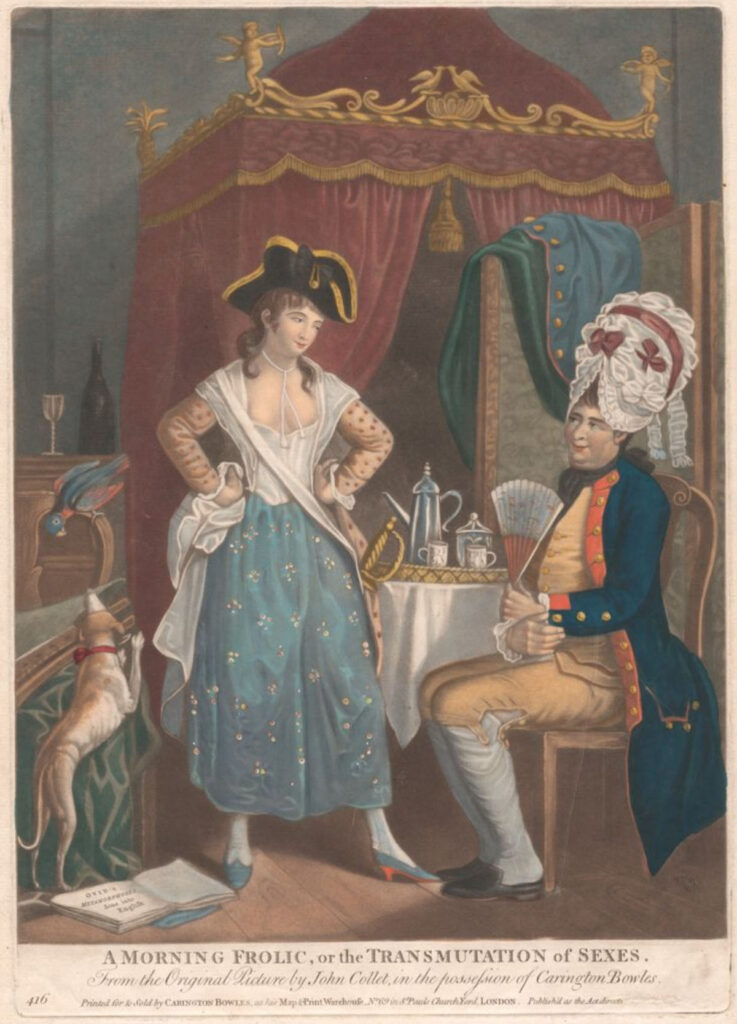
Homes became spaces of concealment and protection, but also sites of performance. They were spaces where identities were trialed, personas debuted, and experiences embodied. Inside Molly Houses — part brothel, part tavern, part queer cabaret — some men adopted female names and addressed one another with women’s pronouns. Long before NYC ballrooms, Molly Houses served. The category is: original Mother of the House. Just like today, Mothers of Molly Houses were the matriarchs of their communities. They protected sex workers and Queers alike. Boots down.
Mimicking domestic rituals like calling each other wives and mothers was not assimilation into heterosexuality. It was an inversion of it — the same exaggeration of language and stereotypes that ballroom and drag continue to spin into spellbinding performances. By parodying and repurposing those roles, Queer people carved out alternative models of kinship, both in homes and Molly Houses.
It’s interesting that we don’t see more of ourselves in Georgian Queers. We tend to view them as proto-Queers with little relevance to the way we organise our social lives today. “The archives show that there were communities with influence and power. They were doing that in the eighteenth century.”
And what can we learn from these spiritual ancestors? Beneath the weight of society, what develops is something more enduring: a refusal to disappear. Whether they were men mocked as ‘Mollies,’ elites entangled in empire, or communities redefining the home, Queer Georgians persisted. Maybe they teach us to find power in our collective struggle. What we should most definitely take away is that acceptance, at least at this stage in our history, isn’t the point — it is ferocity, community, and audacity.