
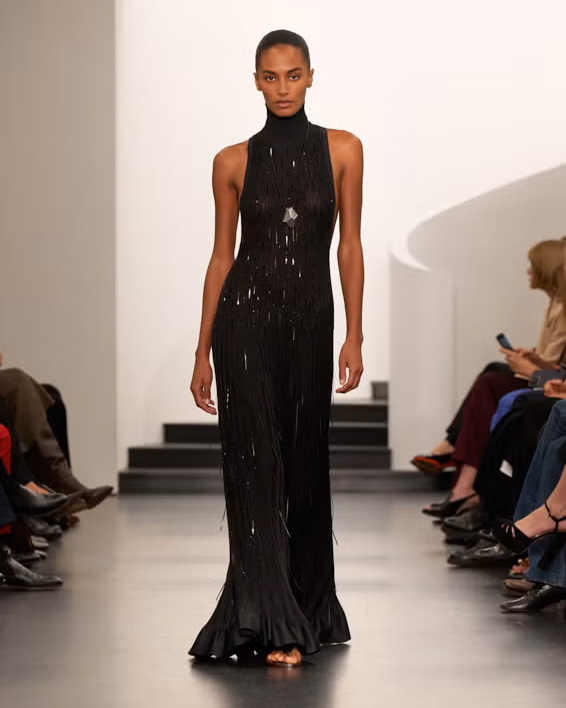
André Leon Talley, the pied piper of fashion, once said in an interview that Ralph Lauren had been listening to nobody other than himself for 50 years, reshaping American fashion as he saw fit. His collections, he said, are akin to cinematic productions. The same simplicity and intimacy that have always been part of the aesthetic grammar of the fashion house returned yet again to grace the runway for Ralph Lauren’s Spring/Summer 2026 collection, the suitable coup d’envoi to New York Fashion Week.
During the Second World War, after Paris had been invaded by the Germans, the fashion epicenter quickly shifted to cloudless climes, and it landed in America. After the war, the ethereal and rarefied debut collection designed by Christian Dior in 1947, known as Corolle, would present to the world a new silhouette. Carmel Snow, editor-in-chief of Harper’s Bazaar, would then describe it in a letter addressed to Dior as “New Look”. However, history teaches us that an American designer had already brought to life that very same flower-like shape, and his name was Charles James.
James’ sculptural and architectural dresses, some of which are now preserved in the Costume Institute of the Metropolitan Museum of Art, began an American tradition of couturiers that put New York City on the map, as a new arbiter of taste. The American style, informal and décontracté, compared to the Parisian grandeur, saw its ambassadors in Roy Halston, who Women’s Wear Daily nicknamed ‘Mr. Clean’, with his pillbox hat created in 1961 for Jacqueline Kennedy, which then became a bestseller in the United States, and after him, Donna Karan and Calvin Klein.


They all were agents of change and innovators, with their casual but extremely refined creations that, like Halston, had a spark of glamour. Above all the aforementioned designers, the one that
stood the grim test of time is Ralph Lauren. He has been considered by the highest fashion echelons, as the quintessential representation of American style since his first womenswear collection in 1972, when he created a look that was a pure expression of freedom, implicitly liberating women’s bodies with the emulation of the male wardrobe. After all Yves Saint Laurent had designed his renowned Le Smoking, a tuxedo declined in its female version, only six years earlier.
Ralph Lauren not only developed his own style, furthering what his fashion comrades had done before him, but he also crafted a lifestyle that goes with the clothes, which would now be considered ‘preppy’. The word preppy comes from English private colleges and their ostentatious uniforms, which started to inspire Ralph Lauren since his first school years. The preppy clothes that had besotted a young Ralph Lauren would then appear in every window on Madison Avenue and then on Ivy League students, the offspring of the new American aristocracy of taste.
At the same time, on the West Coast, the Hollywood scene was abuzz with wonderment, which immediately appealed to the designer he was meant to become. Ralph Lauren wanted to be part of the dream-making machine, and when he realised that he didn’t wish to become the next Fred Astaire, he understood that the only way he could still benefit from that silver screen magic was to dress the protagonists of Hollywood.


And just like that, the first look to open the Spring/Summer 2026 show steals everybody’s breath and, like a contemporary little mermaid, the clothes are silent and understated, but the seashell necklace speaks volumes. The dichotomic black and white, battling forevermore over the female’s body dominance, are wrapped by Theseus’ red thread, which acts as the fil rouge of the entire collection.
Wide-brimmed hats paired with structured shirts pinned by ties or extravagant bows is the perfect combination of the wild-spirit women who carelessly ride horseback and the Columbia University’s proper ladies, reminding contemporary fashion of its intricate duality, or even kaleidoscopic dimension, that Ralph Lauren has mastered since the beginning, managing to still remain true to its original American style.
This Americana infusion stems from that very glamorous Hollywood dream that Ralph Lauren has since then cultivated, designing evening gowns that sparkle without being eye-blinding, that whisper voluptuousness without shouting. In the final act of this tricolour performance, a scarlet dress appears, like Fontana’s spatial concepts, it’s bold and all-encompassing, almost possessing its own gravitational field, but at the same time it flows free like a red river.
And that’s exactly what Ralph Lauren doesn’t do: follow the current, the ephemeral trends that have little to do with style, but more with the evanescent matter of fashion, which the designer has yet again steered to his very own American Look.