
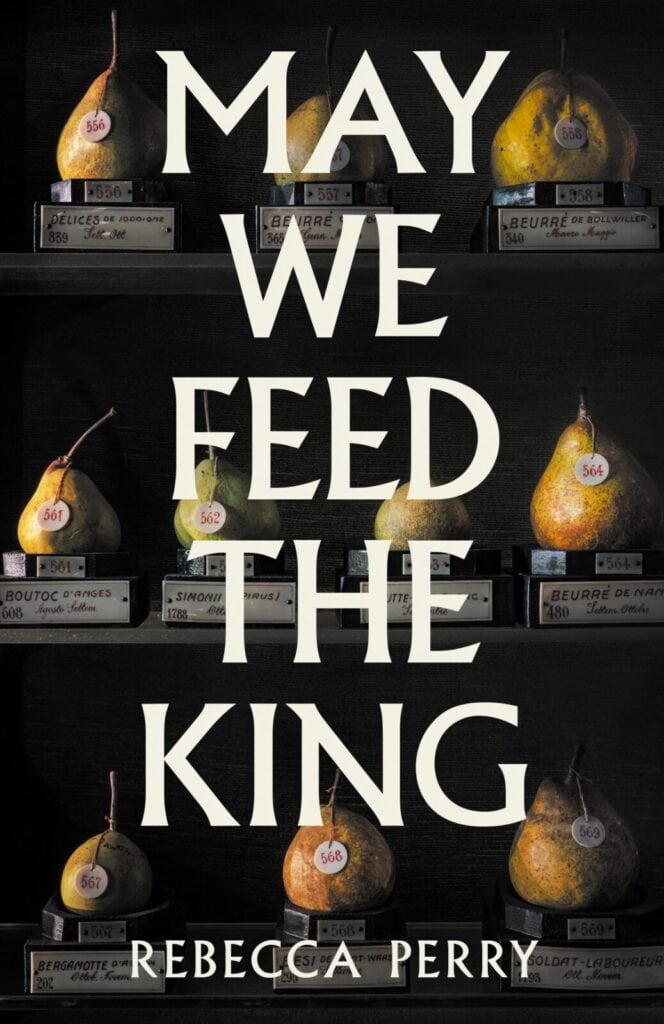
In the first portion of Rebecca Perry’s debut novel, we meet a most unusual character. She works as a scene curator, the person charged with building portraits of a life lived in old houses, castles, manors, the like. She spends her time minutely inspecting replica foods, knowing every silver scale of the fish she wants to buy when the scene at hand is a feast, knowing which apple will bring everything together, which one will shatter all illusion. She’s deeply in love with her work, and Perry paints a wonderful portrait of her eccentricity. She is reclusive, careful, concerned only with the vitality of the scene. In her own words,
“The rule is this: it must appear as if the person or people have just left the room. The viewer must feel as if the air is alive with their energy, that they only just missed them, that they will be back at any moment. If this isn’t the case, the scene is no more than an arrangement of objects. The scene is dead.”
When we meet her, she has been commissioned to build scenes for an old castle celebrating some kind of anniversary, hoping to bring in crowds. She spends days drinking in the old details of the home, sorting through the uniquely detailed archives of its past. There, she meets her King, the one whose day she will reconstruct with her work.
The second section of the book goes back in time – we don’t know how long exactly – into the life of our King. Much like our curator, he’s an unusual man, not quite belonging in his place, time, or position. He never wanted to be King, never thought he would become one. Later, when I speak with Perry, she remarks on how people like this must have existed throughout history. Not everyone could have been cruel, or great, or kind. Some would simply have been there, annoyed, depressed, letting time pass by them.
Coming from a background in poetry, Perry’s prose is incredibly alive with imagery, each metaphor as hand-picked as the Curator’s fake breads and produce. When I make this comparison to her – that the curator and a writer wouldn’t be very dissimilar, conjuring up a whole world for an audience, immersing themselves in the artifice of the world as if it were real – Perry looks into the distance and grins. She hadn’t quite thought about it that way.
With May We Feed the King, Perry conjures two parallel worlds, obfuscated in their unspecificity, yet alive in the portraits of their characters. The Curator clearly yearns for some kind of connection, but it’s one she can only seem to find in the phantom figures of the past, the ones she lays the table and makes the bed for. The King also yearns for connection, but he has a legacy to consider, a country he’s expected to run. Somehow, in a kinship across time, the two meet.
The Cold Magazine (CM): This is your debut novel, after a lot of successful work in poetry. I’m curious about how you found that shift in literary mediums.
Rebecca Perry (RP): I’d published two poetry collections, and then a nonfiction book – a kind of liberal memoir about trampolining – so I moved from poetry to something more prosaic but still experimental and fragmentary, and then into a novel.
When I studied poetry at university, there was this strong sense that you either write poetry or you write prose. For a long time, I couldn’t imagine writing a novel at all. But as I read more genre-blurring work, I realised it was possible to write something that didn’t sit neatly in one category.
I approached the novel like a very long poem. If I’d thought of it as sitting down to write 45,000 words, I don’t think I could have done it. Initially, I thought of it as a series of short pieces – each chapter as its own unit – and then I worked out how to make them speak to each other. It was challenging, but not unpleasant. I really enjoyed taking what I’d learned from poetry and applying it in a different form.
CM: That really comes through. The language feels incredibly lyrical – so many of the metaphors reminded me of poetry.
RP: I’m glad. I actually don’t write poetry any more, and I haven’t for a long time. I wanted the spirit of poetry – caring about images, about the line – without it feeling like you’re reading a long poem
CM: How did the idea for the plot come about, particularly the curator character?
RP: I started by writing a couple of short stories just to see if I could write prose. One was about a woman living alone in a house. In the very first draft, she wasn’t a curator – she just liked making scenes in her home. She would create these tableaus using replica food: one scene might evoke a man living alone, another a mother and son. She was trying to populate her house, to find a scene she could live with.
At the same time, I was writing separately about the attendant to the king. In the first version, he was the portal through which this woman accessed the medieval world. Eventually, I scrapped that entire draft and rewrote the woman as a curator – which was painful, but necessary.
I’ve always loved historic houses and those recreated scenes. I find them compelling and strange. I wanted to write about loneliness and desire, and about characters who are looking for connection – one by looking outside the real world, the other by trying to escape his.
CM: There’s a line where the curator is asked, “Do you think a part of you wants to escape reality?” Did you feel any relation to her as a writer – bringing things to life, entering other realities?
RP: I think if you’re writing or reading, you’re wanting to escape. Not escape exactly, but to move your consciousness somewhere else. I really like that idea of what a novel, or what reading fiction, can do to you.
Generally in the book, I was interested in questions like: what is the story, and who do we believe? I was thinking a lot about artifice – which is obviously there in the food scenes – but also about how, when you’re reading a novel, you’re asking someone to pretend they believe what’s happening. You’re asking them to step over this invisible line.
And I felt like the curator is asking the viewers of her work to do the same thing – to take a small leap beyond the rope they’re standing behind and fill that space with their own imaginings. On a very basic level, that’s what she’s doing, and it’s also what I wanted the book to do.
I wanted to leave a lot of gaps. No one has a name, no one has an age, I don’t really describe what anyone looks like. I wanted people to fill the world in themselves – which, I realised afterwards, is exactly what she’s doing too. That felt quite interesting to me.
CM: I loved that unspecificity. At times I even wondered whether the curator was definitely a “she.” I would pause to ask myself, where is this court, what time are we in?
RP:I really liked the idea of unspecificity. I think it would be unbelievably indulgent, and I would never do it, but I would love ten people to write or draw what the book looks like to them, because I hope everyone has a very different image of the people, the place, and the time.
I have very clear images of certain flashes in the book, but otherwise I don’t really have faces for the characters. I wasn’t interested in knowing exactly what everyone looks like, or where it’s set, and then keeping that information secret and giving readers little clues. I genuinely don’t know, and I liked the idea that no one else would either.
Everyone fills in the story with their own visual material, and I find that interesting. What does it say about what you think people look like, or why you think it’s set in a particular place, or why the weather is like that? It might even change from day to day. It definitely does for me – sometimes I imagine a scene one way, and another time it’s completely different. It feels like a world that exists all the time, and you can just dip into it and see what’s going on.
CM: There’s a recurring phrase, “if someone were to look into this room”, and a strong sense of overhearing and observation. It connects beautifully to the curator’s work. Could you talk more about that?
RP: I wanted to be quite explicit about the fact that this is a story, that it’s made up. It’s not historical fiction in the sense of recreating a real event, and even then, what does that mean? How true could that ever be? Within that, I was interested in questions around truth: are we actually receiving what happened, or are we receiving the curator’s imagination? Where does this sit on the truth spectrum?
I liked the idea of people peering into scenes, of a story being observed. That connects to my interest in artifice, and in readers as viewers, and in how we receive history. Sometimes the book says quite nakedly: this is a scene, now imagine someone looking in on it. But of course, I’m just writing that, and you’re suddenly aware of another level of removal from whatever the truth might be.
I wanted a feeling of eyes everywhere. Not exactly spying, but a sense that everyone is hovering around each other. Some moments are plausible, like someone looking through a crack in a door. Others are more absurd, like imagining someone hovering outside a window, which could never really happen. But once it’s written, you start imagining it anyway. Suddenly there’s another figure in the scene, and that feels strange and destabilising.
At each point, you’re reminded: this isn’t real. And I wanted that. I wanted the reader to stop and realise that they’re not just looking into the scene themselves, they’re also imagining someone else looking in.
CM: Despite being separated by centuries, the two characters share a sense of non-belonging. How did you approach writing that?
RP: I don’t think there’s that much interest, narratively, in people who are very content and unquestioning. I’m sure it could be done brilliantly, but I was more drawn to characters who sit slightly oddly within their environments.
In the same way that plastic food in a castle is trying very hard to belong, but obviously doesn’t, both characters are a little out of place. For different reasons. With the curator, I didn’t want to be explicit about what’s happened in her life, but there’s a sense of rupture – that she wasn’t always like this, and something has shifted, and she’s repositioning herself in the world.
The king is different. From what we understand, he was quite comfortable before, enjoying being strange in a way that worked for him, and then he’s thrust into this position and is simply trying to survive it. I was interested in how they each respond to that dislocation. Hers is a journey inward and backward, but eventually toward connection; his is more opaque, and we don’t really know where it ends. They both want to feel less at an angle to the world they’re in. And that, to me, felt more interesting than characters who are simply thriving.
CM: What was your research process for the historical elements?
RP: I read very widely but avoided pinning it to a specific time or place. I focused on everyday things like food, clothing, court life, so I wouldn’t include anything egregiously wrong.
I also visited a lot of historic houses – Hampton Court, Ham House, Brighton Pavilion – and took hundreds of photos of display scenes, especially ones that felt strange or ineffective. Being physically present in those spaces mattered more than academic specificity.
CM: Food is such a strong motif in the novel. Could you talk more about that?
RP: Food is obviously a strong visual motif, but what interests me is that neither central character really wants to eat. The curator loses her appetite while creating the work, and the king also refuses food. That shared disinterest felt important.
In the contemporary sections, the food is fake; in the historical section, it’s technically real; and then there are moments where food is imagined in ways that feel artificial again. I was interested in what’s real and what isn’t – and why food is so central when the characters themselves are disengaged from it.
I think they’re both pushing away something that’s meant to sustain them. For the king, eating is bound up with his role and survival; for the curator, food sustains her work, but she can’t engage with it personally. In both cases, there’s a turning away from lived experience and a retreat into something artificial.
I’m still thinking about it, honestly. Questions like this are really helpful, because you write something for years thinking you understand it, and then you realise there are layers you haven’t fully articulated yet.
CM: How long did the book take to write?
RP: About two or three years, but very slowly. It wasn’t constant writing. I tinkered, cut half the book, and rewrote major sections. It had to live with me for a long time.
I find it frustrating when I’m not writing, but things do eventually surface. Sometimes you write something and only realise how to use it years later. Patience is hard, but necessary.
CM: I love that idea – a project staying with you for years.
RP: Me too. I didn’t know where the book was going when I started. I had to discover it as I went, and that takes time.Rebecca Perry’s May We Feed the King, published by Granta, is released in the UK on 29 January.