
It was a Sunday morning in June 1940, when Elsa Schiaparelli left Paris for Biarritz, before the German invasion of the French capital. In her 1954 autobiography, Shocking Life, Schiaparelli described the gloomy air that hovered over pre-war Paris, as if the Ville Lumière itself was in mourning. “A black cloud enveloped the city like Cassandra’s veil”, she wrote.
Travelling between Biarritz and Lisbon, Schiaparelli became increasingly persuaded by the words of Lucien Lelong, at the time president of the Chambre Syndicale de la Couture, who firmly believed she had to leave for the United States. Devastated at the mere thought of having to leave her adopted homeland, she boarded a flight to New York.
That historical moment ended an era in which the couturier had travelled between London and Paris, collaborating with artists such as Jean Cocteau, Salvador Dalí and Man Ray. A rarefied past, crystallised in Schiaparelli’s Haute Couture Autumn/Winter 2025-26 collection, designed by Daniel Roseberry.


“Back to the Future”, the title of the collection, exemplifies a return to the past, immobilised in the old black and white photos. These are imbued with temporal exoticism which transports them into the future, almost as if they were travelling on the DeLorean of the film cycle of the same name.
Daniel Roseberry envisions a world without technology and artificial intelligence, two forces that he had already commented with the creation of a bedazzled baby robot for the Haute Couture Spring/Summer 2024 show. This time, however, the connection to an era obsessed with retro-reflective screens seems to dissolve, giving way to dresses entirely deprived of any trace of modernity.
The salon at Place Vendome returns to the splendours of the past, when mannequins used to parade in front of actresses and princesses, and the world, not unlike the present day, was divided into republics, kingdoms and dictatorships. Like Elsa Schiaparelli, who in 1935 captured the Zeitgeist and designed gowns with lavish embroidery and bold stripes, Roseberry as well retraces the aesthetic grammar of the maison, seeking a sort of escape from the chaotic present, by replacing it with a recontextualised past.


Silhouettes lose their corsets, and the female body is reshaped by emphasising the hips, which like the paniers of the French court, are concealed under layers of crepe and silk tulle.
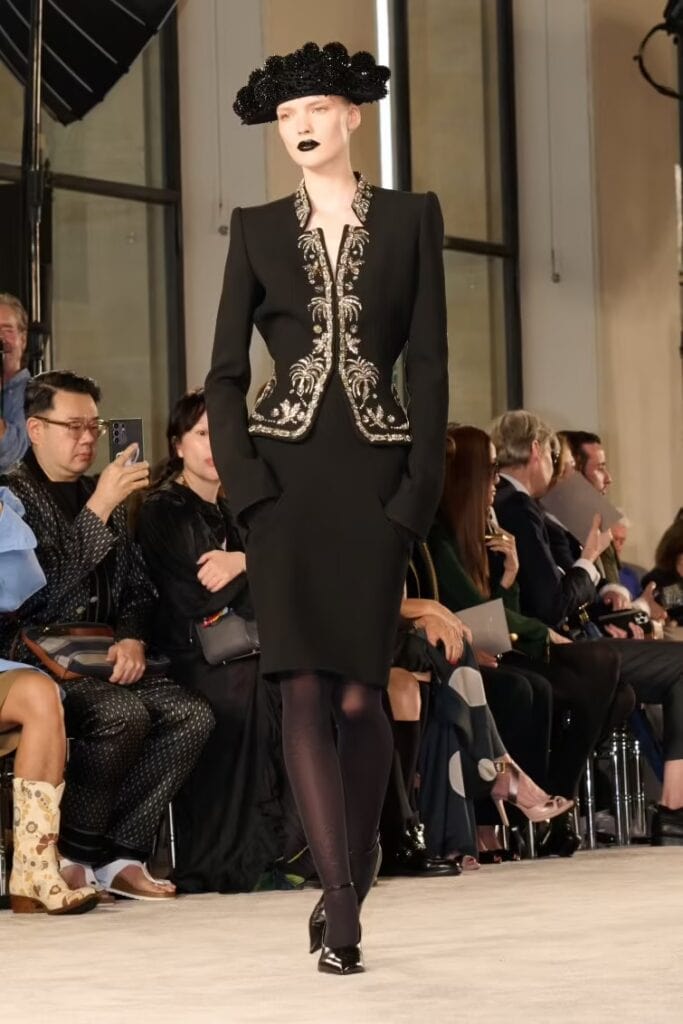
The matador suits, covered in white pearls or metallic leopard spots, seem to have come out of the trunk of a contemporary Marchesa Casati, whom Schiaparelli met in Rome, with a panther tied to a diamond leash, thus celebrating a world of glittering splendour lost among the yellowed pages of Le Petit Écho de la mode.
The Elsa Jacket, reminiscent of the embroidered jackets from the archive, is reimagined with sharp shoulder pads and declined in a daywear version in wool and an evening one, paired with bias-cut dresses, of which Madeleine Vionnet was the pioneer.
A hand-painted iris motif covers one of the dresses, which like a biblical demiurge descends down the catwalk, carrying a long grey veil, a bit like the one of Cassandra described by Elsa Schiaparelli.
Sequins and silver pearls cover the black tulle cape, lined with horsehair, inspired by the Apollo of Versailles designed in 1938-39 by Elsa Schiaparelli, now preserved in the Costume Institute at the Met. It had been made for New York actress Elsie de Wolfe, who was deeply fascinated by the opulence of the 18th century, so it was an ode to the Apollo fountain in the Parc de Versailles.


This creation also inspired the necklace composed of three layers of silver stars, which adorns the final look worn by Alex Consani.
La pièce de résistance is the red satin dress with a bust of a woman on the back, which like a Greek statue is bedecked by a rhinestone necklace with a beating mechanical heart at the centre, inspired by Salvador Dalí’s Royal Heart, a mechanical jewel studded with rubies that reproduces the heartbeat.
A look at the past and a future that emulates it, like a game of mirrors, suspended in an eternal carousel of cyclical fashions, just like all stories, destined to repeat themselves.
