
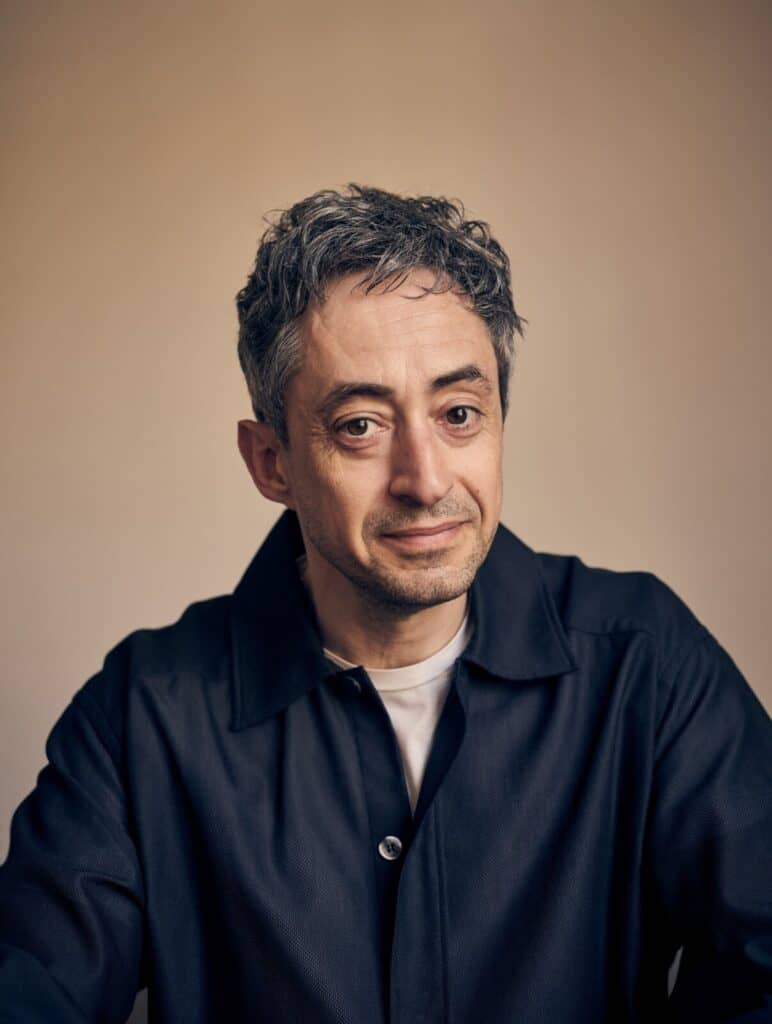
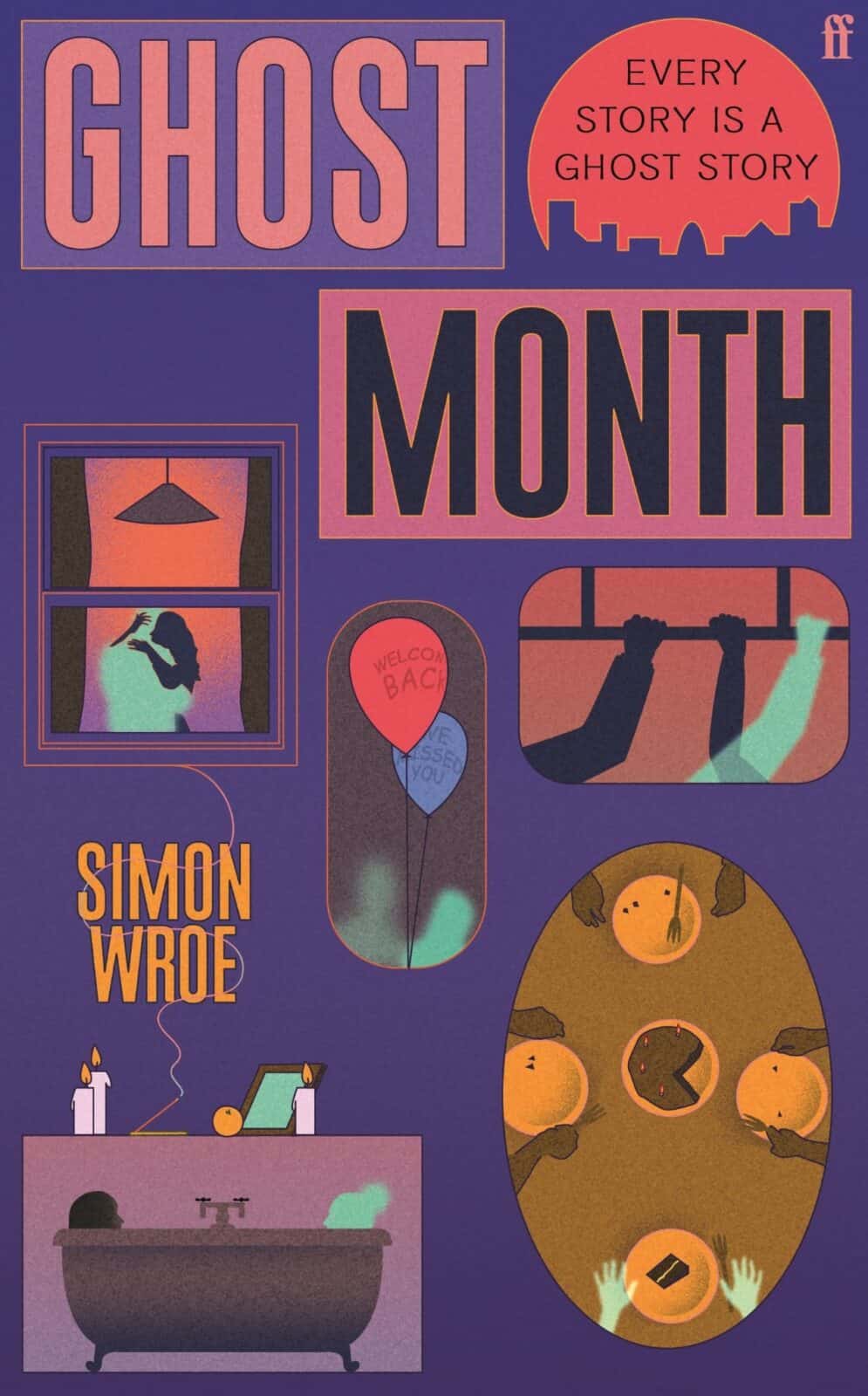
Every September, the spirits of the dead return before vanishing four weeks later in a puff of green ash. This is the eerie concept behind Simon Wroe’s third novel, Ghost Month, but Wroe’s handling of grief, memory, and love after loss is anything but slapstick. When the novel opens, it has been five years since the dead first began appearing, and over the course of the month, we follow four strangers as they prepare to welcome their spectral visitors.
Spirits, hauntings, clouds of green ash – it all might sound like something out of a Halloween cartoon, but Ghost Month rides this wave of familiar imagery to deliver a moving portrait of contemporary London life after a collective rupture. Sound familiar? In many ways, Ghost Month is a novel about what happens when the impossible becomes mundane and how people adapt when the world they knew has irrevocably changed.
I sat down with Simon in the weeks leading up to publication to discuss the novel’s connection to the COVID-19 pandemic, what inspired him to write about grief, and how you can tell a gripping ghost story without falling into cliche.
The Cold Magazine (CM): Simon, congratulations on the book! Publication day is just around the corner. How are you feeling?
Simon Wroe (SW): I’ve got a bunch of interviews coming up. I’ve written a few books before and I used to be a journalist, so I’m not entirely new to the interview process or talking about having your thing out in the world.
But there’s always this strange moment where the book goes out into the world. It sort of stumbles out there on its little wobbly foal legs and you want to say, “Look after it, be gentle”. It’s always fascinating seeing how people respond.
CM: One thing that struck me while reading was that there’s some serious meditations on grief going on here, but the book is not without its comedic elements. It almost feels like a mirror, where readers bring their own experiences to it.
SW: I hope so. The books and films I love most tend to be hybrids and work that mixes genres. They’re dark, but they still leave room for humour.
I really admire stories that balance different tones, so I wanted Ghost Month to have a bit of all those things. I wanted it to feel like a thriller, a satire of contemporary London life, while still having these gothic flourishes and something slightly otherworldly.
Ultimately, I hope people take from it whatever they want to. Someone interested in horror might pick it up and discover it’s not really a straight horror novel. Equally, someone who would normally avoid ghost stories might realise there’s enough here beyond the supernatural.
CM: How did you go about crafting the image and the rules of this world where ghosts are real?
SW: The ghosts were never really intended to be monsters. They’re ciphers for memory and grief and very real human emotions. Their presence prompts people into action, but everything they’re confronting already exists inside them. The ghosts are really a visual, physical manifestation of things the characters have been carrying all along.
CM: Early in the novel, a performance of Hamlet is interrupted by the arrival of the ghosts. Were you consciously in conversation with Shakespeare as you wrote Ghost Month? What other works of literature shaped your thinking as you were writing?
SW: I think all English literature is under Shakespeare’s auspices and in his shadow. I liked the idea of haunting his haunting, breaking into this famous scene from Hamlet with its themes of duty, revenge, and instability, themes which Ghost Month shares. The Bonfire of the Vanities was another literary influence.
I love how Tom Wolfe’s novel spans the city of New York. In Ghost Month, I wanted the sense that this phenomenon of ghosts returning is affecting everyone across London, whether they are directly haunted or not. At the same time, all of these characters, however disparate, are linked by one central story too.
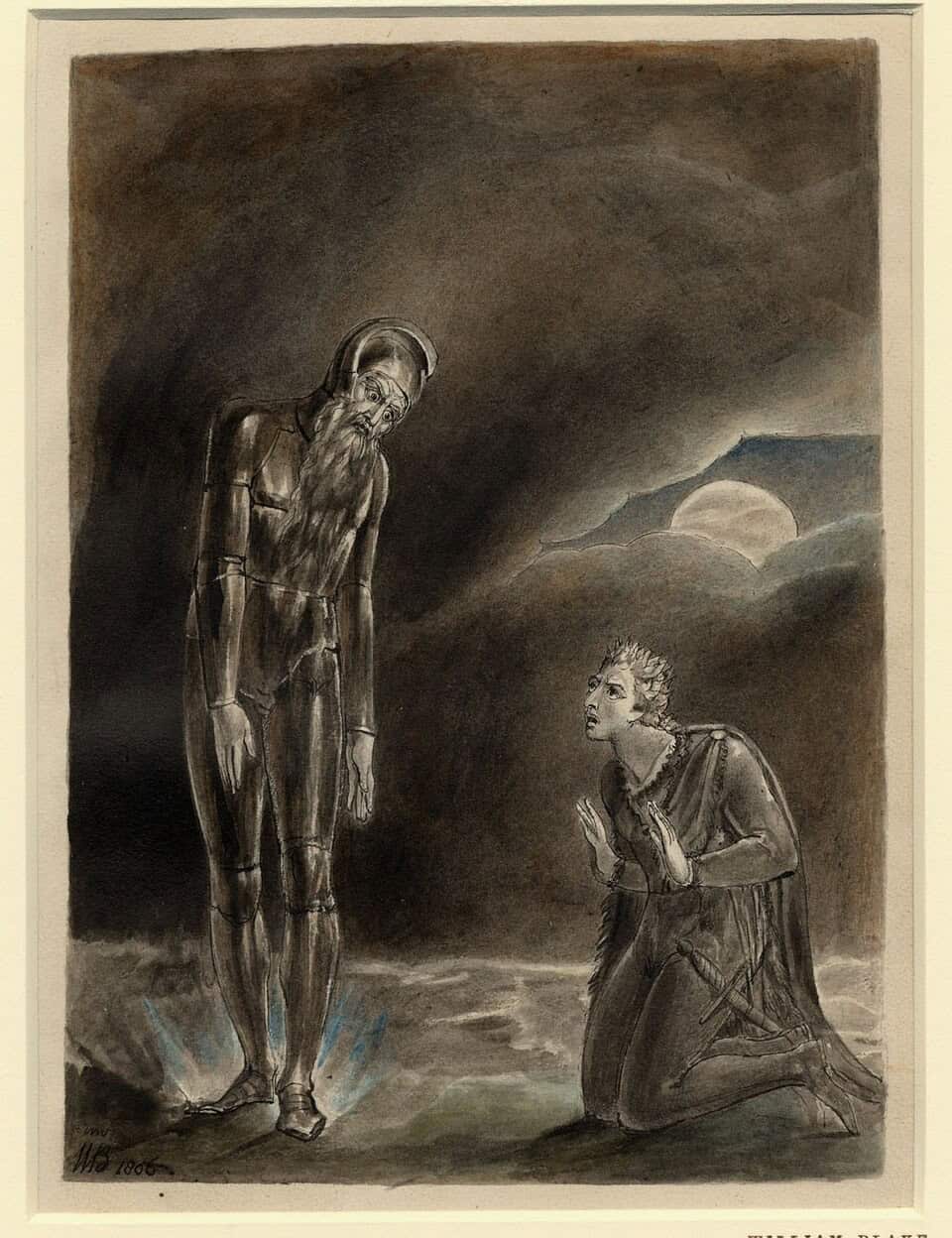
Hamlet and his Father’s Ghost, William Blake, 1806. The British Museum
CM: Although Ghost Month feels unmistakably contemporary, it also belongs to a long gothic tradition. As an American, London already carries those literary associations for me. I’m thinking of the Tower of London, Dickens, Victorian ghost stories. Was that heritage consciously in your mind while writing?
SW: I think ghost stories are inherently gothic. The tradition we recognise today really developed with writers like Edgar Allan Poe and Arthur Conan Doyle after the Industrial Revolution.
Those early stories often have this confidence about them. The Victorian British man feels as though he’s conquered the world, and the next challenge is to conquer the unknown – to solve the supernatural as well. There’s this belief that everything can be solved and explained. I knew I was writing within that tradition, but I wanted Ghost Month to be completely contemporary. I wanted it to deal with modern London and the concerns of modern city life.
CM: Why London?
SW: London felt like the obvious setting because it’s my city. It’s this place where millions of people live side by side, but often never really connect. The ghosts don’t care about class or neighbourhoods or social boundaries; they cut straight across them, linking lives that otherwise wouldn’t intersect.
I was also fascinated by what would happen if ghosts returned every year. How quickly would a city like London commercialise something so extraordinary? How quickly would there be products, services, and businesses built around Ghost Month?
You’d have psychics, professional doubles, fake husbands, all these strange industries growing up around it. It felt believable because that’s what a capitalist city does. Whatever extraordinary thing happens, the response is always: How do we make money from this?
CM: The novel also feels like it’s in conversation with very English ideas about grief and repression.
SW: Absolutely. The Victorians had this fascination with death, but they were also incredibly emotionally repressed. So many classic ghost stories are about societies bound by convention, and then the ghost arrives and punctures all that repression. I think we’ve inherited a lot of that.
The English are still very emotionally repressed around death. Other cultures live much closer to their dead. There’s Ghost Month in parts of Asia. There’s Día de los Muertos in Mexico. The Irish, too, have a much closer relationship with death than we do.
By contrast, we bury our dead on the edge of cities, or we cremate them, and then we try not to think about them anymore. That became one of the central questions behind the novel: What happens if you force an emotionally repressed society to stand face-to-face with the people they’re trying to forget?
CM: When the book begins, it’s been five years since the dead first began returning, and as I was reading I kept drawing parallels with COVID-19. Like Ghost Month, here was this earth-shattering event that people had to reorganise their lives around. Was that in your mind while you were writing?
SW: I’m very glad you picked up on that. I started writing the book during COVID, and it was absolutely one of the influences.
You know, COVID was this earth-shattering event where suddenly everything changed. Everything you thought was fixed about the world was no longer fixed. What fascinated me was how quickly people adapted. Suddenly we weren’t leaving the house, we were disinfecting our groceries – things we’d never imagined doing became completely normal almost overnight.
The other thing that fascinated me was how differently people responded to the exact same event. You had people disappearing into conspiracy theories, people who were overwhelmed with fear and barely left the house, and others who carried on as though nothing had happened. Here was one reality that everyone was experiencing, but everyone’s emotional response was completely different.
Walking through London during those early days, I found myself wondering: if people can react so differently to a global pandemic, what would happen if you introduced something even more impossible? What if death itself became part of everyday life?
CM: In the future, I could really see Ghost Month being discussed as one of the seminal literary works coming out of that moment in history – literature inspired by the pandemic.
SW: I’m very happy for people to think of Ghost Month as a COVID novel, but I don’t usually lead with that because I think people have a very fixed idea of what a COVID novel is. This isn’t a diary of lockdown or a book about buying toilet paper.
Instead, I wanted to come at it sideways. I wanted readers to feel that same shadow hanging over everyday life – that sense that something inescapable has entered the world and everyone has to find their own way of living with it.
CM: So was it those experiences during early COVID that inspired the novel, or had the seed been planted earlier?
SW: There were a few different seeds. My father was diagnosed with multiple myeloma many years before he died in 2014. He was originally given six months to live, but he lived with the disease for twenty-one years.
When someone is ill for that long, you spend years believing you’re preparing yourself for their death. You always have that shadow hanging over you. What surprised me was that when he eventually died, I was completely unprepared for how alive he still felt.
I could still hear his voice. I could imagine exactly what joke he’d make about something happening in my life. His presence didn’t disappear at all. In that sense, his ghost has remained very alive to me.
I’ve had similar conversations with friends who have lost people too. They described that same feeling that someone could be gone physically while still feeling vividly present. I found that really interesting, and I was already thinking about cultures like Ghost Month or Day of the Dead, where there’s this understanding that the dead aren’t necessarily as far away as we like to imagine.
CM: Talk to me more about the infrastructure around Ghost Month. In the book, you have characters hiring body doubles to be haunted in their place, or hiring fake husbands to impress the ghost of their dead mother. A whole industry has grown up around the phenomenon!
SW: Watching something as extraordinary as a pandemic become formalised, with rules, government policy, routines and rituals, made me realise I could apply that same structure to ghosts.
I never wanted to write a traditional haunted-house story. That wasn’t where my interests lay. What interested me was imagining a world where everyone already understood the rules. Ghost Month has been happening for five years. Society has adapted. Everyone has worked out how they personally deal with it.
That’s where the novel really came alive for me. Not asking, “What if ghosts existed?” but asking, “What would people do once ghosts had become ordinary?” Because that’s what we always do – we try to make sense of the things that frighten us. We create routines, we build systems. We ask how we can control them.
CM: That idea of control feels like the point where we meet each of your four protagonists. They’re all preparing for Ghost Month, but each is trying to control it in a completely different way. How did you go about building those four perspectives?
SW: The novel gradually reveals the connections between them, but they’re all people whose lives are deeply shaped by the return of the dead. Some are looking forward to Ghost Month, others are terrified of it, and others are trying to pretend it isn’t happening at all.
Their preparations tell you who they are. Gideon throws money at the problem. He hires people to deal with his ghosts for him. Jane is trying desperately to become the daughter she believes her mother’s ghost wants her to be. She’s denying parts of herself in order to please this memory she’s carrying.
Eddie is caught between his parents, who have completely opposing ideas about what the dead mean. His mother wants every opportunity to reconnect with her lost son, while his father believes the dead should remain dead and that reopening those wounds can only cause more pain.
Then there’s Lil, who has experienced a terrible tragedy in the past year. She’s homeless, struggling with alcoholism and trying simply to keep going. She doesn’t even know whether the person she’s lost will return.
Through all four stories I wanted to explore different relationships with grief. There’s no single correct way of living with the dead. Holding on too tightly can stop you moving forward, but refusing to acknowledge them at all can be equally destructive.
London was the perfect place to tell those stories because it’s a city where vastly different lives exist right alongside one another. Ghost Month allowed me to create a real cross-section of the city.
CM: I’d love to talk about Gideon. While each of the novel’s four protagonists seems to embody a different facet of contemporary London, Gideon stood out to me as a particularly pointed portrait of wealth and privilege.
Was he, for you, a way of interrogating that world? What aspects of that affluent, well-connected London life interested you most when writing him?
SW: Absolutely, Gideon was a way to look at that rarified world. As a writer, characters like Gideon are very easy to feel nothing for (if not actively hate). You have to find ways to make them feel human. Gideon interests me because his fate is sealed from the moment of his birth. He’s never had to do anything or be anything – and it’s ruined him.
I was also interested in how that world protects its own, and while Gideon can’t ever really be anything on his own terms, he also can’t ever really fail. You only have to read the news to see real life Gideons, protected by money and power, getting away with all sorts. I was interested in ghosts testing that power and privilege.
CM: Eddie is the youngest of the book’s four protagonists and the only child. What drew you to telling part of the story through a child’s eyes?
SW: Eddie is the only main character who can admit to himself that he doesn’t know how he should feel or act now that the dead are returning.
All the adults have formed their opinions and made their plans, foolish or otherwise, about how best to handle this month. It’s something we learn to do as we get older: knowing what we feel and want. It can be a tremendous strength, but it can also lead to arrogance, intransigence, and error. Eddie continues to question what is happening, and as a result, the book’s littlest character sometimes asks the biggest questions.
CM: What do you hope readers are left with when they close the book?
SW: Obviously I’d love people to be moved by the characters and their stories, but beyond that, I’d love it if the novel made readers think a little differently about death. I sometimes feel we’ve convinced ourselves that the dead are completely behind us, when perhaps they’re closer than we realise.
When I look at other cultures, I find their relationship with death really beautiful. In Japan, for example, families return every year to commemorate someone, bringing food they loved and spending time with their memory. There’s an ongoing relationship there.
We don’t really do that in Britain. We tend to think, “They’re over there now. That’s finished”. If Ghost Month encourages people to feel even slightly closer to the people they’ve lost – to be a little more open to those memories – I’d be very happy.
And if people start holding their own Ghost Month…well, I’d be delighted.
Simon Wroe’s Ghost Month will be published by Faber on 27 August 2026.


