
What is sustainability? How can a brand define it in an industry flattened by greenwashing and familiar rhetoric? STEM, a Danish brand founded by Sarah Brunnhuber, offers something more specific and considered.
Intentionally small in scale, STEM operates in a way that allows room for experimentation. Brunnhuber approaches sustainability as an overarching ethos: it informs how every garment is made, how it behaves, and how long it is meant to last. With a background in textile design, she grounds her practice in fabric innovation that has been refined over time, expressed in new weaving techniques that significantly reduces waste at the point of production.
As one of Copenhagen Fashion Week’s (CPHFW) latest additions under the NewTalent banner, STEM has already established a clear point of view, one that echoes the sustainable ideas CPHFW has been built on in recent years. The brand calls for a slow, meaningful, and transparent production cycle, one where every decision feeds back into a larger ethical framework.
Nothing is wasted. Off-cuts of garments are repurposed as fringes – becoming one of the brand’s signatures. Fibres remain entirely natural, reinforcing a circular approach that leaves a minimal ecological footprint.
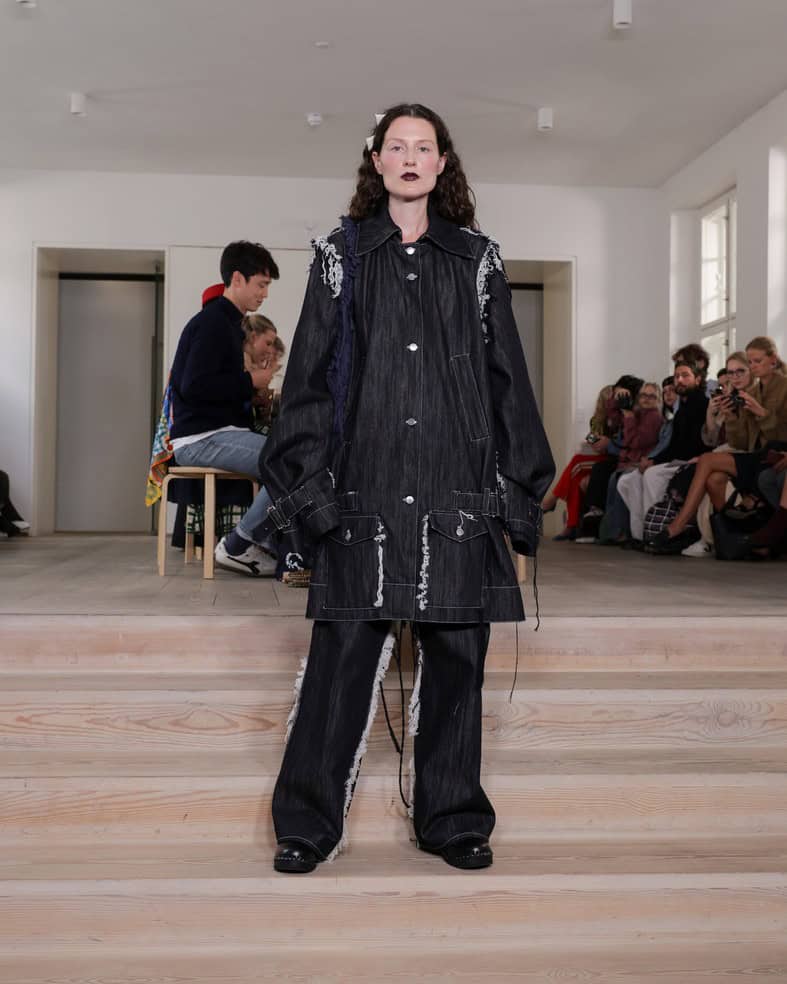
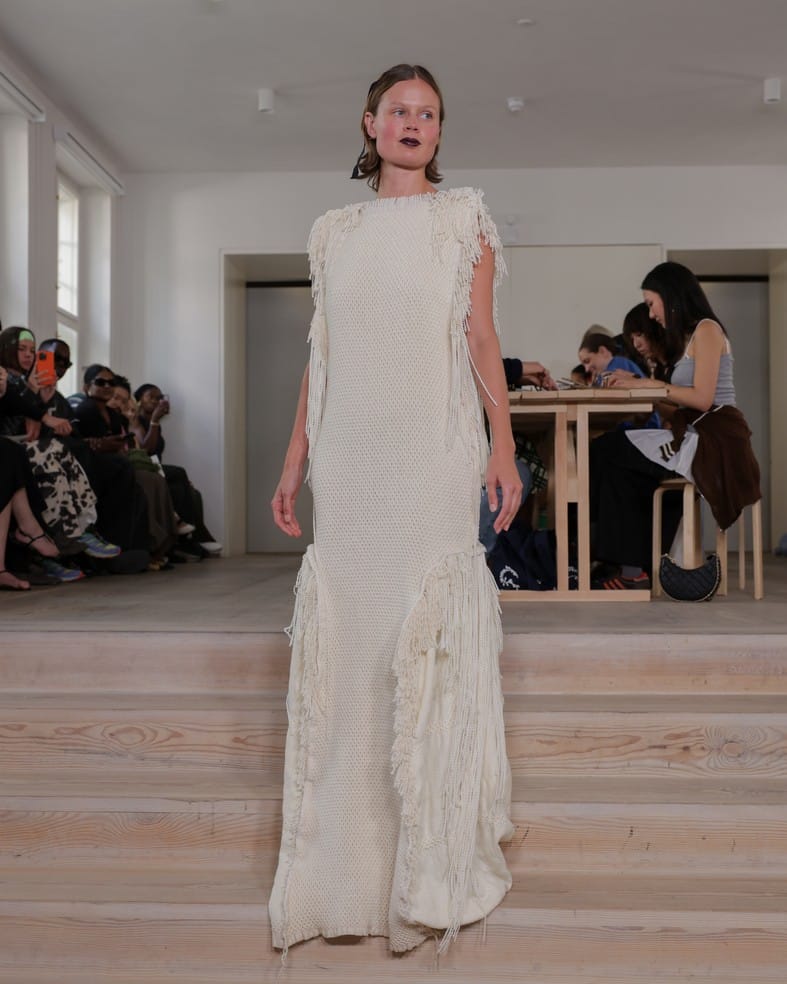
Following a denim collaboration with Ganni in 2022, STEM has been steadily establishing itself on the regional scene. Last season’s collection was defined by an innovative and intricate pulling technique, further demonstrating Brunnhuber’s commitment to process-driven design.
With the brand gearing up for its second collection within the developmental scaffolding of the CPHFW NEWTALENT programme at CPHFW AW26, STEM’s work stands above the parapet, shouting from the rooftops about how much can be achieved when intentions are clear, and core values are held onto. Cold spoke with Brunnhuber to gain her perspective on what it means to be creating this quietly radical work in a slightly bleak fashion landscape.
The Cold Magazine (CM): From your point of view, how would you best describe “zero-waste” production?
Sarah Brunnhuber (SB): STEM is based on no waste, and a waste production technique that I developed for woven garments. It basically means that I’m eliminating, on average, 15-25% of fabric that is lost during the cutting process. I’m producing garments in a way that I can use up the entire fabric, so that I have control over the process. I do my best to ensure that there isn’t any waste in that. I often ask the sewing room to send me their bin back of any threads they’ve cut off, because we use those to make little patches and tags. This method creates a much more conscious approach to production from the beginning. I digitalise the pattern pieces and nest them, so that I’m arranging them in an efficient way, and then put in the weave structures. I also weave patterns directly onto the loom. I’ll move the pattern piece for a sleeve, for example, and all the areas in between, which would normally be off cut waste; these I weave with a loose weave structure. Through a cutting technique, they stay attached to the pattern pieces and become the fringes that line the seams of all the garments. That way, I can use up the entire material.
CM: From what I understand, you have a digital pattern process. How does the pattern transfer onto the loom? What kind of looms do you use?
SB: In the beginning, before I harnessed my technique, it took me about two weeks to weave a shirt. This was in 2018, around the time of my graduation. I graduated with this hand-weaving technique from design school, then spent time industrialising it so that I could scale it and have more impact on the industry. You get the exact shapes because the loom itself is digital. You send it a file, and then it knows the pattern.
CM: Are all your trims equally sustainable?
SB: I’m learning along the way. I did a collaboration with Ganni, and at the time – this was in 2022 – I was really adamant about using screwable denim buttons, because I wanted the garment to be easy to recycle. I got these special buttons, and I did a lot of research, and I got buttons from YKK that unscrewed a little too easily. They worked a little too well, so there was definitely some learning there. Now I use a different button on my denims. You can take them apart with a specific tool, but they’re much more secure.
Other trims are either dead stock – for example, I recently got a massive box of zippers from another brand – or I develop specifically. For buttons, I’m using ones made from nuts. I don’t use polyester threads. I mostly use tensile because it’s stronger. On the wool garments that I’m developing now, I sew with wool thread, so the whole garment is properly 100% wool. I’m trying my best with that, but it’s complicated for sure.
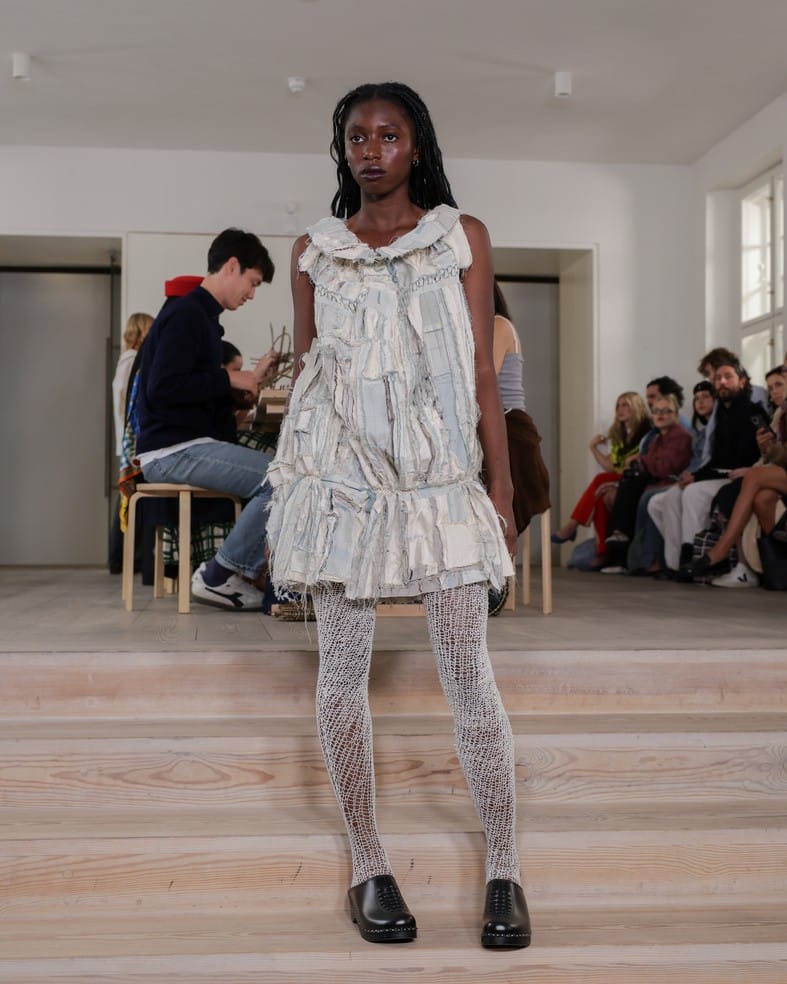
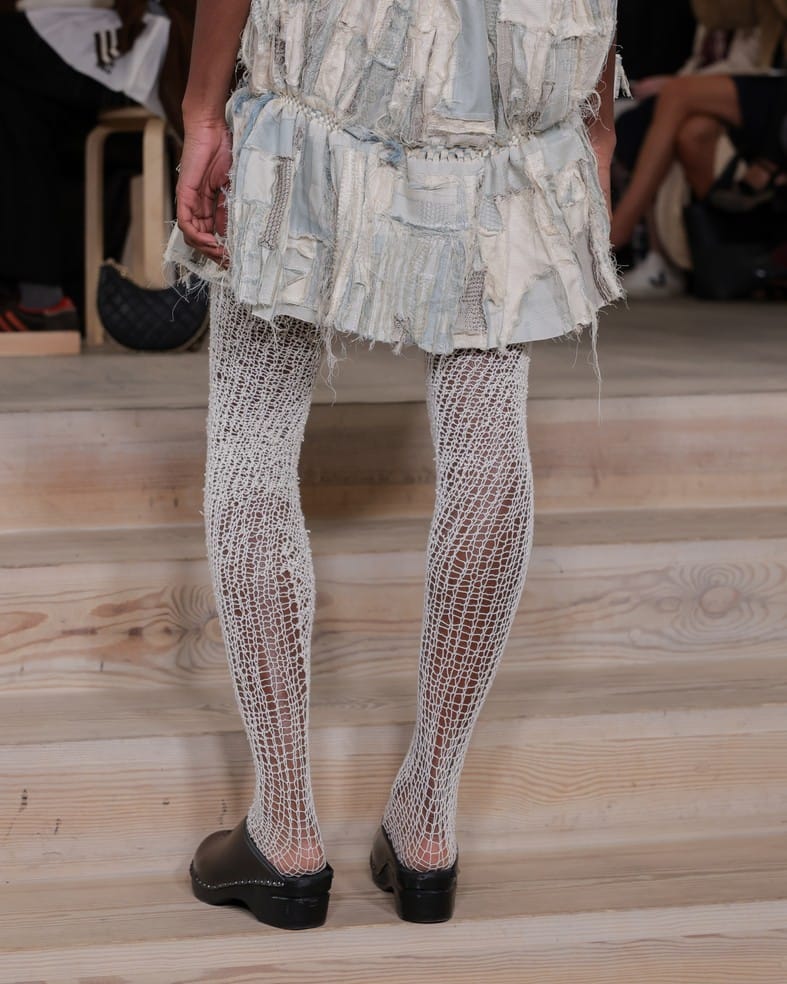
CM: What are the design limitations to your weaving technique? Could you create a form fitting garment?
SB: The elastic wool means that I can make form-fitting garments, and that was the purpose. From early on, when I started weaving, I wanted to make stretchy woven garments. If you want stretch, it’s usually either knitted or synthetic, so I needed to find a natural material with those characteristics. I’ve tested cellulose fibres, but they just don’t behave in the same way. Nettle might have some similar qualities, which I’m planning to test out this year. Woven garments, by nature, are not as stretchy as knit. With the STEM technique, I could make any woven garment and tailor it to be more form-fitted. But if you want something stretchy, I am limited to elastic wool, because I don’t want to use any synthetics or blends.
CM: With competition in mind, how does STEM compare to other sustainable brands?
SB: I have some interns, but there’s only so much one person can do. I have focused a lot on material development and weaving techniques, and on using Fashion Week as a moment to make presentations about production. In the summer, I presented the collection in a space that also hosted a willow-weaving workshop. Guests sat together and learned the basics of weaving – the repeated over and under motion – and basket weaving is a great way to visualise that at scale. It allowed people to understand the craft and see connections between the loose weave structures in the collection and the process itself. The response was positive, so I’m continuing the workshop format this season, focusing on Danish wool. Storytelling and communication are where I place my energy. Certifications are something I could improve on, but I’m working with the skills I have as a weaver and textile designer.
CM: From what I’ve learned, you are currently in business with a mill in Prato. How did that relationship take form?
SB: Yeah, I’m working with a few different mills in Prato, as well as in other parts of Italy. I’ve been working for about five years with a studio that brings artists and designers together with production there. They act as a kind of middleman because they have this strong network in Prato. When I made the denim collection with Ganni, we found someone who specialises in jacquard denim, which is very niche and specific, and would otherwise be difficult to find. So I’m lucky to have them as a production partner.
CM: How do you think STEM best represents Copenhagen and its unique creativity?
SB: I was born in Germany, I grew up in London, and then I studied design in the Netherlands, where I met my Danish boyfriend, which is why I’m here. So maybe I’m an example of a Copenhagen that’s not quite as Danish. I think Copenhagen does have this reputation of putting sustainability on a pedestal. It’s something that they want to focus on, start conversations about and be at the forefront of. And I’d like to think that I am trying to be a part of that.
CM: How would you best describe your greatest influences, and what excites you the most about fashion?
SB: The first thing that comes to my mind is antique textiles. Being a textile designer, I’m always looking at old weaving books or samples. I have this amazing book of antique lace samples that I bought at auction, and I often look at other crafts to see how I can apply them to weaving. I always say that I approach fashion from a production point of view.
In October, I was lucky enough to go on a residency in Norway at a weaving mill, just to understand more about how it operates. They have all these beautiful looms that are over 100 years old. One machine they let me use was a needle-felting machine. It’s generally used to make felted wool for insulation or wrapping, but I used it differently. I fed in some woven wool fabric and pleated it, then kept the machine in one place so the needles moved up and down without advancing the fabric. The needles pushed through the wool and created a sort of braille-like texture. I’ve made these beautiful woollen skirts from this technique without sewing anything. That kind of discovery, using a machine in a way it wasn’t intended, is what still excites me the most.