
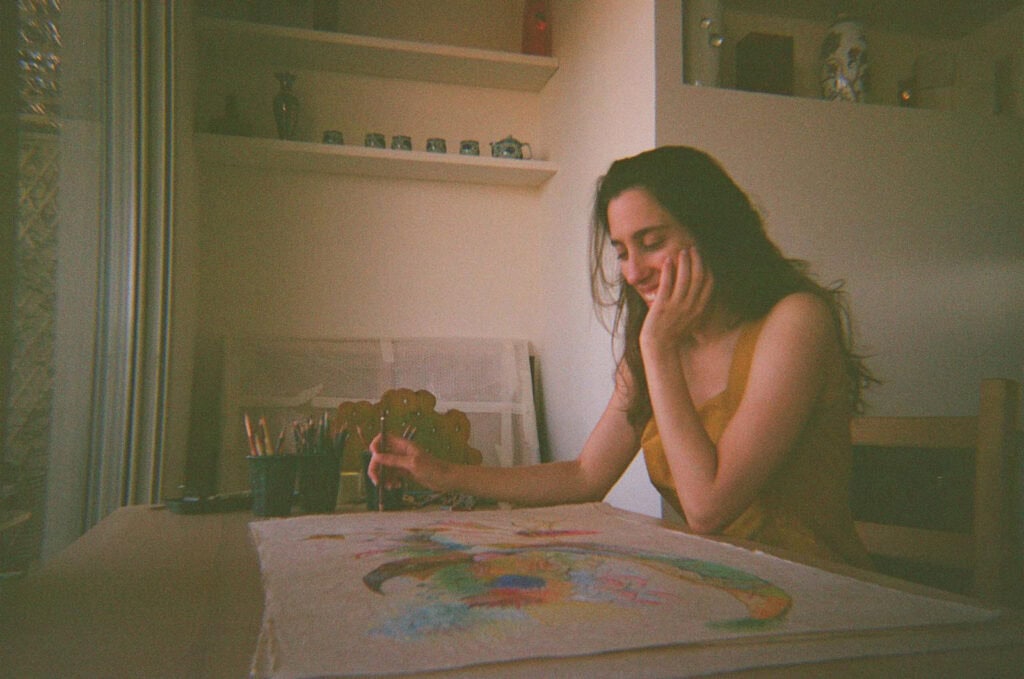
Greek-Italian artist Valentina Bartolini builds “in-between” worlds where the real, the dreamlike, and the supernatural converge. Her new series, Sky Ladder, draws on memory and the unconscious, unfolding through shifting creatures, crystalline fragments, and landscapes glimpsed from a transcendent vantage point.
The series takes its title from a full moon rising behind Mount Hymettus, where mountain cables seemed to bridge the earthly and the metaphysical, like a little ladder.
Will be presented at Art Athina (19–22 September), followed by her next solo show at Callirrhoe (22 January)
INTERVIEW
Valentina Bartolini (VB): Lately, I’ve been painting birds. I like birds.
The Cold Magazine (CM): Apart from the work with the snails (Revenge of the Snails, 2025), you haven’t painted animals before, right?
VB: No, but they have a kind of symbolic quality; they’re not exactly representational. They’re birds with very long tails, and inside their tails they keep hidden things: amulets, stars. There’s one I made that looks as if it carries the stars of the sky, or maybe diamonds. They have strange beaks. It’s not that I sit down and say, Now I’ll paint a bird. I just started painting something, and it ended up becoming bird-like.
CM: So they’re not real birds, or inspired by any specific bird?
VB: No, no, not at all. For me, it’s more about the idea. The tail can serve as a covering element, concealing while also providing strength. They have wings. I also enjoy playing with dimensions: how a being that’s above the earth sees us. The mountains I paint below, mountain ranges, snow-covered peaks, and so on, the sense of distance, of elevation, all of that.
What also interests me a lot in painting is sensation. I start making them without looking at anything. I’m not thinking of an image and then creating it. I just think about the feeling of the thing.

CM: Tell me a bit about the paper you use.
VB: The paper, I really love the detail it can hold, but at the same time, it makes things very difficult for me, because it’s very rough, full of fibres and threads. It’s a handmade paper from Thailand, and in practice, it complicates my work, since I can’t capture much detail with a pencil. It tears easily, you can’t erase it too many times, and it has all these difficulties. But somehow, it allows me to record feelings. That’s why I chose it.
CM: So your creative process is a dialogue with the paper.
VB: Yes.

CM: Do you want to talk about the dream you mentioned earlier?
VB: Sure, it was a dream where I was inside a bus, or maybe a school bus from my childhood. And when it stopped to drop me off, I had to gather my things to get out. I had a suitcase filled with clothes and dresses, and I realised that someone had stolen some of them. I told a man about it, and he said, “Ah, these things don’t happen… how could this have happened? So you don’t leave feeling disappointed, I’ll give you something.” Then he opened some huge cupboards, and inside were these flashy garments, which were clearly very expensive. He kept searching and searching, moving everything aside, until he finally found a very, very small piece, just a single little earring, almost like a cap, nothing that seemed to have much value. But on it, there was a painted peacock. And he said, “Keep this. It’s one of the most important things we have here.”
I’m in a phase where I’m drawn to these small hidden details, the little treasures you might discover. I’m interested in what is secret, the esoteric.
When I work, I sit and look at the mountain Hymettus, and I feel as though I’m standing on its peak, empty of everything, free of anxiety. There’s a clarity there.
CM: Do you feel spiritually identified with birds?
VB: Yes, probably. And now that you mention it, I’ve actually seen in my meditations that I was a white peacock, so in a way. I think birds, because they have this ability to leave the world and go wherever they want, they carry a kind of purity.
CM: Do you find birds sacred?
VB: Yes, you could say they’re a bit like a higher spiritual self. Some of their feathers could be iron, metallic, sharp-edged. They’re not monolithic. Each bird has many different parts, because it carries everything we experience, everything happening in the world, all the restrictions and imprisonments we face.
CM: Speaking of imprisonment, throughout the history of birds, there’s a strong element of captivity, cages, and hunting. How does that connect to your own birds?
VB: I think subconsciously, I’m definitely affected by the history of the abuse of birds, how they’re creatures born to be free, to fly, and yet we place them in cages. But in my work, it always transforms into something else, something that overcomes those conditions. If you look at them as a whole, they emit a certain force, not something worn down, not an organism crushed and destroyed.
CM: The birds in your works aren’t the kind of birds one could put in a cage. Even if you don’t depict peacocks directly, because of the tail and the sense of height, the birds often tend towards peacock-like forms. And peacocks are among the very few birds that are not really caged. That’s not really a thing, to put one in a cage.
VB: Exactly, I’m not painting canaries. I make extravagant birds. I imagine their tails like enormous fans.

CM: Another thought I had, small birds carry a specific symbolism and connotation in culture. It reminded me of Ibsen’s A Doll’s House. One of the subtler but aggressive ways Torvald diminishes and patronises his wife, Nora, is by calling her things like “skylark,” “songbird,” “dove.” They’re the sweet, harmless little creatures. But that has nothing to do with your birds. The ones you create hold whole worlds in their tails. They’re so large and grand, and it’s as if they are protected.
VB: That’s a very interesting point. In Hitchcock’s The Birds, the birds are incredibly powerful, shown in a completely different way, as if they were nature’s revenge, in a sense. The attack, the inexplicable. Nobody understands what has happened in the world, and suddenly, the birds turn on them. But at the same time, there are those two lovebirds, two little canaries, small, harmless, sitting quietly in their cage. And the film ends with them being taken away in the car, untouched by the chaos, as if nothing had happened to them.
CM: But your birds are neither one nor the other. Neither attack nor defence.
VB: They carry many things within them.
CM: Do they carry weight?
VB: Yes, they do. Even just with all those metallic elements they bear, the weight is there. But that’s what makes them dynamic. As they fly, nothing truly carries weight in the sky; everything is suspended.

CM: That’s beautiful, their weight becomes something precious, transformed into stars, into amulets.
VB: Exactly, it’s transformative. You can see the process, what I do with memory, with grief, how I work through it. That’s what comes through, I think.
Below is a free translation from a passage from Jorge Luis Borges’ The Book of Imaginary Beings (1957), a book Bartolini has been reading and which quietly inspired her work in this series.
“Birds fly, fish swim, animals run. We can catch the running beast with a trap, the swimming one with a net, and the flying one with an arrow.
But then comes the Dragon • and I do not know how he carries the wind, or how he ascends to the skies”.