
In the opening to Mike Leigh’s Abigail’s Party (1977), we meet Beverly and Laurence – equal parts a parody of and a startlingly accurate depiction of the era’s British suburbanites. They’re hosting a dinner party, we learn, which quickly becomes a performance of status for their guests, Angela and Tony. The mother of the titular Abigail is also in tow. She has been invited over to skirt her teenage daughter’s party upstairs.
Mapped between a strangely sexual undercurrent and a wry nod to art-world seriousness, the play culminates with Laurence, on the floor, having a heart attack. Voices are raised. Decorum dissolves. Infighting ensues. In the background, rock music from Abigail’s party reverberates to her mother’s increasing dismay.
“Why return to this play after fifty years?”, I ask Rose Easton ahead of the eponymous at her London gallery. “It still feels uncannily relevant,” she replies. “The initial impulse for the exhibition was celebratory. But Christmas, like Abigail’s Party, is never uncomplicated. Beneath the surface of festivity there is always tension, longing and discomfort – that duality became central to the exhibition’s curatorial logic.”
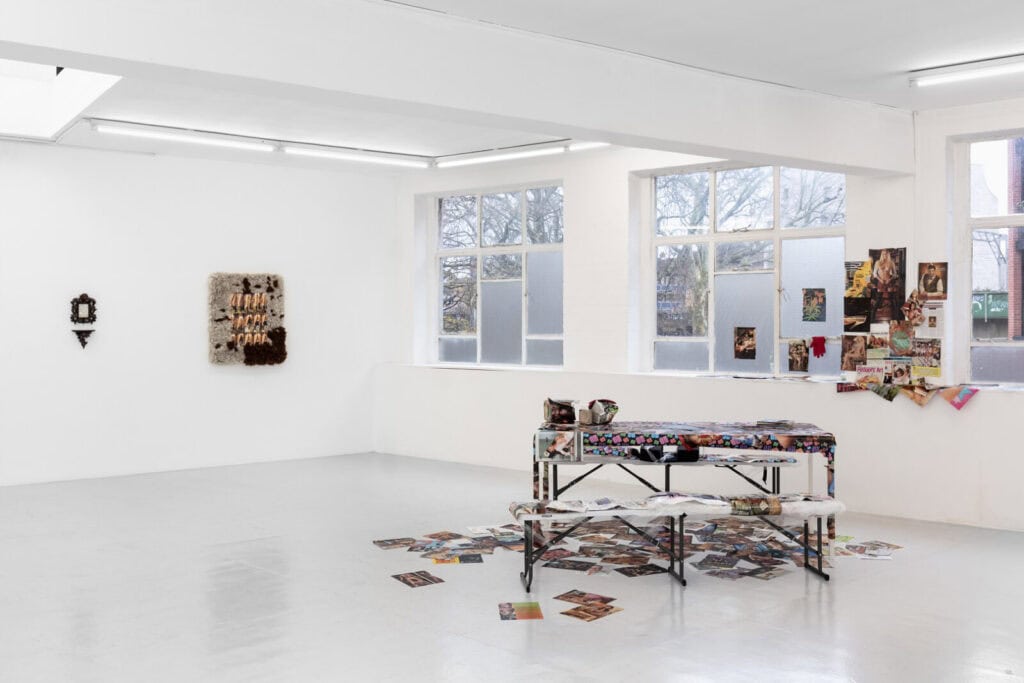
Behind a graffitied door across from Bethnal Green Gardens, the gallery’s white walls have been adorned with artworks from nineteen international artists, all looking at desire and performance. An immediate standout is Amanda Moström’s ‘Doggedly Forward’ (2025), featuring a selection of bums in a barn. They’re encased in a fuzzy, alpaca fleece frame. Echoing the satire of Abigail’s Party, Moström’s disarming unseriousness probes at the discomfort of being sexualised. These are, after all, exposed rear-ends unwittingly captured from behind. The message may feel a touch forward, but that’s the point. As author Sam Moore says in the exhibition note, “Camp is an act of refusal… It looks back as a parody of seduction.”
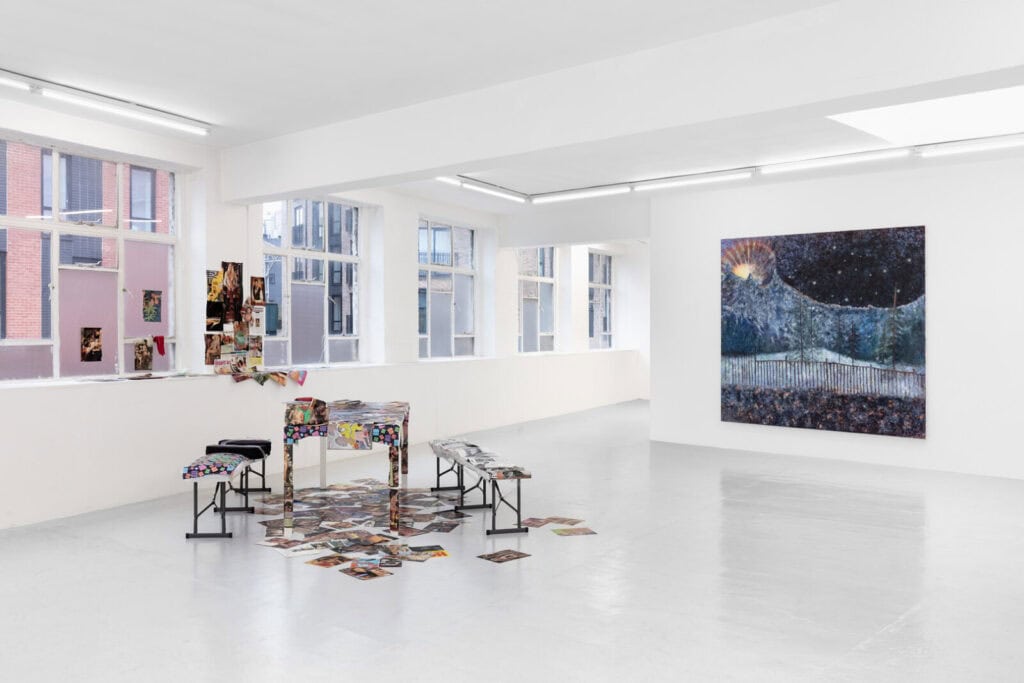
Where Easton’s curation is strongest is her emphasis on “a wanting: for connection, for excess, for beauty, or for escape,” which drives many of the artworks on show. An ethereal landscape from Lara Shahnavas is rendered in dreamlike blues and browns, backgrounded by a fenced mountain, which feels just out-of-reach on the monumental canvas. In Łukasz Stokłosa’s ‘Stockholm’ (2025), an intimately scaled carriage is foregrounded in a bright yellow over a murky midnight – a longing for something, just beyond the precipice of the moment.
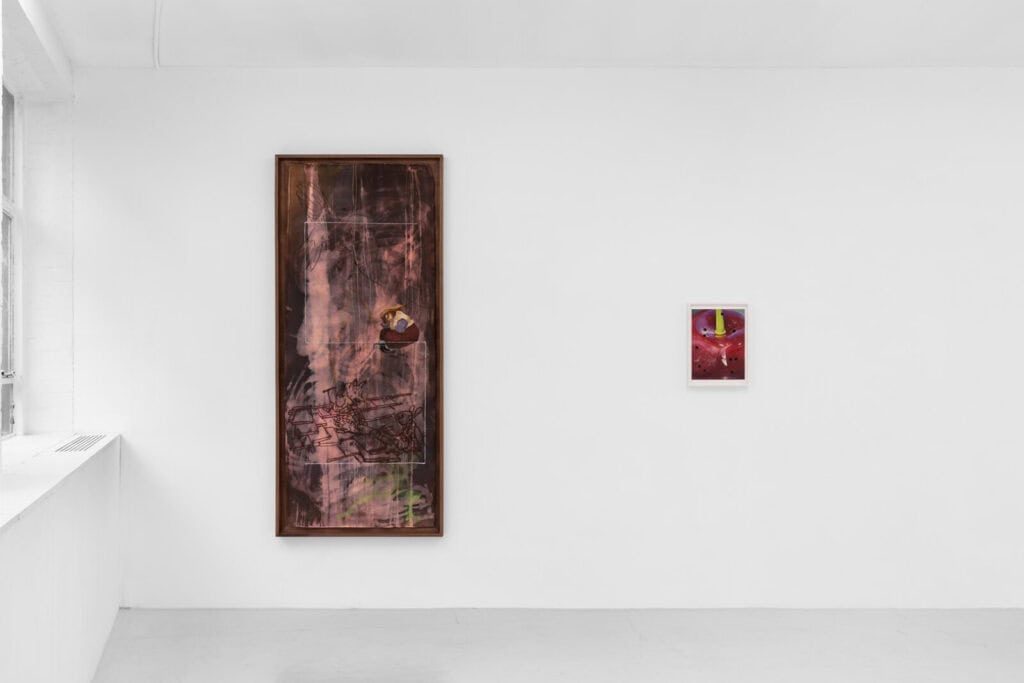
Talking to me about Abigail’s Party, Easton continues, “Camp offers refuge from boredom. It creates a space where exaggeration, humour and fantasy can flourish, allowing us to escape the rigid seriousness of contemporary life.” Cary Kwok’s ‘Pin-up Manga Hoarder with a Kawaii Macoto Facelift Bathing in Pink Martini’ (2018) represents this idea at its logical extreme. Sketched on paper, a naked woman lounges in a martini glass, encircled by dildos, Sailor Moon and Hello Kitty in a pastel shrine to contemporary pleasure.
If some of these works embrace camp as escape and indulgence, others hint at its political edge. Cara Benedetto’s ‘The Wrapping Room’ (2025) is the only durational performance in the show. By the window, participants collage vintage porn magazines, drawing on the table and collecting ephemera to scrapbook. Scrawled in pink over an image of Prince Charles and Princess Diana in the alps is the message: ‘BORED 2 DEATH’. Appropriating the voice of an imagined teenage girl in the nineties, we wonder: have we grown bored to death with regalia? Are its days over? Positioned centrally in the gallery, the piece is designed to be loud and affronting.
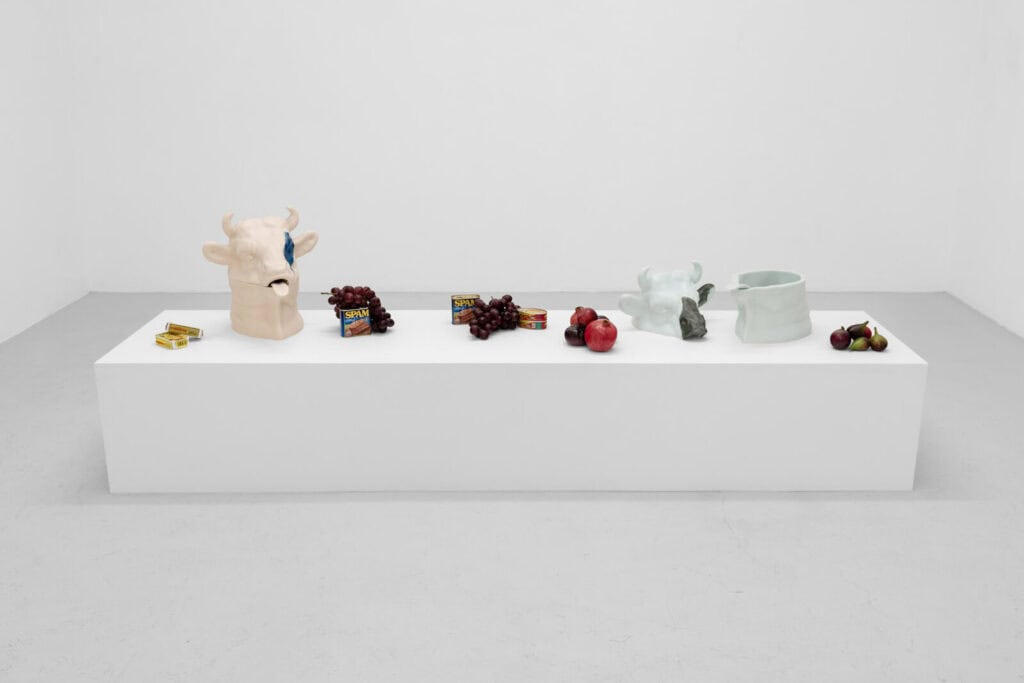
Across Abigail’s Party, Easton’s framing of camp overtly recalls its namesake play. Just as it vibrates with some very 1970s, middle-class anxieties over status and image, so too does today’s exhibition hint at the escapism, humour and absurdity needed to survive in our current climate. In a contemporary landscape dominated by ‘serious art’, the exhibition reminds us that camp is not purely indulgence but a vehicle. One that expresses the contradictions and moral gravity shaping our increasingly volatile social worlds.