
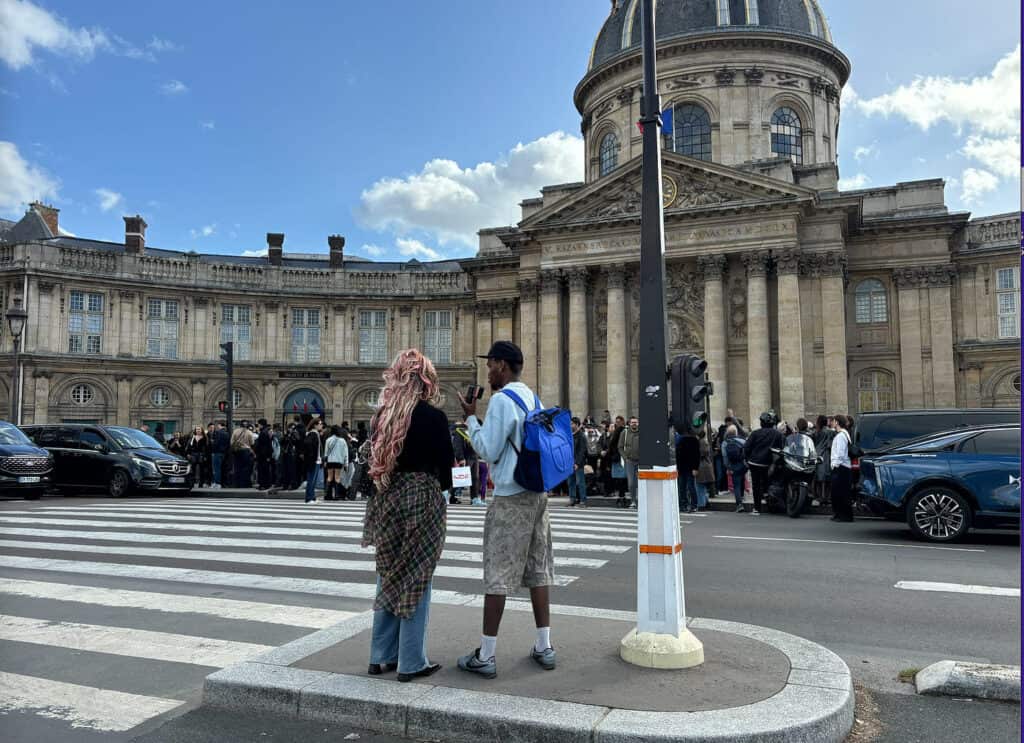
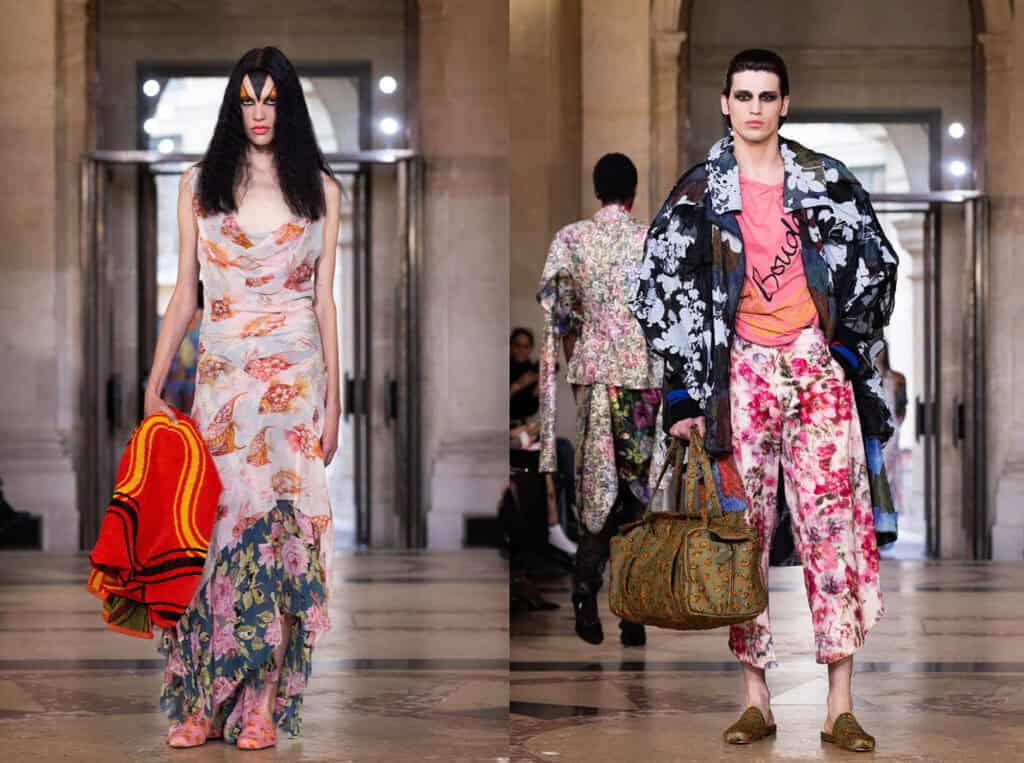
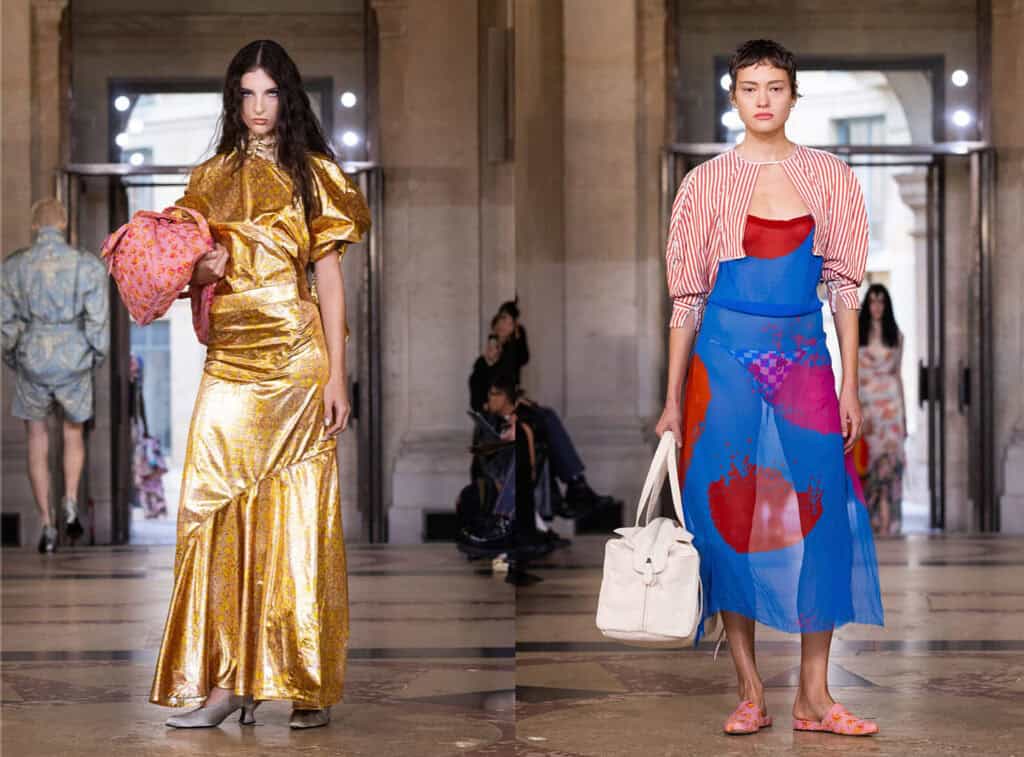
Saturday, October 4th in Paris swept in a storm of skirts: tartan, lace, full-on kilts, the like. Myself, I was on the lookout for the metaphorical jewel. A crowned orb and satellite.
At her show at L’Institut de France, it was a sea of spiky hair, heavy metal, and cigarette smoke. Tourists lingered on the bridge across the street at Pont des Arts. Groupies and photographers pressed themselves against the metal fence extending from the main doors, and more trickled in as the minutes passed.
I couldn’t say the crowd felt more reminiscent of one Westwood era than another—her oeuvre allows plenty of room for interpretation. Guests paid tribute through thick pearl necklaces, black-and-yellow patterned blazers, corsets worn as outerwear.
The latter, donned by an American girl I briefly chatted with, became extremely popular with the street photographers. I watched upwards of twenty people approach her, snap a photo with little or no permission, then turn and prowl for the next best image.
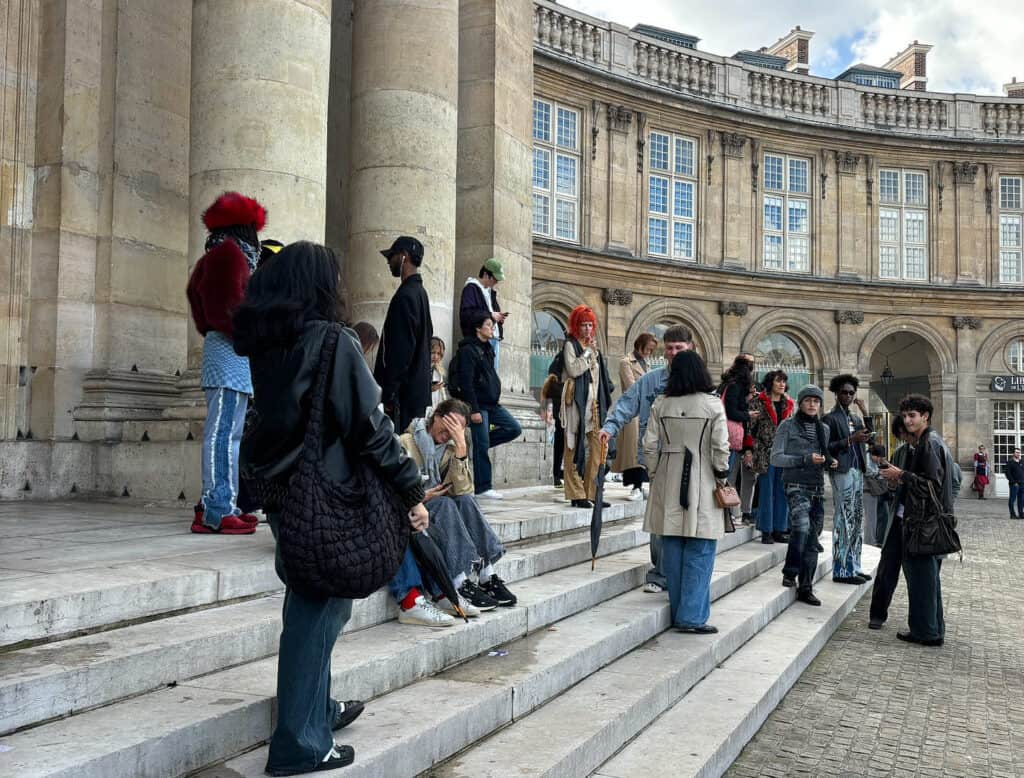
All through the city, the Vivienne Westwood image was alive, though the woman herself was gone—and during a critical moment in fashion history at that. We have emerging designers, dying house legacies, and a deep rift between heritage and innovation: in an age of algorithm-driven artistry, some labels are adopting sustainability measures or shooting for idiomatic stylings, while others continue to abuse fast-fashion methods, trading individuality for market interests.
Westwood’s absence is a tragic loss in this regard, as what set her apart was her unrelenting advocacy. It was the very foundation of her work: rebellion against the machine. She consistently used her platform to discuss politics: climate change, the harms of fast fashion, wrongful incarceration. In her own words, “I just use fashion as an excuse to talk about politics.”
But today, Westwood may be better known for the orb-and-satellite symbol than her disobedience. A brand that began as anti-capitalist counterculture has become one of the hottest commodities of hyperconsumption. The ethos behind her pieces – to provoke or inspire engagement – is undercut by their cultural capital.
My impressions of the seasons since her death, formed solely through a screen, have been underwhelming. There’s the same name and there are interpretations of her punk spirit, but not the follow-through – the controversial statements that once got her written off Condé’s Nast’s guestlists. I feared that without her physical advocacy, the brand’s accentuation would lapse into inaction.
Much has changed in fashion since Westwood began on Kings Road in ‘71, the year she opened her first boutique with Malcolm McLauren. “Let it Rock” – later renamed “Sex” and then “Worlds End” – was considered ahead of its time for using recycled fabric and anti-establishment rhetoric.
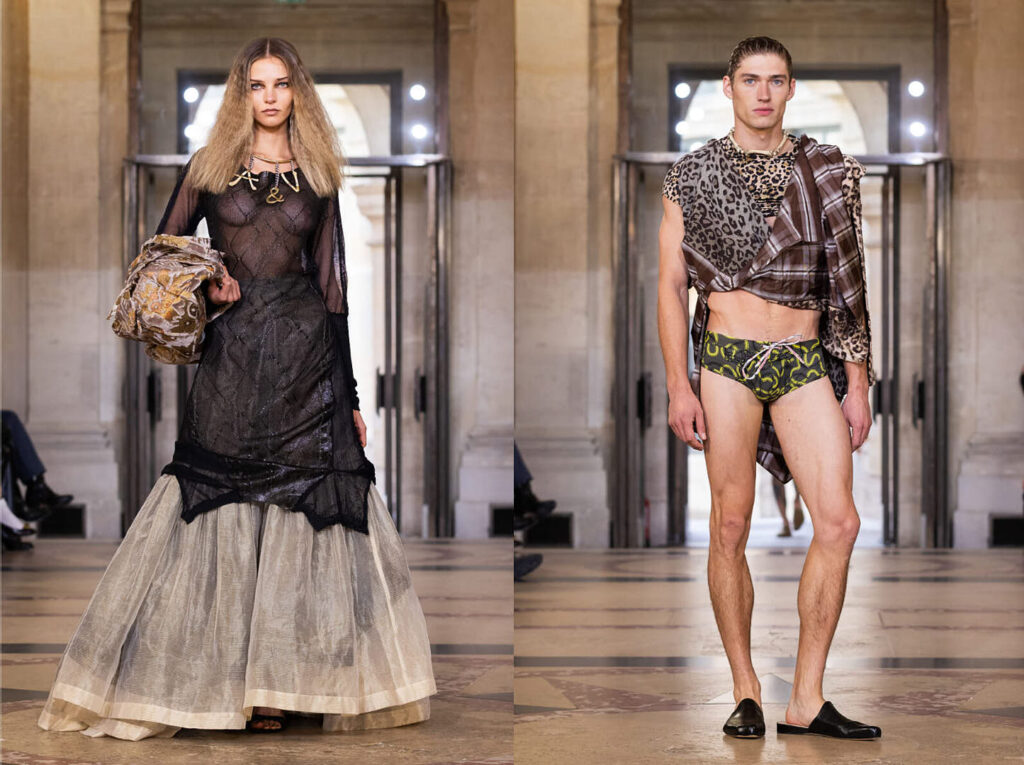
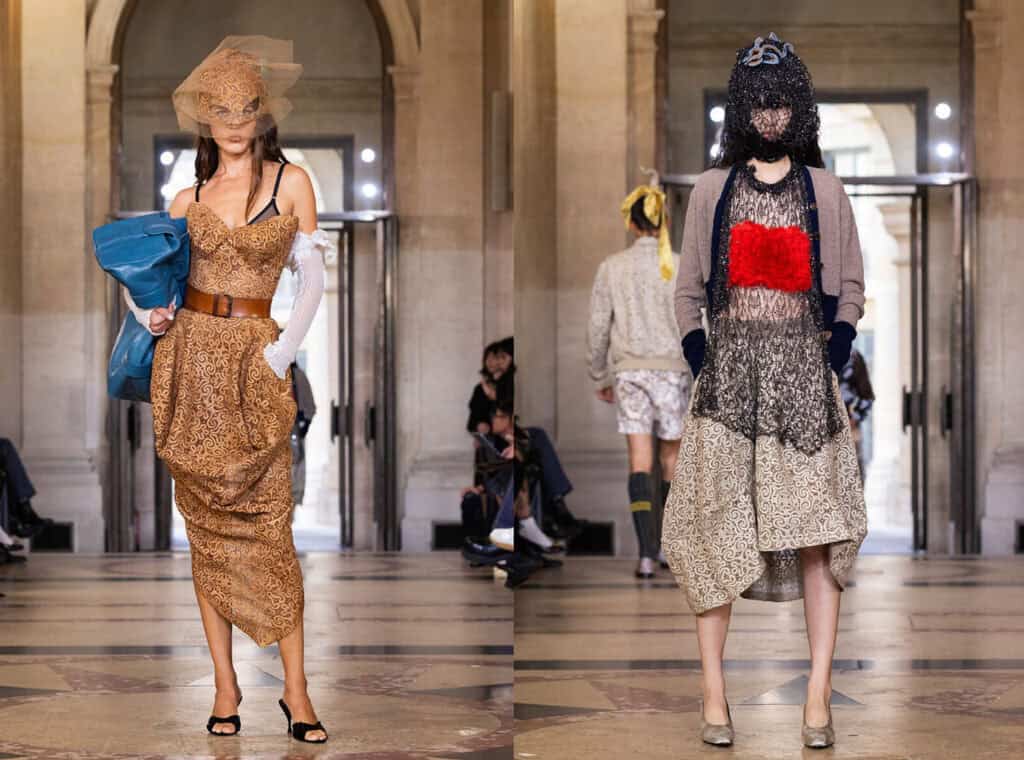
This vintage refurbishing was a way of being capitalist against capitalism, a statement that could be worn by its consumers. Material protest was integral to Westwood’s marriage with the punk movement. Popularised in the 70s during a severe economic recession, Westwood punks wore S&M leather, metal spikes, ripped clothes held together by safety pins. Think the iconic “God Save The Queen” tee with a slash through Her Majesty’s eyes and mouth.
Punk music was successful, sparking political and public outcry. Corporations realised they could sell the feeling of rebellion by selling rebellious imagery. By oversaturating these images in the market, they could negate or distract from their origin.
The issue, later vocalised by Westwood, was that punk subculture in fashion became the thing it protested: a marketing opportunity. Punk’s stylistics were not simply adopted into the mainstream – they became a substitute for punk action and ethos. Thus, the seal was broken for punk’s aesthetic commodification and subsequent reproduction, just one example of how revolutionary movements are co-opted by the systems they protest.
In 2020, two years before her death, there was a Westwood renaissance. Knockoffs of her crowned orb necklace started selling like candy on TikTok shops, partly due to a trending audio from the anime Nana, whose characters consistently wore Vivienne’s brand. Trending audios and clips reproduced the orb-and-satellite symbol in starlight across people’s screens.
Fast-fashion markets seized the opportunity to extract the symbol and resell it for cheap. In turn, they sold a feeling of relevance: a flash of high fashion just above the collarbones, and for a fraction of the price. Consumers devoured the accessory, which now stood as a status symbol of being versed in both fashion and entertainment.
The success of both aesthetics was enough to inspire a Westwood x Nana collaboration this year, a prêt-à-porter capsule collection. As explained in the author’s statement, “Since its inception, NANA and Vivienne Westwood have shared an enduring reverence for self-expression—a realm where style becomes an extension of character.”
But it was not purely self-expression that was being sold on the TikTok shop, nor is it what’s being sold now; it is primarily the trendiness that consumers want to purchase, the driving force behind its market success and fast fashion’s affluence.
Today – just as yesterday, or last decade, or the ‘70s with its Sex Pistols punks – this wielding of collective culture has direct impacts on the individual, and it appears in ways that appeal to our hunger for the new.
A critical flaw of the fashion industry is that it intensifies cycles of production, consumption, and disposal fabricating a superficial sense of identity – materialism. It presents the false belief that a certain life can be attained through items alone, and that new materials must be constantly sought so that an evolving life can be sustained. On social media, this extends beyond what you wear to what you do, the objects you present, the novelty you contribute to the feed.
Consumption is integral to capitalism. But this is exactly what Westwood resented: consumption taking the place of culture.
In her profile “I Do Things That Irritate People” Westwood lamented: “The world’s forgotten more than it knows. Consumption is about throwing away the past. But to engage with the world we must engage with the past through art and reading. It gives you a critique of your own life, and you realise: ‘I’m not doing anything. Human beings are capable of amazing things and I’m just sucking things up.”
But what is culture in an age of hyperconsumption? It cannot simply be the aesthetic we adhere to, nor the altar of endless absorption we seek on the internet, but these have become our most heroicised cultural sources.
It is helpful, then, to remember Westwood’s advice when we seek to create something new, engage in our community, or even develop our personal style – all individual actions that shape our local and wider environs: go outside ourselves. Go to art and history and others instead.
Westwood was correct that we must be more mindful of what we take in as consumers, but significant change ultimately comes from the fashion domain and the systems that propagate it. How that is being sold is critical. Her brand’s mission urged her audience to buy less and make their clothing last. She knew this well enough—she had been DIY’ing and recycling since “Let it Rock”.
Westwood is a brand that still prides itself on the sustainability Vivienne preached, but its claims do not negate the severe damage it contributes. According to the City Diplomacy Lab, fashion accounts for 2% of global GDP, but generates up to 10% of greenhouse gas emissions, 20% of water pollution, and 35% of ocean microplastics, while only 1% of textiles are recycled. Considering the brand’s low sustainability scores, its industrial actions do not match the environmental activism of its namesake.
Fashion as a monolith sits at the helm of cultural transformation while it undergoes its own capitalist mutations. We as shoppers are standing in the red-light splash zone.
But that Saturday at L’Institut de France, the crowd’s coloured apparel stuck out like lightning against stone. Those of us waiting outside Vivienne Westwood were there because we love the woman and the brand, but really, we also love the sense of individuality that emanates from her style. Speaking for myself, I wanted that unique spirit which accompanied a Westwood piece – action in the form of an orb-and-satellite necklace, one that my teenage self purchased in pink for approximately eleven pounds.