
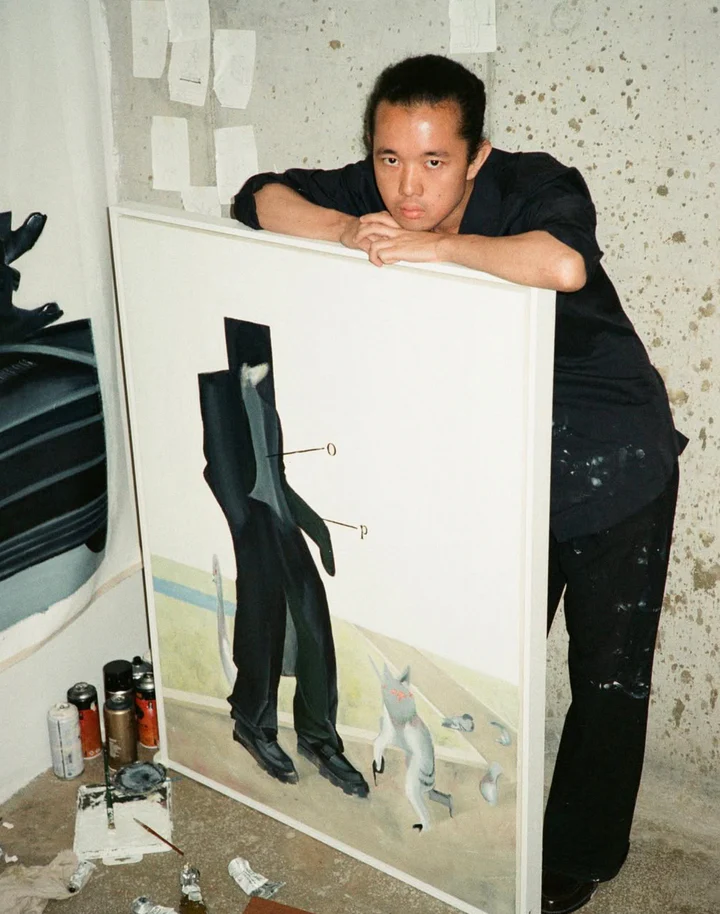
In a city that feeds on reinvention, where the paint never quite dries on the walls of East London, Yutaro Inagaki moves like a quiet beat beneath a neon hum. Somewhere between the flash and the carnage, he sketches the rhythm of the modern city. The 27-year-old Japanese artist, now based in London, constructs worlds that look familiar and alien all at once: sleek humanoid figures sheathed in black synthetic skins, faceless yet intimate, wandering through the burnished debris of modern urban life.
Born in the late ‘90s in a quiet suburb outside Tokyo, Inagaki’s earliest memories are not of galleries or classrooms , but of the city’s persistent, flickering spirit. The narrow streets smelled faintly of yakitori smoke and rain on asphalt. Meanwhile, vending machines glowed like small lanterns at every corner, offering warm drinks to hurried commuters. Fluorescent lights spilled over concrete stairwells and canalized alleyways, casting long shadows where salarymen and schoolchildren crossed paths.
As a teenager, Inagaki’s first creative acts unfolded here – in hidden corners and backstreets where graffiti could bloom unnoticed, a quiet rebellion against the order and conformity that structured daily life. “Graffiti in Tokyo is totally different from London,” he says. “You get caught once, and it’s game over.”
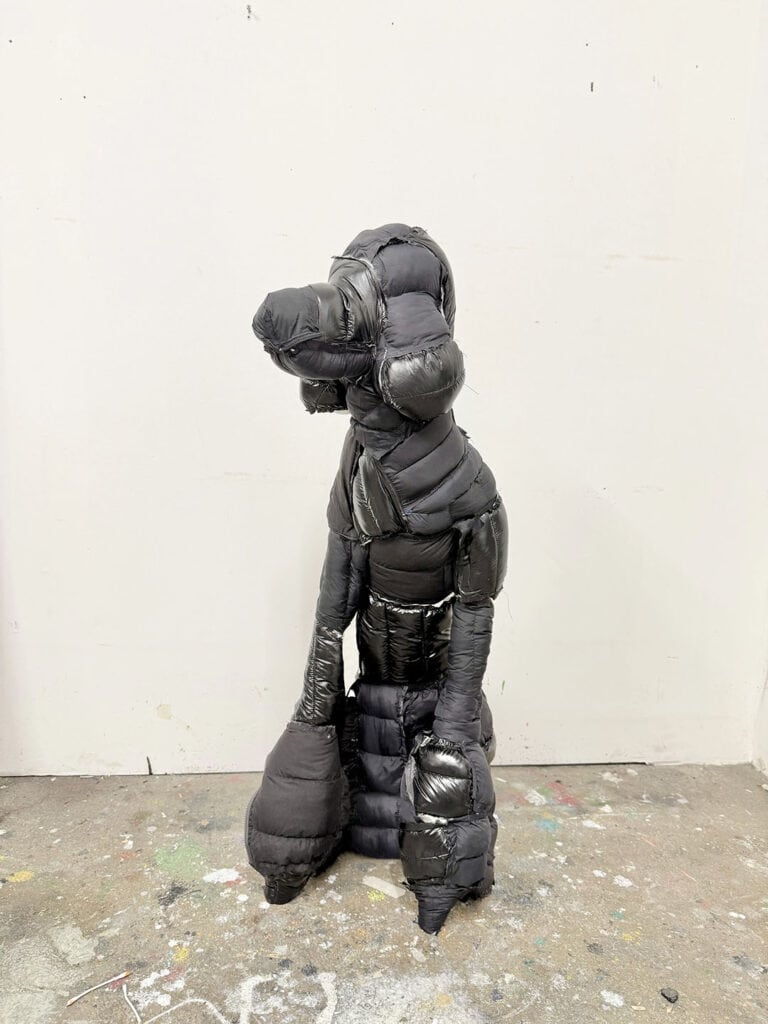
That edge and tension never left his work. His current practice – encompassing painting, sculpture, and installation still carries the residue of urban exploration: a sense of risk, a fascination with surfaces, a constant negotiation between concealment and exposure.
Inagaki’s figures, often rendered in deep blacks or industrial materials like puffer jackets, foam clay, and aluminium foil – inhabit a world of synthetic realism. They might be human; they might not. Regardless, they seem to breathe with a mechanical rhythm, as if animated by the pulse of the city itself. “I’ve always been into sci-fi,” he says, referencing Akira and Ghost in the Shell as formative influences. “I’m drawn to that ‘in-between’ feeling – not quite human, not quite machine. Maybe that’s what we are now.”
It’s this space, the threshold between person and collective, intimacy and anonymity – that defines Inagaki’s art. In a sense, his practice is an archaeology of the present, a study of what it means to be human in a world that increasingly feels post-human.
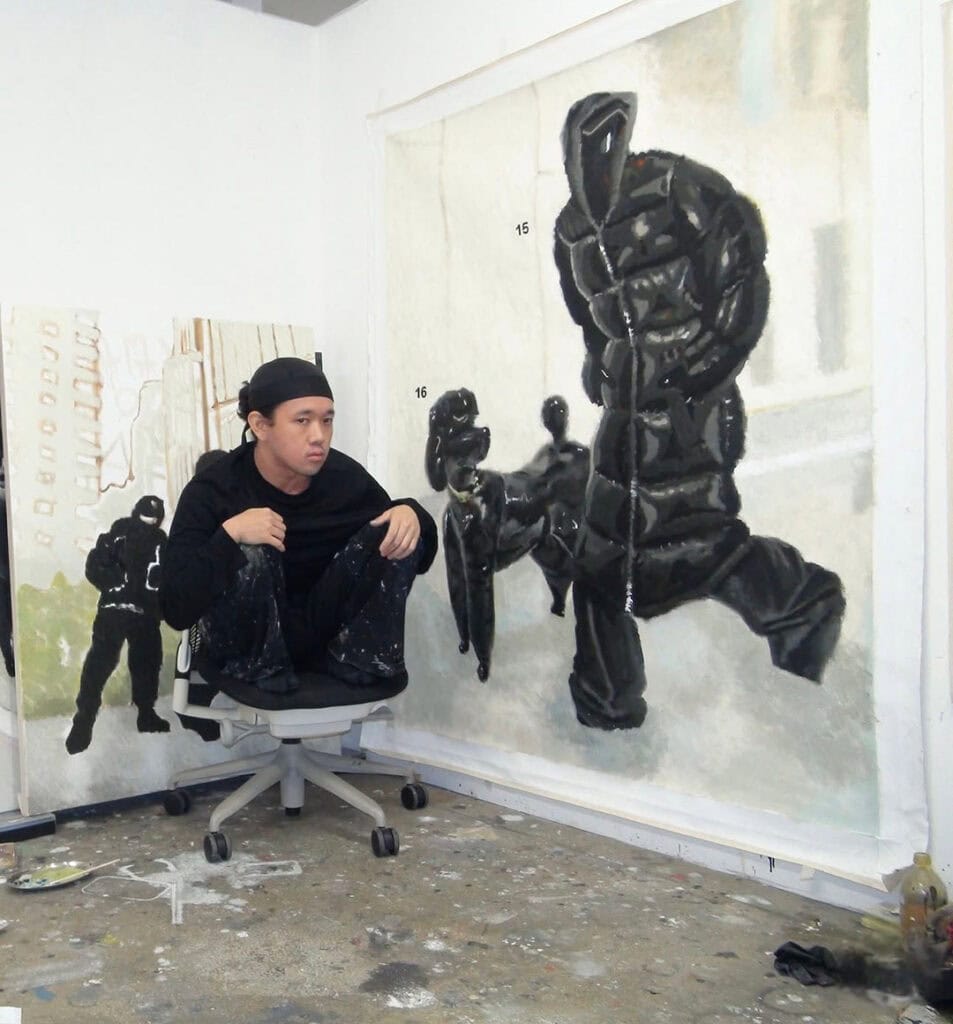
Growing up in Japan, where the social fabric prizes harmony over individuality, Inagaki learned early how difference could feel like dissonance. “Standing out is a big no-no,” he recalls. “I had allergies, curly hair- just little things, but they made me feel out of sync. That sense of being different, it sticks with you.” Those formative frictions now translate into his fascination with collective identity – and the ways cities compress, distort, or dissolve it.
His current series of dog sculptures, DOG B, takes this metaphor further. Each canine form is cloaked in a black puffer jacket, both armor and insulation, survival gear for what Inagaki calls our “winter era.” “A puffer jacket is warm and fluffy, but it also feels like protection,” he says. “It’s something you need to survive in the city. Economically, politically, even culturally – it feels like we’re all walking through winter right now.”
For Inagaki, cities like Tokyo, Moscow, and London are not just backdrops but emotional climates, each with its own temperature, its own breeds of isolation and connection. “In Japan, it’s about blending in; in London, it’s about standing out; in Moscow, it’s about endurance,” he muses. “Together they form three poles of what a big city can be.”
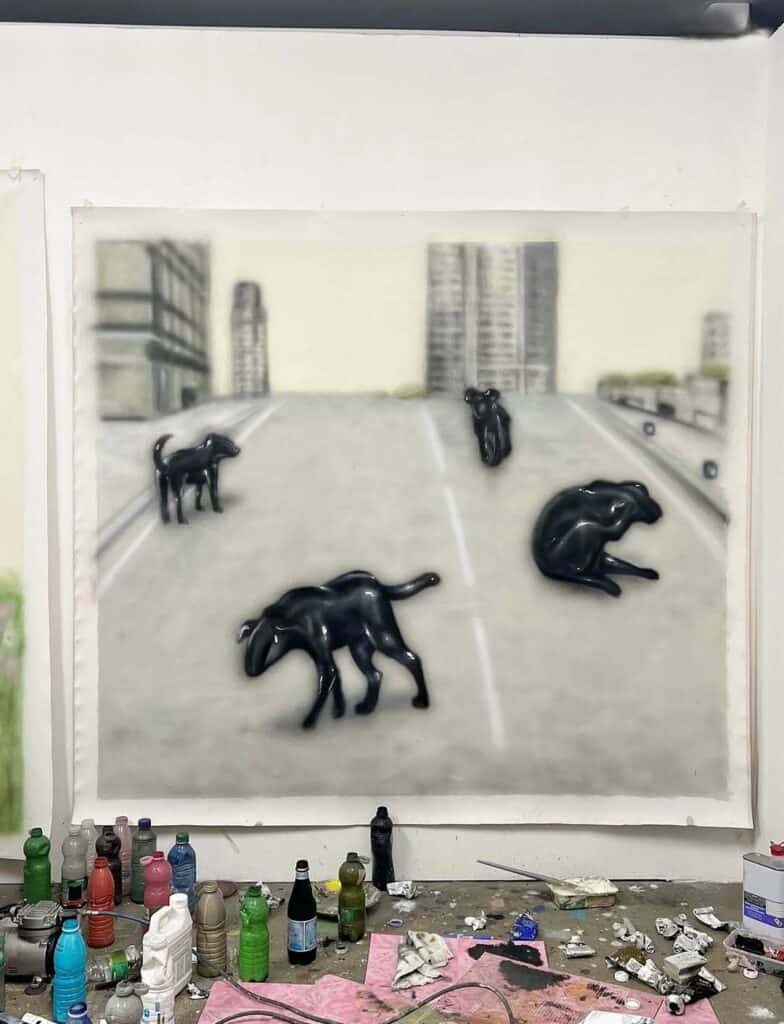
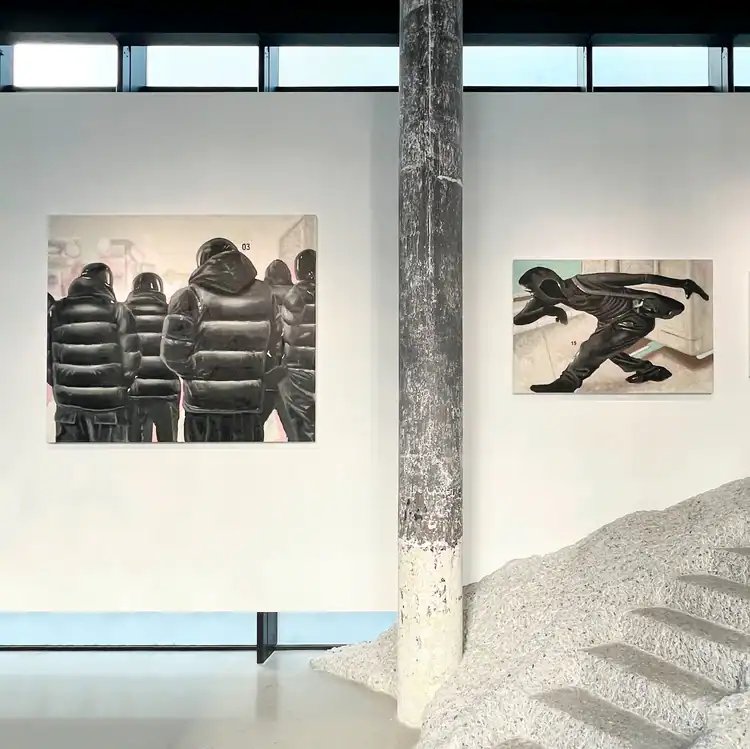
His art, then, becomes a cartography of modern existence – mapping the invisible frictions between people, the weight of systems. Where George Condo’s “Artificial Realism” sought to expose the constructed nature of human psychology, Inagaki’s version situates the artificiality within the architecture of a city. “I’m not interested in realism as copying reality,” he says. “I want to paint the artificial reality that humans have built – this plastic, psychological, urban landscape we live in.”
And yet, despite the cold surfaces, there’s something deeply human in Inagaki’s work, a yearning, a quiet melancholy and an empathy for the lonely shapes wandering through his imagined cities. His figures, faceless and glossy – still manage to feel vulnerable. They hold within them the same paradox that defines urban life: the coexistence of anonymity and intimacy.
Inagaki’s figures hover somewhere between human and machine, softness and survival. They carry the temperature of modern life – beautiful, synthetic, a little lonely. His world isn’t a warning or a dream. It’s just the one we already live in.