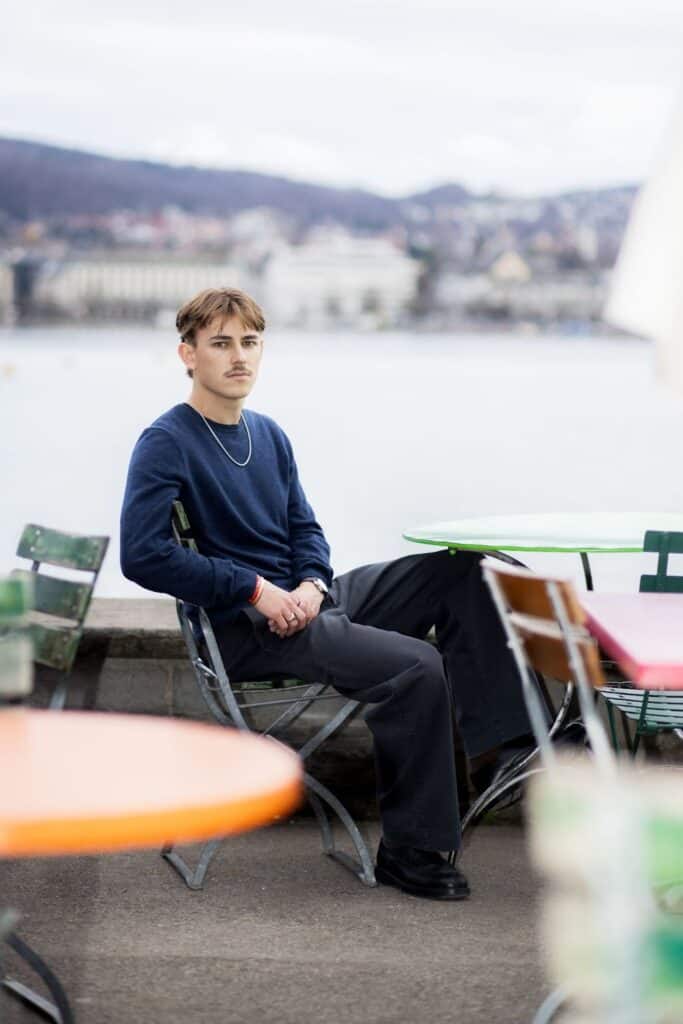
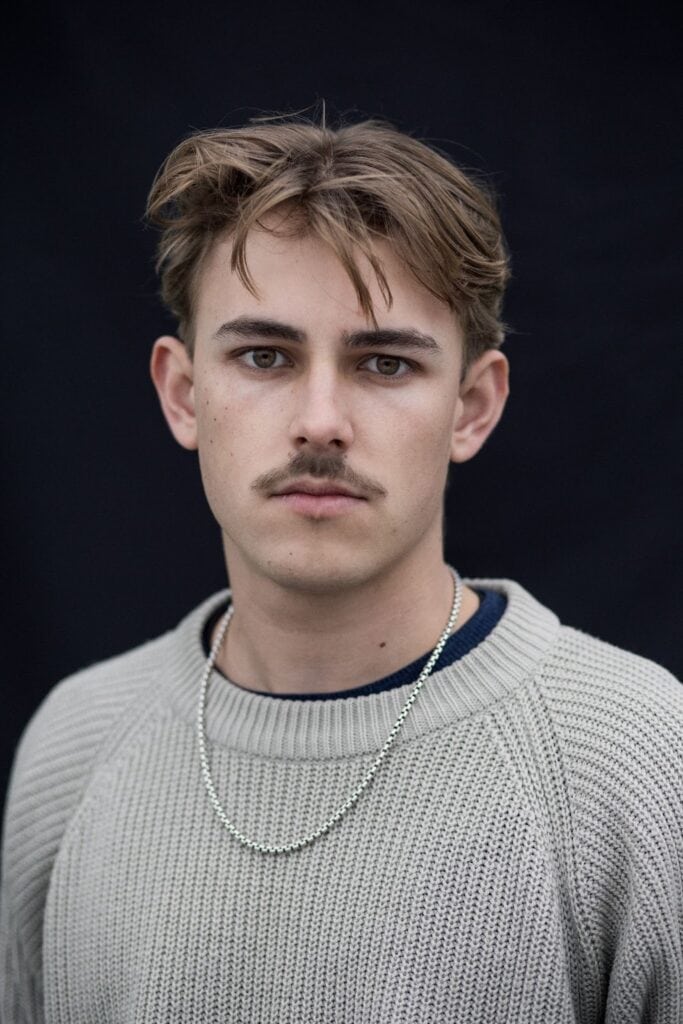
“He’s a sensation in Germany;” “His book sold out in Cologne;” “And he’s only 22!” It all sounds like something a friend might whisper to you about a stranger in an art gallery, or in a crowded pub about their professor. But, for author Nelio Biedermann, it’s just his life.
A Zurich native, Biedermann really was born in 2003 and, when he pings onto my laptop screen on a cloudy March afternoon, I see kind eyes and a slight smile – none of the gravitas you might expect from this literary star, if you were familiar with the pages of the Süddeutsche Zeitung.
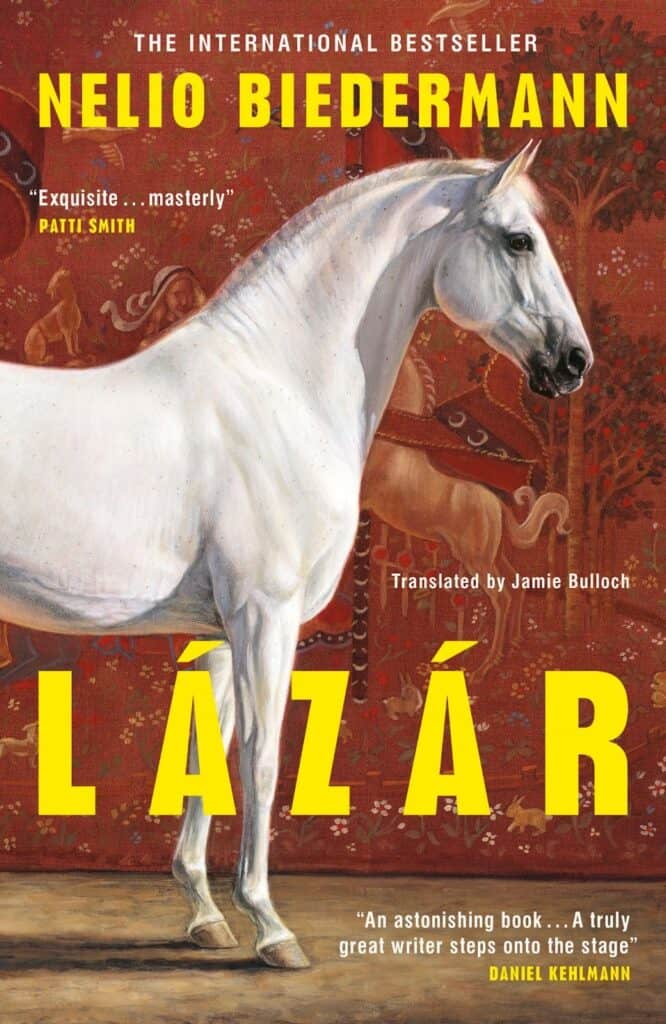
Lázár is the rocket that has carried this 22 year old into the stratosphere. A tale of war, and magical realism, this book traces four generations of an aristocratic Hungarian family from the beginning of the twentieth century to the Hungarian National Uprising of 1956. There are castles and dark forests, battlefields, bombs, and snowy Swiss mountains – but most of all, Lázár offers razor-sharp insight into the ways lives can be changed, not by international politics, but by a look, a letter, by the way leaves shake in the wind. It’s an elegy of the everyday, and a kiss blown to past generations of Biedermann’s family.
It’s no wonder this 2025 title has taken Middle Europe by storm. And with over 25 translations in the works, it will soon be taking over the world. Thanks to translator Jamie Bulloch, twice winner of the Schlegel-Tieck prize for German to English translations, Lázár hit U.K. shelves on 26 March.
Ahead of its release, we sat down with Biedermann to discuss how to write a family epic, the power of translation, and what it feels like to go international.
The Cold Magazine (CM): You have the UK launch of Lázár coming up very soon. How are you feeling?
Nelio Biedermann (NB): I’m very excited. I’m not as nervous as I was with the German publication – I think because it went so well. Now I feel more relaxed. Everything that’s happening now, all of the translations that are soon to come out, feel like nice add-ons.
CM: Take me through the process of translation. Is there a sense that the English version of Lázár is an entirely different book?
NB: It is different. German is a very different language – it has a certain heaviness, and the book is about 80 pages longer in German. The English version is a bit lighter, just because of the language.
But I love the English translation. For me, as the writer, it almost feels like a different book – even though I know the story, of course. It reads differently, and I enjoy that. I think Jamie did a really great job in translation. It wasn’t easy, especially because of the tone and the lyrical passages, but he handled it very well.
CM: I’ve only read the English version, but I agree, there is a lyricism that really comes through. There’s something essential about your style that survives the translation.
NB: That’s nice to hear. I think so, too. Of course, I have to trust the translators, especially in languages I don’t speak. I always told them that they can reach out to me if they have any questions and they did. Through these questions, I really got a sense of how deeply they cared – how much they were inside the book, inside its themes and history.
CM: Stepping outside of the book itself for a moment, there’s been so much attention on how young you are, and how assured the writing is. The German press had heralded you as a new literary star. It’s striking to think Lázár likely began as a very private project – something you were writing alone in your room.
NB: I actually wrote it by hand.
CM: Really?
NB: Yes, in my bedroom. It’s my second book, and the first I wrote on the computer, but whenever I got stuck I switched to writing by hand. I realised it helped my process, so with this book I did everything that way.
It’s a slower process. It feels more like creating something, rather than just typing. I would write in the evening, then transcribe it the next day. So the version I sent to my agent was already almost a second draft. That really helped the process.
CM: That’s so interesting. And the novel is full of writers, and reflections on writing. There’s a moment where a character looks at the hands of a famous playwright and thinks, those are not the hands of a writer. What were you thinking when you wrote that?
NB: I like contradictions. People have very idealised ideas about what a writer is – what they look like, how they live. But it’s not like that. I mean, Carl Zuckmeyer, the playwright in that passage, of course, was actually a writer, but he did not look like the typical writer you have in mind, I think. Like Hemingway – he also didn’t look like a writer.
I’ve experienced that myself. People imagine writers as older, more established figures. Now that I’m a writer, I can look behind the curtain of those images, and in the book I wanted to deconstruct that stereotype a little.
CM: Being a writer comes with great power. You have immense power over your characters, and there is real tragedy in the novel.
NB: While writing, I sometimes felt a kind of guilt towards my characters – because I let them go through all these terrible things. Of course, I’m the one in charge and I could have saved them. That feeling is in the book as well: the idea of the writer as someone who plays with lives.
But later, while reading from the book, I realised it’s not really like that. It felt as though there was someone sitting behind me who knows what has to happen. I couldn’t save them, because history didn’t save them. It went like this and I had to tell it in this way.
CM: And yet the ending offers a kind of hope.
NB: I always knew I wanted an ending that wasn’t exactly a happy ending, but was hopeful. The book can feel quite claustrophobic, so I wanted to end with something more open.
Leaving readers with the feeling that these characters were on a precipice, with the old world behind them and the new world in front, was very important to me. It’s inspired by my own family’s story. They fled Hungary and moved to Switzerland, and I knew I wanted to end there, with a sense of hope attached to this particular place.
CM: You end with two characters entering Zurich in midwinter, and it’s almost like the whiteness of the landscape is, literally, a blank slate for these characters and their descendants to write on – to start anew. Was there a lot of family research involved in writing the novel?
NB: At first, I thought I wouldn’t need much. I had all these family stories from childhood. But after a few months, I realised it wasn’t enough. Often, what I really needed to know were the small details that help create atmosphere.
So I went to Budapest, where my great-uncle still lives. He could tell me a lot about the time back then, because he experienced it himself. He also has a kind of family archive that includes photographs and documents. I could ask him about everything, like what people ate, how they dressed, how they spoke. Those details were essential in my writing process.
I also read a lot, both historical material and literature from that period. That helped me find the tone. I knew the style had to feel, in some sense, classical, but also carry a modern perspective.
CM: Exactly. Speaking of a modern perspective, there’s a tension in the novel between romanticising the past and laying bare its darker sides. We follow these characters through really ghastly times in history, including two World Wars, the Holocaust, uprisings, and revolutions. Were you at all nervous to tackle these topics, all from the eyes of the ruling class, no less?
NB: In my family, the stories were often romanticised, as they are in many families. People tend to tell only the good stories. But I always knew there had to be another side. I hope the novel shows both.
It was difficult, because in my research I was often confronted with those idealised versions. But the darker elements are just as important.
CM: There’s also a pervasive sense of loss in the book. Every character must say goodbye to something irreplaceable – to a mother, to a house, to a city. How did you navigate the emotional weight of these losses? Do you feel like generational trauma, or memory, played a part in your depiction?
NB: It’s difficult to tell. I don’t feel as though I’ve lost something, or that I want to return to that world. I’m glad that I didn’t grow up in a castle and that I didn’t grow up with all of this wealth. But I recognised those feelings in my family – in my great-uncle, my grandmother, my father.
You have a sense of having lost something that belonged to you and belonged to the family, and now it’s in different hands.I think it helped that I had some distance from those emotions. I could reflect on them, without being overwhelmed by them.
CM: That distance seems tied to the narrative voice, that slightly detached, almost omniscient perspective.
NB: It took time to find that voice. The book that’s now being published is actually my fifth attempt at telling this story. I started writing when I was 16. One of the first stories that I wanted to tell was this family inspired story, but I always had the sense of not being able to do it justice and not managing to get across my vision of the story. So I started again and again and again.
And in this process of trying, I really played with all of these different variations of telling the story. And then with the fifth attempt, I, almost out of nowhere, had this first sentence that is now still in the book. And I knew it could work.
CM: There’s a deep love for literature running through this book. Your characters’ lives are changed by literature, by reading Virginia Woolf, Proust, Kafka, E.T.A Hoffmann. I was moved by the way you depicted literature as this powerful force. Did you feel like that was a bit of yourself seeping through?
NB: Of course. I don’t think it’s a coincidence that in a lot of books, the characters are writers or readers because you always tend to write about what and how you experience the world yourself.
It’s also an homage to the writers who inspired me. In the novel, literature is almost like another character. It intervenes, it changes people’s lives. I like that idea: that reading can be transformative.
CM: There’s a moment where one of your young female characters reads A Room of One’s Own and feels something in her shift permanently. It’s such a precise emotional experience and felt very relatable to me, personally, as a Woolf megafan. What was your process in crafting these rich female characters?
NB: At the core, we are all the same, and it doesn’t really matter if you’re male or female or if you’re born in London or in Zurich or anywhere else. How we experience the world is, I think, pretty similar. This enabled me to have the courage to write female characters.
And of course, I read a lot of literature written by women. I also showed the book to women in my life including my mother, my sister, my female friends, and my girlfriend, so they could tell me if something felt wrong.
CM: What did your family make of the book?
NB: It was important to me that they understood it as fiction. The characters live through the history that my family experienced, but these characters are not representations of my real family. That made it easier. They’re all very proud. My great-uncle is waiting for the Hungarian translation.
CM: That must be so exciting. In the press, the book is often categorized as this great, historical epic, or a family saga. However, what stood out to me are the smaller, intimate moments. You’re telling very human, and at times very small, stories within this larger framework.
NB: Thank you. That was my main goal. I really wanted to focus on my characters’ private lives and show how, at times, the characters care more about their private life than they do about these big historical events.
They are invested in what they can control – their own life and the people they love, how they express love, and also how they betray each other. At the end of the day, I’m not a historian and I’m 22 years old. I don’t have the capacity to say very smart things about these historical events, but I can show how they affected daily life and people. I didn’t live during these times, but I know how families work.
CM: Finally, the book has already reached so many readers. Is there anything you feel has been overlooked? Something we’re all missing?
NB: I don’t think readers have missed things, but perhaps the media – especially in Germany, with all the attention – didn’t always have the time to look as closely as I often wished they would. I hope that, with time and distance, people will notice more of the details.
Nelio Biedermann’s Lázár, published by Quercus Publishing, releases in the UK on 26 March 2026.