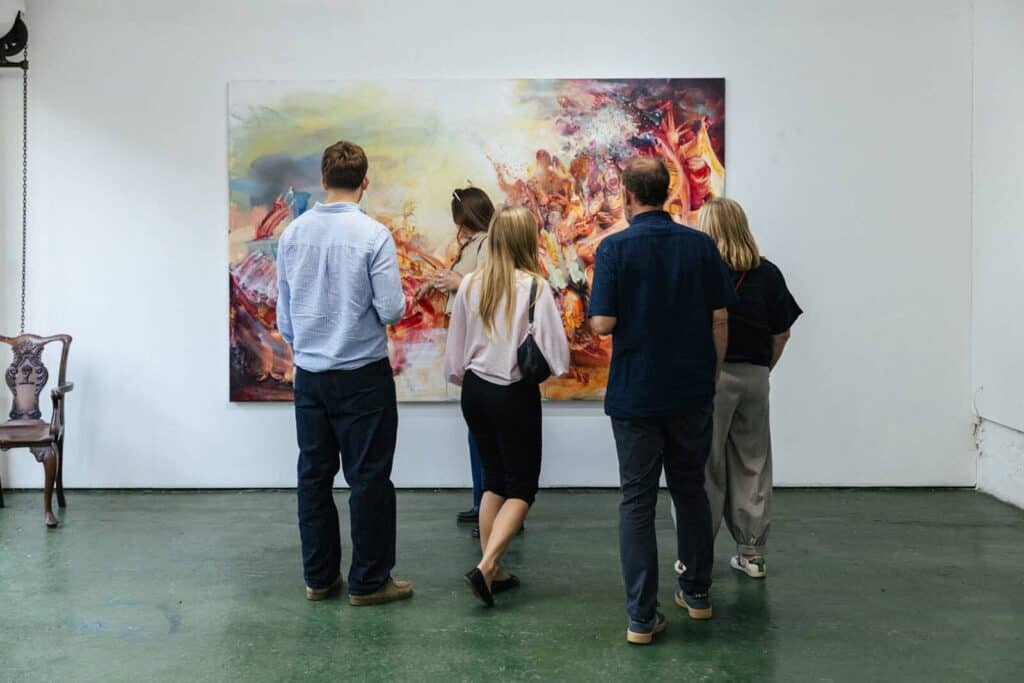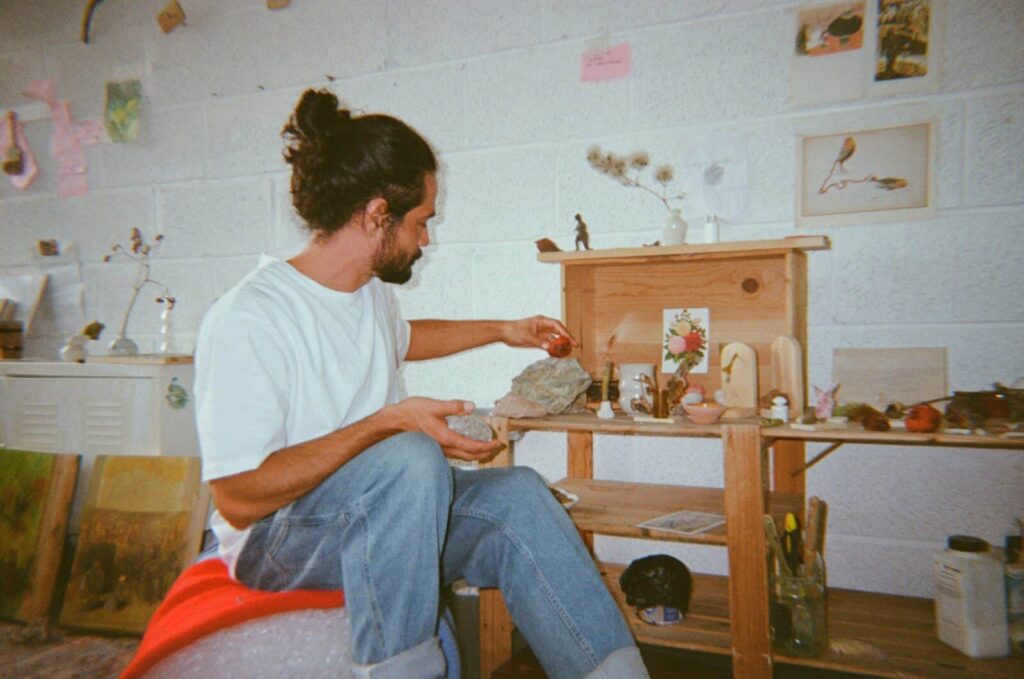
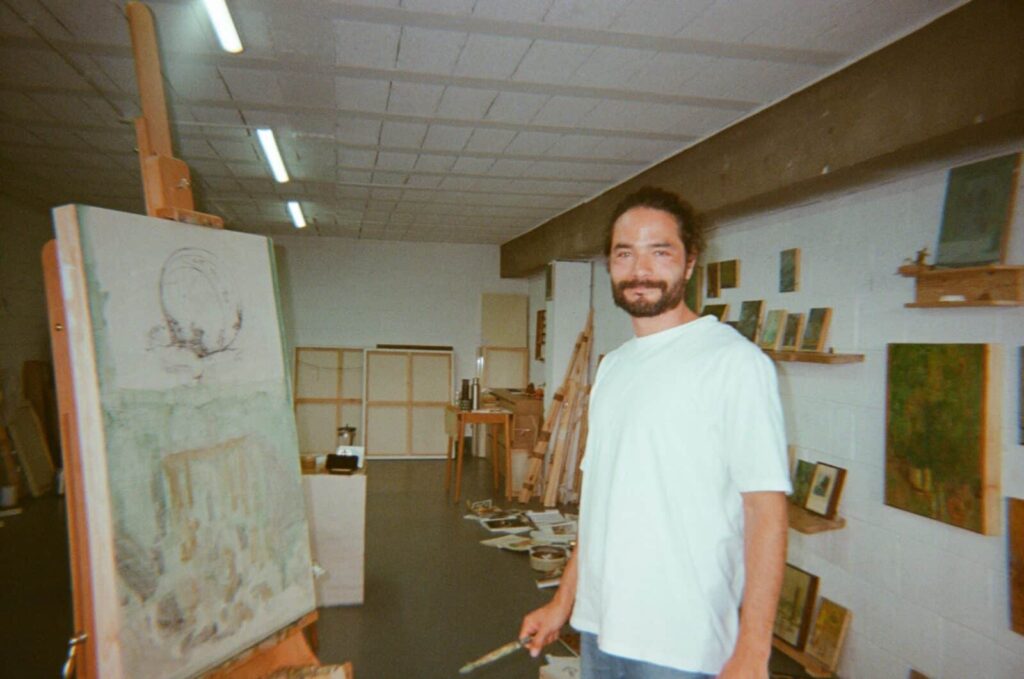
London-based Chilean painter Sebastián Espejo works through sustained attention to what is often overlooked. His paintings drift back to modest, unstable forms, lichens, shadows, and fragments of landscape. In this format, he depicts the process of creation, and the way it reverberates in our subconscious. Developed through glazing and layering, his surfaces resist immediate legibility, holding the viewer at a slower pace. Forcing further attention to detail, his works require the viewer to decipher, instead of merely view.
Across the body of work, questions of scale begin to surface. The same visual logic that structures organic growth appears to echo in his interpretation and usage of constellations. Here, scattered points are drawn into systems through a slower act of recognition. Rather than staging a direct comparison, Espejo allows these connections to emerge through process. Here, material decisions and perceptual shifts unfold over time.
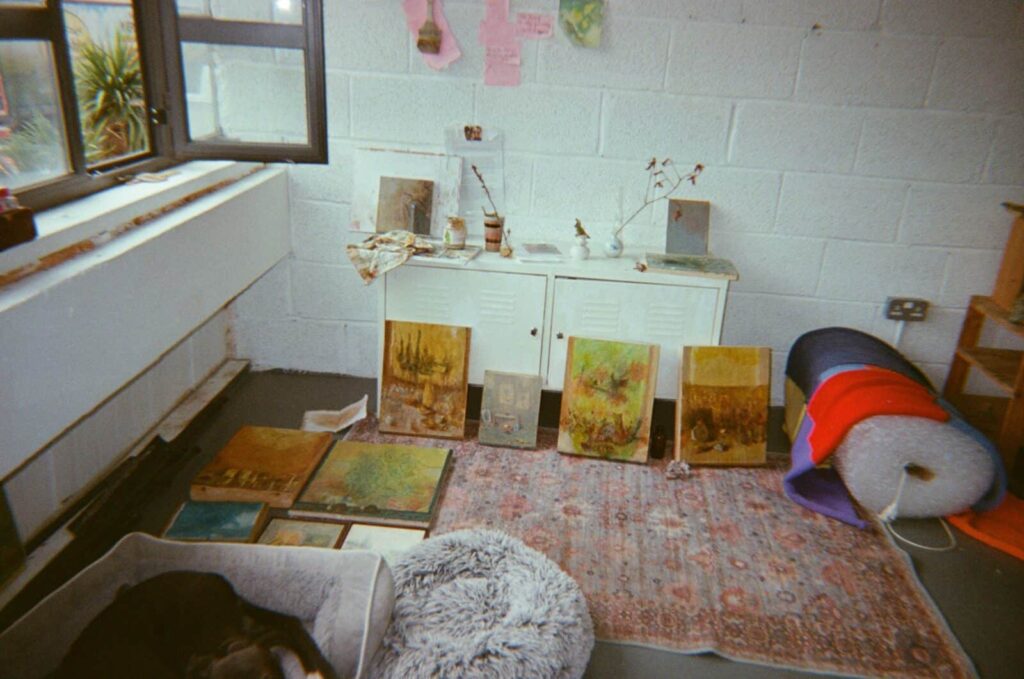
In Siluetas (2025–26), two vessel-like forms sit along a shallow horizontal line, without quite settling into focus. Espejo has spoken about revisiting the same set of objects, painting them again and again. Each time, familiarity settles in with shapes as they reappear slightly altered, aged, with that transience carried into works like Dogs (2025–26), where the viewer is reunited with the figures in a shifted setting. Espejo lends us an intimacy formed through this sustained, attentive process of return, held together by an enveloping, warm palette.
In the following conversation, Espejo reflects on painting as a space shaped by repetition, uncertainty, and the unstable relationship between observation and meaning.
The Cold Magazine (CM): You started painting at a very young age, around six. How did those early experiences shape your relationship to painting before theory came into play?
Sebastián Espejo (SE): It was a place of joy, but also of failure, and even competition with my brother and my family. I’m the youngest of two siblings, and I wanted to paint figures and paint realistically, which, of course, was difficult for a child. So I felt this sense of failure. In the end, that failure became a source of energy. It was frustrating, but I think that frustration was the crucial element that kept me on this path.
I never felt I had a natural gift or talent, quite the opposite. For my brother, everything came easily, and he didn’t care too much. I think good paintings often come from that place of ease. For me, I found joy in small whims and gradual improvements.
My teacher, Sergio, simply provided me with large canvases, some acrylics, and a space to make a mess, nothing more. He was very conscious of how many elements and variables he introduced. At the beginning, he gave me just three pigments, then slowly added another. I always wanted to paint with oils, but he kept me away from them for years. He wasn’t teaching techniques or how to draw; instead, he sustained a sense of excitement by carefully introducing new elements over time, which helped keep that feeling of frustration at bay.

CM: Reflecting back on your education at the Pontificia Universidad Católica de Chile – what stayed with you, and what did you consciously have to unlearn?
SE: I feel that the process of learning has been feeding my unconscious mind. I keep that. I try to protect it, the openness of my mind. These theoretical foundations, which at a certain point felt constraining, are now something I can’t imagine my practice without. I’m not able to judge them as something negative.
CV: You’ve spoken about reclaiming beauty as a legitimate artistic drive, especially after it was treated with suspicion during your academic training. Do you think beauty remains a contested concept in contemporary art?
SE: I think this might be changing a little now. When I was doing my undergraduate degree, it was almost forbidden to think about beauty. It would have been very provocative to make something simply because you found it beautiful.
This question reminds me of a quote from The Domain of Arnheim: “He admitted but four elementary principles… the love of woman… living outside… the contempt of ambition… and the creation of a new beauty.”
I came across it through a Chilean TV literature series called La nueva belleza, “the new beauty”, which opens with: “El amor de una mujer, la vida al aire libre, la ausencia de toda ambición y la creación de una belleza nueva.” Julio Cortázar translated Poe and took some liberties; that’s his version.
There is such a long tradition in Western culture of relating beauty to truth and to the good, but beauty can be more than that. I can’t define when something is beautiful, and there is something very Platonic in that. Beauty is a condition of the material world, something contradictory, but I think it needs to be.
CM: How do you distinguish beauty from decoration or sentimentality in your practice?
SE: I try to avoid all sorts of decorative elements, and I try to avoid sentimentality.
CM: That’s interesting, because some of your works do evoke a certain sentimentality. Do you think that’s something that emerges after the work is complete, rather than something consciously considered during the process?
SE: I think it’s similar to my relationship with terms like creativity or originality. I don’t actively pursue them because if I keep them in mind, they create anxiety and expectations. With emotions and sentimentality, I know something will happen, but I don’t push it in any specific direction.
As part of the process, I often return to the painting and apply glazes of colour, mainly yellow. These are semi-translucent layers that produce different effects depending on the surface texture and temperature. You start to get these optical mixtures of colour, for example, if you apply a yellow glaze over blue, it becomes green, but not a very strong green. I’m very interested in what happens in that space, because while you control the action, the result is often unexpected.
If you imagine a pink glaze over a landscape, it will inevitably evoke a certain mood or atmosphere. So in some cases I am aware of that, but it’s more about the materiality and the relationships between colours through these optical mixtures.
CM: Your work seems very attentive to surface, texture; are you interested in that kind of haptic visuality in painting?
SE: Painting is a medium that can establish a relationship between time and materiality, and time often takes the form of different textures, through layers and applications. There is also an element I really love: the presence of the brushstroke as a signifier.
If we think in semiotic terms, it relates to the idea of the index, something that points to a physical presence, something that was there. There was contact. Like smoke indicating fire, or the track of a boar in the woodland.
There is something that imprints a quality onto the surface, and that is a haptic moment that becomes a signifier. This happens a lot in painting, it’s part of the sensuality of the medium.
CM: Your use of collage feels like an extension of that, where one trace is established and then another emerges alongside it, creating a kind of dialogue. Could you talk a bit about that process?
SE: In that process, there is something you can’t control anymore, that moment when a painting starts going beyond expectations. As you place elements together over time, they begin to form a dialogue. Then you return to the same painting and add another layer of dialogue. It becomes an exponential interaction, and it’s almost impossible to control. I think that’s the beauty of it.
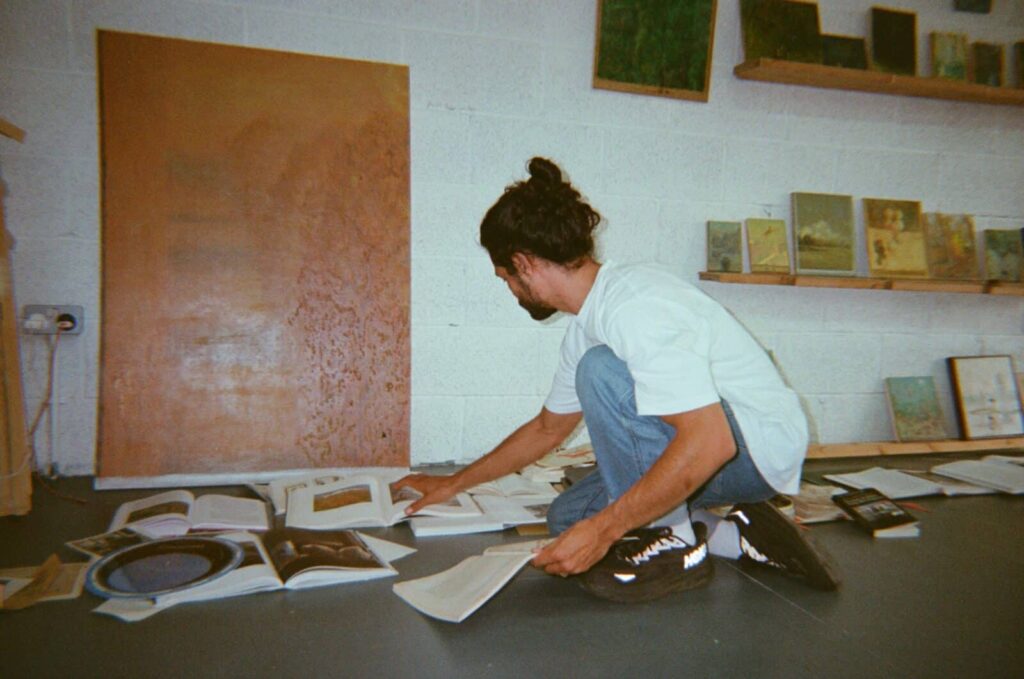
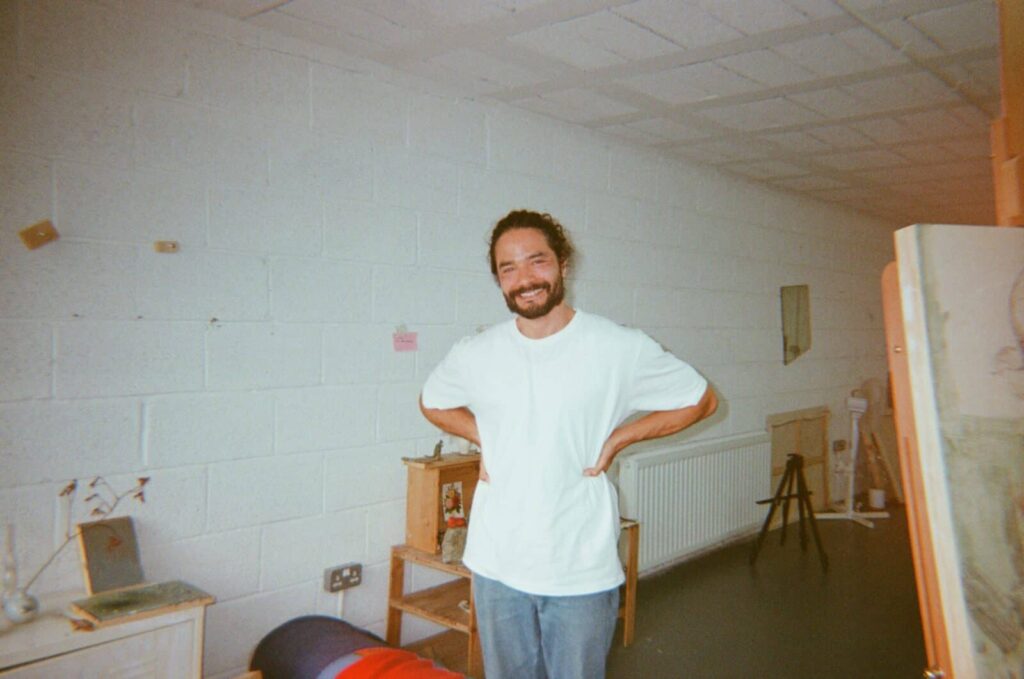
CM: You place emphasis on the act of observation. How do you understand its role in your practice, and in what ways does it shape the relationship between the observer, the object, and your sense of self?
SE: I constantly think about the place of the observer and what attending to something implies, in terms of implicit content and the translation of experience. There is an analytical way of understanding the creation of knowledge that is more aseptic, where the observer can be extracted from the equation. However, today there is another proposition. For example, in quantum physics, you are affecting what you observe. Observation is an experience that impacts the real world, the observed world, and, at the same time, what you observe affects you. This can also be framed philosophically through the ontological question of how much agency objects have. When thinking about objects and the role of the observer, there is a gap, but at the same time, something that unifies them. There is a distance that allows observation, yet simultaneously, you merge slightly with what you are observing. Returning to painting, this process contributes to building the self. The motifs of the objects shape or modify you to the point where your identity is also transformed.
CM: Do you think that’s connected with your return to the same set of objects? There’s a comfort with them.
SE: Because of time and repetition, they carry something that creates a sense of belonging. At the same time, I come to understand them more and more; they keep changing. Each time they are different, but they are also the same.
CM: You’ve referred to “shadow objects” and “shadow organisms.” What role do ambiguity and the unseen play in your work? It reminds me a bit of In Praise of Shadows by Junichiro Tanizaki: “Were it not for shadows there would be no beauty.”
SE: I think ambiguity is essential for art, it’s something you want to keep and nourish. It connects with the openness of description as a way of engaging with elements you cannot control. Shadow beings or objects are often more ambiguous because they inhabit corners or less-seen parts of the world. Lichens, for example, are harder to notice than leaves, they grow in undergrowth or darker spaces, and that ambiguity comes from not being able to describe clearly in the dark.
CM: In your work, there’s a simultaneous attention to the minuscule, like lichens, and the cosmic, like constellations. How do you navigate that spectrum, and could you share what drew you specifically to constellations?
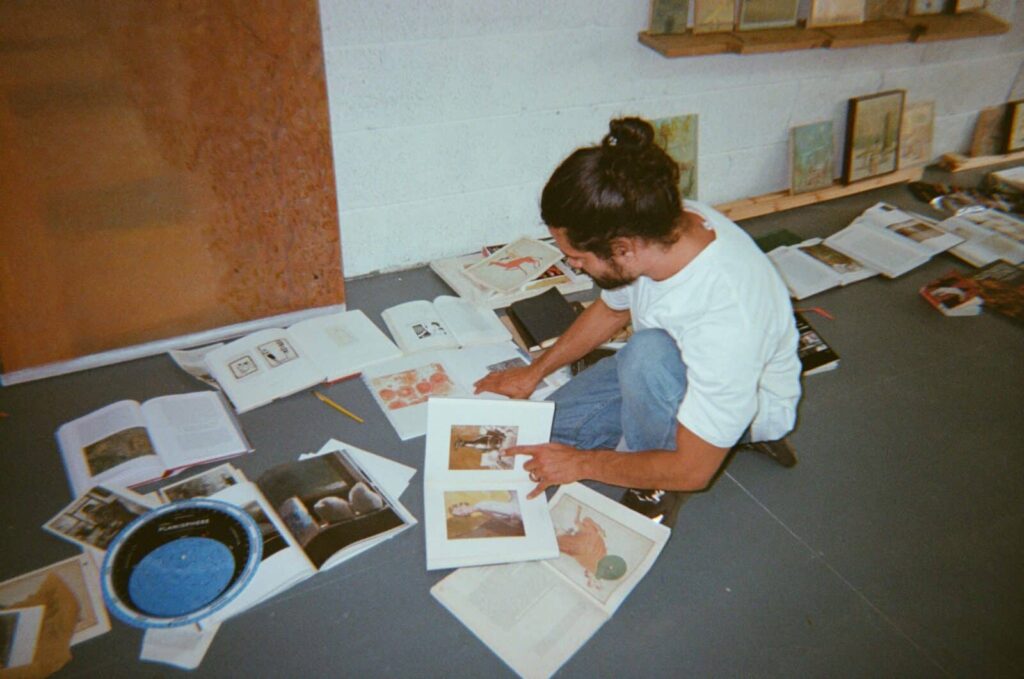
SE: I know very little about constellations; I know very little about lichens. Both fields are huge, and I feel incapable of mastering them. I’m just drawn to them. I spend time painting constellations and lichens, and reading a bit, but what fascinates me is how many layers of understanding underlie our notions of constellations.
There’s this process of extracting figures from the stars, from dots of light, and creating an idea in the mind’s eye. Humans have been doing that across cultures for ages. Constellations carry omens, mythologies, and histories. I think it connects with how we recognise patterns: by associating random elements, like stars, with stories or figures, we make them more memorable.
This feels similar to looking at a painting. You connect dots, establish relationships, and in doing so, you can read the image beyond its individual elements, whether it’s tracks, brushwork, or marks on the surface.