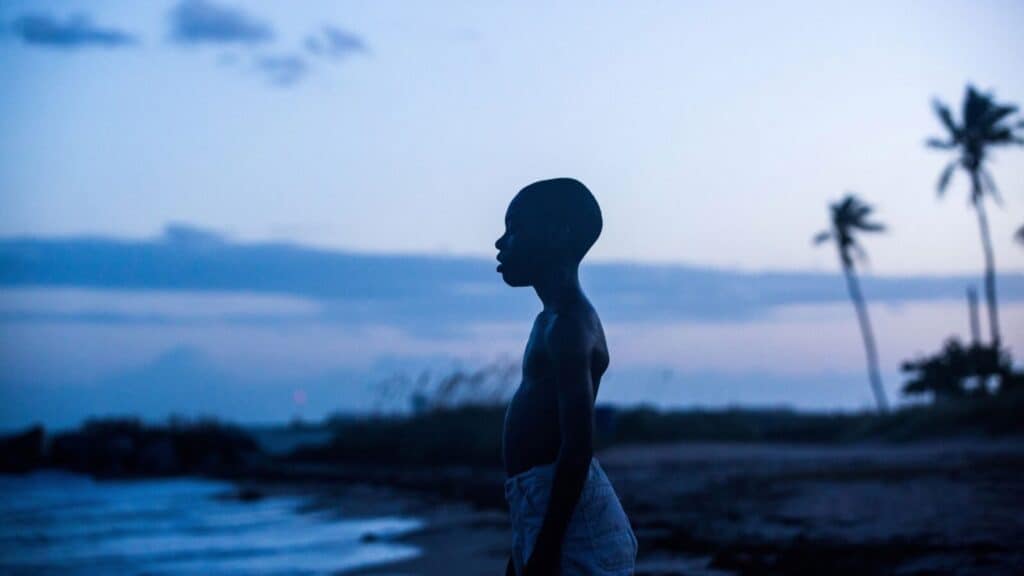
“In the Moonlight, Black boys look blue” is the title of Tarell Alvin McCraney’s unreleased play, a script that forms the blueprint for Moonlight (2016), the directorial breakout success of Barry Jenkins. Split into three stages, Moonlight details the childhood, teenage years, and early adulthood of Chiron, a young African American man juggling relationships with family, lovers, and friends. Now a decade old and widely celebrated, the film sits against a shifting socio-political backdrop.
Today, its teachings on masculinity and sexuality still hold, yet they’re met by an increasingly prevalent online manosphere, governed by opportunistic “thought leaders”, and the reality that a second Trump presidency was partially catapulted to victory by black male votes. Moonlight is well overdue for a revisit, and an inquiry into whether, in the moonlight, black boys look red?
Set in 1980s Liberty City, Miami, amongst the crack cocaine epidemic, we first meet a young Chiron, then known as Little, seeking refuge from bullies in an abandoned crack house. Juan, a local drug lord, discovers Little and takes him under his wing, compensating for the neglect of his absent mother. Their relationship is not without contradiction. Little’s abandonment is in large part due to his mother’s crack addiction, an addiction that is sustained by her local dealer, Juan. The inherent perversion is not intended to undermine Juan’s generosity; Jenkins uses it throughout the film as a proxy for Little’s growth.
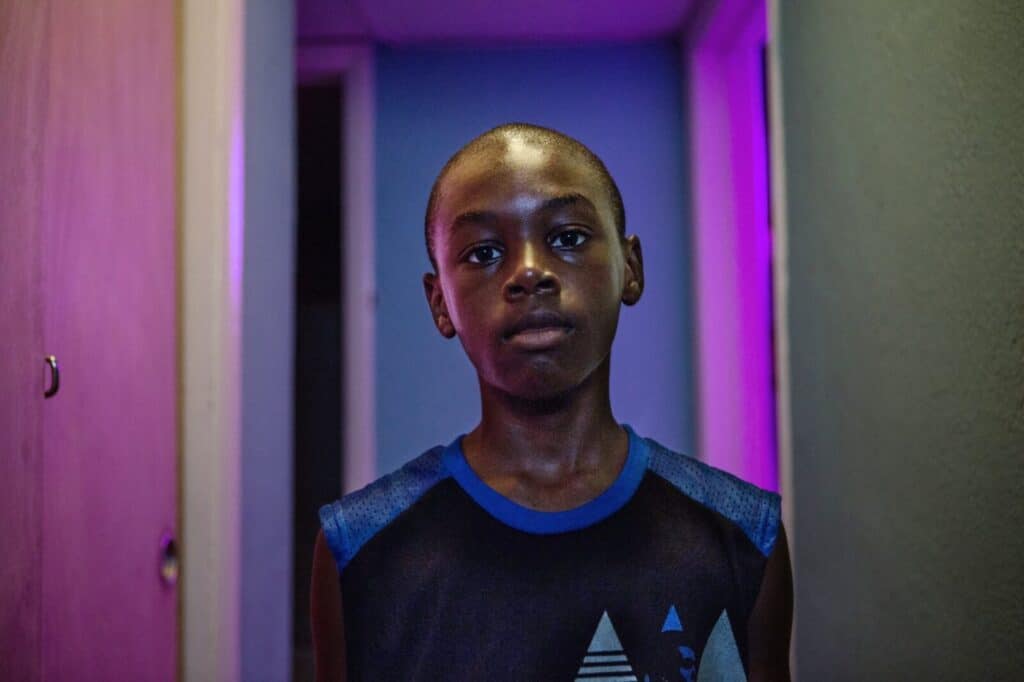
In an intimate scene between Little and Juan, the latter recounts the story of his childhood in Cuba, of how he would play in the moonlight without shoes, like our protagonist, Chiron. Juan remembers how an old lady stopped him and said, “In the moonlight, black boys look blue, you blue.” “So you blue?” Little asks, to which Juan replies, “Nah, you gotta decide for yourself who you wanna be”. Whilst Juan’s character is limited to the film’s first act, his teachings on masculinity tether the film’s three phases together.
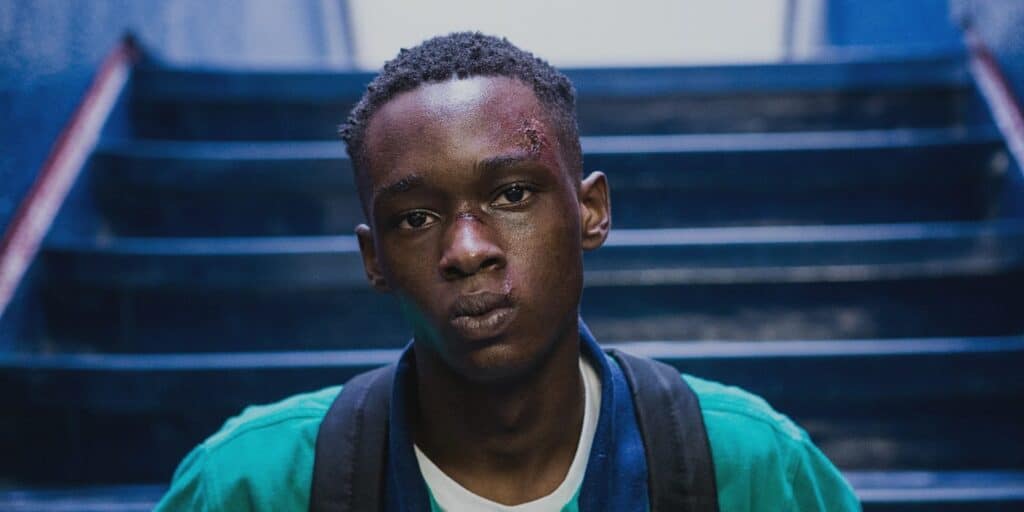
In adolescence, our lead, now known as Chiron, is the same awkward boy, just slightly longer in frame. His teenage years are scarred by merciless bullying at the hands of his classmate, Terrel, who has an intuition for Chiron’s sexuality. Terrel forces Kevin, now muscular, popular, and the envy of Chiron, to batter his friend. Compelled by the need to maintain playground respectability, Kevin obliges and beats Chiron. The beating breaks Chiron; the following day, he returns to school and brutally assaults Terell. We last see Chiron being arrested and taken away in the back of a police car; Kevin, regretfully, watches from the school gate. When we’re reunited with the final version of Chiron, he is unrecognizable. Hardened by prison time, self-hatred, and the necessity of self-preservation, Chiron (now known as Black) is a physically imposing figure. Fulfilling the narrative arc of Juan, Black inherits the former’s drug empire.
10 years from its release, Moonlight’s understanding of the black male experience feels more crucial than ever. Running parallel to the film’s anniversary is 10 years of Trump’s America. In the 2024 Presidential election, Trump received 15 percent of the African-American vote – representing a marked increase from the 8 percent he won in 2020. This jump was largely due to a significant increase in support from black men under the age of 40. When contrasted with the “Brat” presentation of the Harris campaign, the eco-nationalism of the Trump 2024 campaign and its promises to reprioritise American wealth and American jobs proved to be a more successful electoral strategy. Paired with Trump’s performative hypermasculinity and shallow yet pervasive propagation of support for “traditional men”, the campaign’s message resonated with a demographic of black voters who felt their existing social contract had little to offer them.

This resonance is reinforced by the Black Manosphere, a male-only digital space where Black men engage in conversations with and about their fellow men. Podcasts like “Fresh and Fit,” an online talk show hosted by two black men, propagate the idea that the modern world is incrementally eroding the stature, agency, and authority promised to men through our collective social contract. The growth of these online movements and the ideas they champion has dislodged the conventional loyalties of a community that was once considered politically predictable, and created new dividing lines between African American men and women, with African American men increasingly voting red, and women remaining blue.
Jenkin’s acuity is rooted in his understanding of what it means to be a black male. As a native of Liberty City and the child of an absent mother, Jenkins uses his childhood as a means of humanising his work. Moonlight speaks to the structural marginalization that has inclined black men towards strongman figures, but does so in a way that avoids lazy generalisation. The film follows the story of a black man struggling with sexuality, poverty, and inequality, but refuses to be solely defined by these themes. In avoiding sweeping representations, Jenkins reaches for something else: individuality. Black men cannot be typecast into identifiable political and cultural tropes; Chiron is much the same. He is both a commanding neighbourhood figure and a boy terrified of his mother, distant and detached, and an enduring romantic; in short, he’s human. Cinematic representation can be perilous; the portrayal of a character is both a mirror and a brush, and depictions extend themselves into our lived world, where they have lived consequences. In remaining acutely aware of this responsibility, Jenkins creates a film in which the idea of the self is both individual and endless.
Moonlight leaves behind a totemic cinematic legacy. Nominated for an Oscar eight times and the recipient of the Golden Globe for Best Motion Picture, it’s widely considered a cinematic masterpiece. Whilst harder to measure, its grassroots impact is equally laudable. In providing a humanising, nuanced account of queer black adolescence, the film reflects the experiences of a long-neglected community. Gay representation has been (and remains) overwhelmingly white; TV dramas like Queer as Folk and Will & Grace did much to highlight gay lived experiences, but the racial homogeneity of their casts limits the scope of their inclusion. By unapologetically platforming black characters, Moonlight made queer black men visible. Writing for The Guardian in 2017, Josh Lee reflected on how “when you strip away all the messages of hope and reconciliation and fear and love Moonlight contains, what’s left is a simple and powerful affirmation of queer black men”.
Today, Moonlight feels enduringly innovative. Whilst the popularity of Queer cinema has markedly increased, and TV shows like Heated Rivalry dominate streaming services, Moonlight stands alone in its celebration of blackness. As a young black man, its teachings feel both recognisable and admirable, and its ability to reflect the continuing isolation of black queerness makes it feel intimately knowable.
The decade since Moonlight’s debut has been marked by the emergence of novel political movements and the erosion of legacy cultural orthodoxies. Whilst it’s unclear what will come next, it’s evident that black men are engaging with the public sphere through channels that are increasingly difficult to foresee. So if we’re to return to the question that opened this article, Moonlight could show us that black boys are neither red nor blue, perhaps, in the words of Juan, “you gotta choose for yourself who you wanna be”.