Decentralized, Disruptive, Designed: The STADION Vision
Written by Lola Carron
Edited by Lily-Rose Zumin-Morris
STADION doesn’t belong to one person. It belongs to the collective. Where fashion often revolves around singular figureheads – designers as celebrities, their names stitched into every label – STADION rejects the hierarchy. It is an entity built on community, a brand where power is decentralised and success is shared. The brand functions as a network of minds working in collaboration, where the clothes are the focal point, and the process is as valued as the final product. “If I ever started something, I knew I didn’t want to be the face of it. A brand should be able to live beyond one person,” the founder explains. The anonymity isn’t to be pretentious – it’s an ethos, a quiet rebellion against the industry’s obsession with the designer-as-deity. At its core, STADION is a living, breathing ecosystem where the founder leads the design process, shaping each collection’s vision. Yet, the final pieces are enriched by a network of designers, stylists, manufacturers, and artists who refine and elevate the work. There is no singular ego here—only the clothes, the process, and the collective effort behind them.

The London-based brand, rooted in Hackney, thrives on collaboration at every level—sourcing materials locally and working with a tight-knit community of creatives who bring each vision to life in an environment built on trust. The brand is not interested in chasing trends, nor in simply replicating the past. Each piece is constructed with longevity in mind, meant to exist in a wardrobe as a future relic rather than a fleeting indulgence. “There’s a misconception that timeless means boring. But for us, it’s not about making something basic—it’s about refining essential silhouettes in ways that feel modern yet lasting.” Instead, it exists in the tension between nostalgia and futurism, fusing traditional craftsmanship with an eye towards what comes next.
Biovirtua, the previous Spring/Summer collection, served as a foundation, a mapping of STADION’s vision—a community moving through the stages of dressing, from workwear to nightlife, before dissolving into the digital. It set the stage for what was to come: Skin, the latest Autumn/Winter collection, which debuted at the recent London Fashion Week. Skin is where these ideas intensify. If Biovirtua laid thefoundations, Skin takes them to the next phase—examining how we reflect, manipulate, and contort ourselves in response to our increasingly digital existence. Fashion is often called a second skin, but what happens when that skin is stripped away? When identity becomes fluid, shifting between tangible and simulated realities? “We didn’t want to go fully digital and remove the physical element of the clothing, just as we don’t want to make something hyper-traditional that ignores the way we exist in these two worlds now.” Skin doesn’t provide the answers—it invites you to exist in the space between.
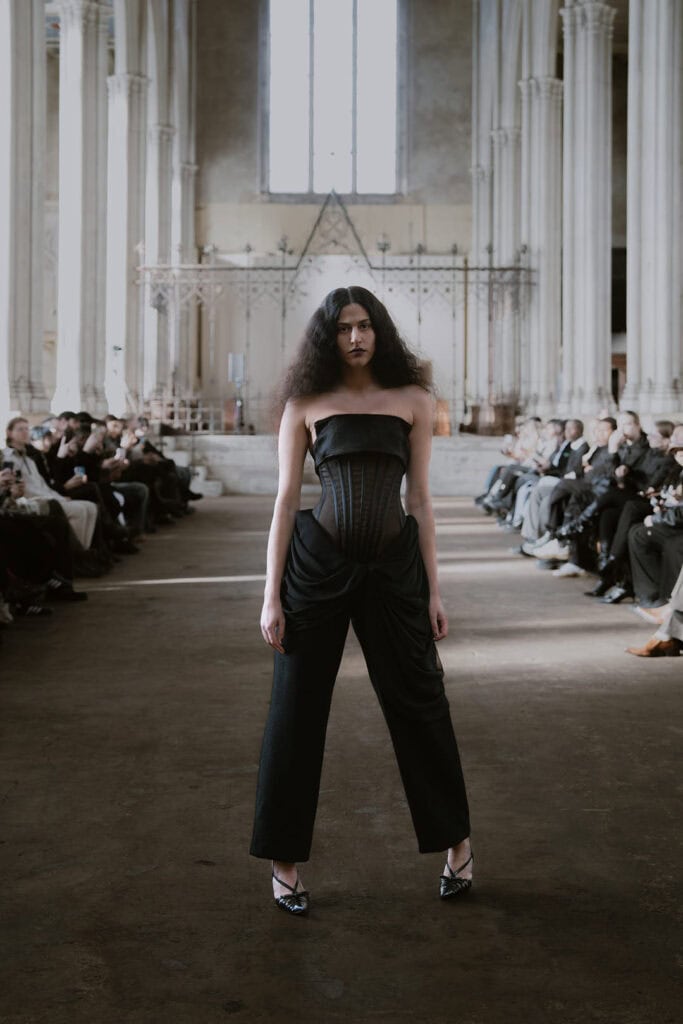
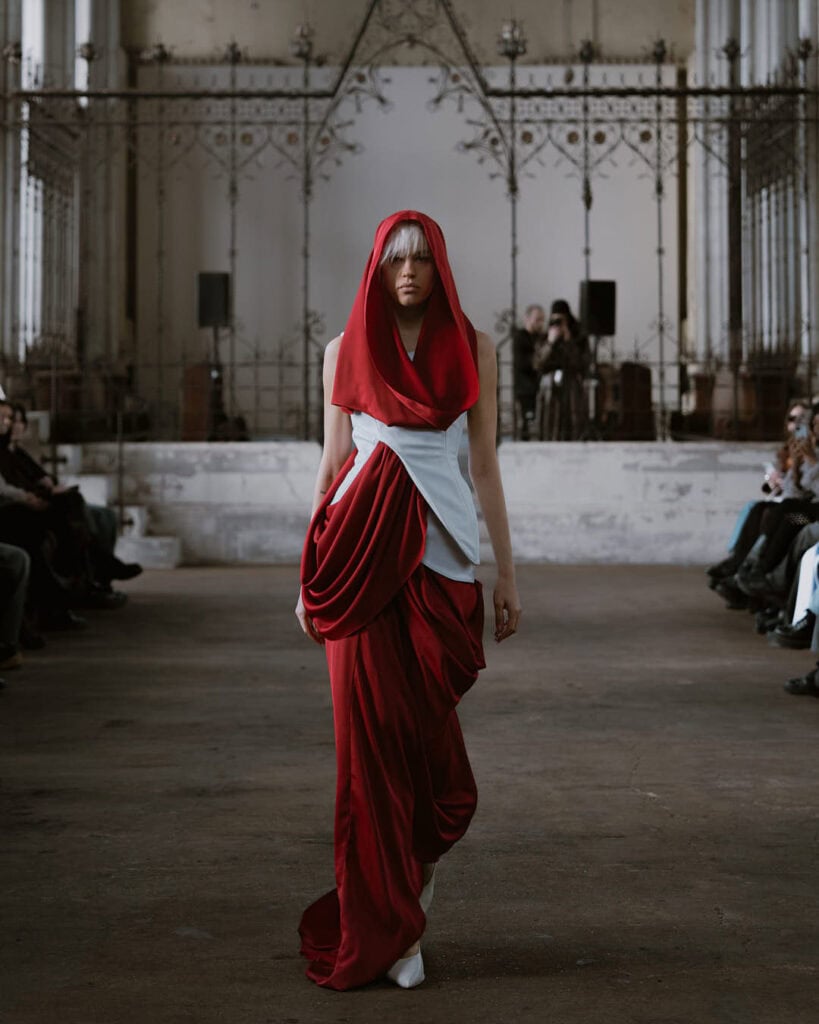
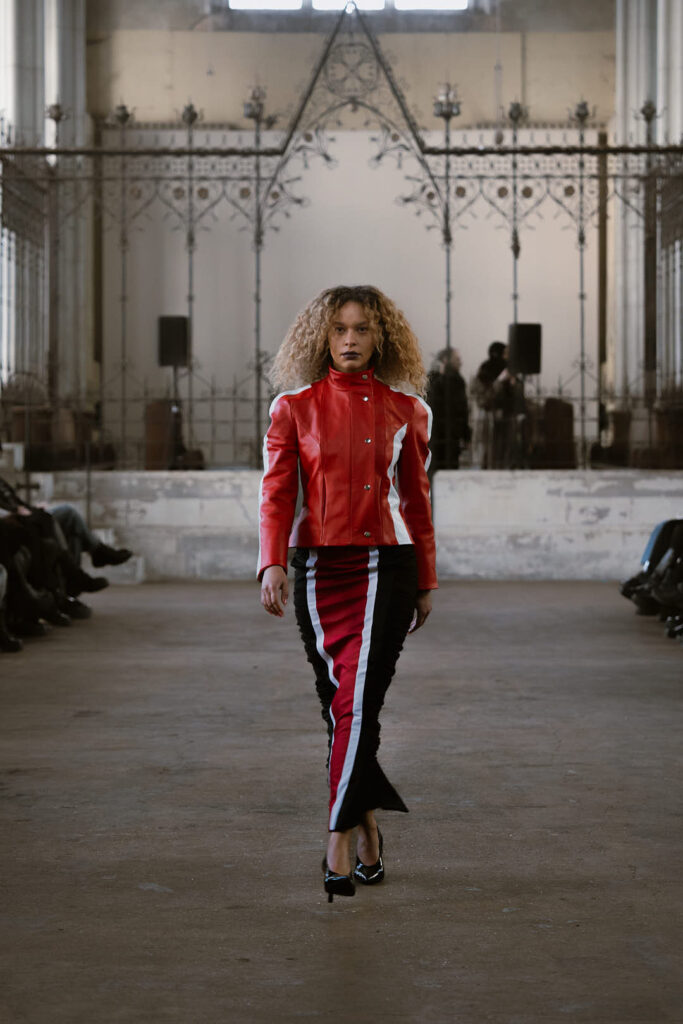
The runway setting—a hauntingly derelict church—added to the atmosphere of the show. STADION’s models walked through the space like spectral figures, theirmovements both fluid and mechanical, reflecting the collection’s central tension between the organic and the constructed. The garments themselves played with silhouette and structure, subverting natural anatomy: knee pads that mimic muscles, sculpted tops that imply exaggerated shoulder bones, and trousers that cling and contort, questioning where the body ends and the garment begins.
But STADION is not just about the clothes. It’s about the people behind them.
The brand operates as a continuous dialogue—between its team, its collaborators, and its extended creative community. Unlike the revolving-door nature of many fashion houses, where stylists, models, and manufacturers change with every season, STADION prioritises long-term relationships. “Community was a huge part of why I got into fashion in the first place. I didn’t grow up surrounded by people who were into it, so I found my way into fashion through online spaces—Facebook groups, Reddit, Discord. That sense of community is something I wanted to build into the brand.” The models from the last collection are the same ones walking this season. The stylists return. The manufacturers remain. The brand isn’t interested in disposability—not in the garments, not in the people. “We want people to feel like they’re part of this journey. Whether that’s our models, the people who work with us, or the people who buy our clothes, it’s always about creating something together.”
Even its supply chain reflects this ethos. Every piece is sourced and produced in London. In an industry where production is often outsourced to faceless factories overseas, STADION keeps its entire operation close to home. Communication and community flow through every layer of the brand—from design to production, from concept to consumer.
This commitment to collaboration extends beyond fashion. STADION envisions working with creatives who challenge norms and shape culture in unexpected ways. Collaboration isn’t just about names—it’s about visionaries who redefine their fields. “Forever, in terms of actors, I’d love to work with Harrison Ford—obviously, he played Blade Runner—or Denzel Washington. I think Denzel Washington in Training Day is absolutely fantastic,” the founder shares. Imagine a campaign shaped by Washington’s quiet intensity, Ford’s effortless gravitas, and Hideo Kojima’s ability to weave reality and fiction into something entirely new. Each of them represents a different kind of storytelling—whether through performance, presence, or world-building. It’s this intersection of craft, character, and reinvention that aligns with STADION’s ethos: creating something lasting, something disruptive, and something that speaks beyond the present moment.
Innovation is often associated with technology, but at STADION, it is found in the meticulous construction of a garment, in the balance between structure and movement, in the way a piece transforms with the wearer. “For every design, I try to draw it a hundred times,” they explain. “Not all of them are good, but the repetition forces me to push the idea further. Maybe the tenth sketch has a detail I bring intothe thirtieth, or maybe by the fiftieth, I realise there’s a completely different direction worth exploring.” It’s this iterative approach that gives STADION’s garments their distinct identity—minimalist in their outward aesthetic, yet rich with subtext, structure,and unexpected intricacies.
That tension—between tradition and innovation, physical and digital—feeds into the brand’s philosophy. There is an inherent duality to STADION, an ongoing negotiation between worlds. The founder references techno-shamanism, the idea that technology is not inherently oppressive or liberating, but something that must be approached with balance. “It’s about not feeling enslaved by it, but also not feeling the need to resist it completely. We exist in both worlds—so why not embrace both?” The brand is not about rejecting the digital age, nor about succumbing to it fully. Instead, it explores the space between—garments that function as both artefacts and experiments, mirroring the fluidity of identity itself. “I think brands today can serve asimilar purpose: helping people navigate technology in a way that doesn’t feel oppressive or addictive but integrated and balanced.”
At The Cold Magazine pop-up, where STADION’s work was introduced to new audiences, the hope wasn’t just to sell clothes—it was to share an idea, a philosophy. The founder doesn’t expect everyone to resonate with the brand, and that’s okay. “If people loved it, they loved it. If they didn’t, that’s fine too. We’re always open to conversation.” STADION doesn’t dictate meaning; it invites people to interpret it for themselves. For those drawn to STATION’s world, the journey doesn’t end at the runway or the occasional pop-up. The brand operates primarily through its online platform and select collaborations, where new pieces emerge as part of an ongoing dialogue rather than seasonal drops.
The brand turns a year old in March, a milestone that feels both monumental and strangely irrelevant. STADION was never designed to follow a linear trajectory—there is no five-year plan, no rigid blueprint. The goal has always been to evolve organically, to allow each collection to emerge as a natural progression of the last. The brand is not a closed system; it is a constantly expanding circuit, where every person who touches it becomes a part of its ongoing narrative. In an industry obsessed with the next new thing, STADION’s commitment to slow, considered design feels almost radical. “I don’t want to dictate how people should feel about the brand,” the founder reflects. “What matters to me is that it sparks conversation. If someone has a strong reaction—positive or negative—that means they engaged with it, and that’s what’s important.”