
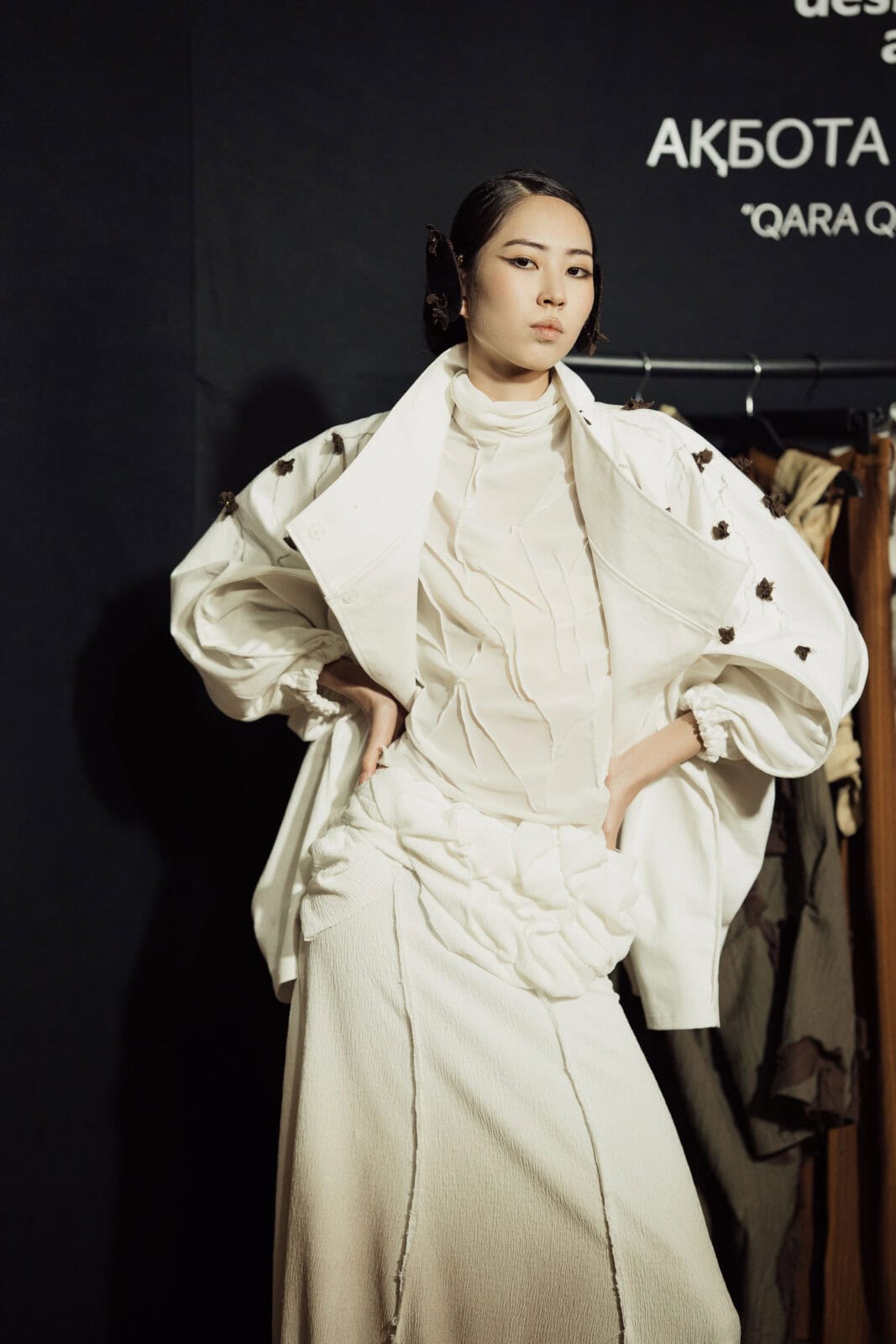
According to legend, the Qara Qandyagash, a tree native to Central Asia, releases a red liquid resembling blood. It is found in regions like Bayanaul in Kazakhstan. It symbolises deep roots and flowing life, and is extremely rare.
When Kazakhstani fashion designer Akbota Kapsalan first heard about this tree, it changed the way she saw nature, realising that beyond organisms, they are a life form with memory, wounds, and their own story. She was so fascinated by the tree that it became the inspiration for her collection at the sixth Next Designer Award empowered by Visa, where she came in third place. “I approached this theme not only as a visual concept, but as a narrative about heritage and continuity,” she tells The Cold Magazine.

The central symbol of the collection is Baiterek (the Tree of Life). She further explains: “Its deep roots – zheti ata, the seven ancestral generations – represent the lineage that gives a person strength and stability. The trunk symbolises who we are today, connecting the past with the present. The branches represent future generations, for whom we are building the foundation today.” The collection is about something that can be felt; something deeply connected to the human experience.

Concepts such as zheti ata and shezhire are not just cultural references for Kapsalan, but a way of understanding the self. “These ideas naturally manifest in my work through form, layering, and meaning. Growing up in Kazakhstan, I deeply absorbed cultural codes that shaped my visual language. I am inspired by nomadic culture, symbolism, and the philosophy of lineage and continuity,” she says.
“For me, it is important to present not just clothing, but an atmosphere and a complete narrative. To show not only the forms, but also inner meaning,” shares Kapsalan, adding, “It is an attempt to materialise the memory of ancestry and the connection between humans and nature through fabric, form, and movement.”
Her journey into fashion began early, when she was drawn to the visual and emotional sense of clothing. At first, she didn’t see it as a pragmatic career path but, over time, she realised its power, and saw how she could express ideas through design that she found difficult to put into words. “That moment became a turning point for me, and I remember being deeply inspired by images, traditional garments, archival silhouettes, and theatrical costumes.”
The theatre has always been close to Kapsalan. Her father is an actor and her mother is a sound engineer. Her entry to the industry began when a stage designer noticed her and invited her to assist on a production, an experience that became a turning point for the aspiring designer. “After that, I was invited to work on more projects, and eventually I became part of the theatre team. I have now been working in theatre for about a year and a half, gradually developing my approach to costume as an essential part of dramaturgy and character.”
Kapsalan’s path into costume design developed gradually and largely through practical experience. A graduate of the Kazakh National University of Arts with a degree in Fashion Design, she also worked as a stylist on international television projects, collaborating with artists and public figures from Kazakhstan as well as other countries. She recalls: “We created looks, developed styling concepts, and I was also involved in tailoring. This period gave me a strong foundation and an understanding of how clothing interacts with personality.”


She currently works as a Costume Designer at the Kazakh National Musical Drama Theatre, where she creates visual and costume concepts for productions.
For her, fashion and costume are deeply connected. She doesn’t see them as separate disciplines, but as practices in constant dialogue. “Costume gives fashion narrative depth and a way to remember the past, while fashion brings dynamism, the future, and trends. I am inspired by creators who work at the intersection of image, story, and identity, both in cinema and theatre, especially those for whom costume becomes an extension of a character’s inner world, rather than just one element.”
Kapsalan is currently preparing to participate in Tashkent Fashion Week, which she considers a very important stage. “I expect it to be a space with strong energy and an open audience, where there is genuine interest in new voices from the region. I believe it will allow me to reveal my work in a fresh way.”
Ultimately, everything Kapsalan designs is about connection, whether it’s between past and present, a person and their identity. She is deeply inspired by creators who bring together craftsmanship and storytelling, especially in cinema and theatre, and in her native Kazakhstan. In the end, her work always finds its way back to her roots.


