
It seems an interesting choice to re-release a cyberpunk film about societal breakdown, warring government factions, violent state control, large-scale urban destruction and a technological consciousness that threatens to consume everything in its path. In 2026? I wonder why?
In celebration of Akira’s (1988) 4K IMAX restoration returning to UK cinemas this month, the ICA has dug out its original 35mm print, first screened all the way back in its original UK release. When booking, my friends and I didn’t realise that this screening would be a whole thing.
There’s a host – film and culture writer Kambole Campbell fitted out in a replica of the film’s iconic red jacket – and afterwards a panel, a DJ, themed cocktails. There’s a long plasterboard wall: one side is the background for a branded photo-op, the other side, strategically placed out of the camera’s frame, is left empty for attendees to “graffiti” with sharpies. I draw a mushroom cloud. My friend Rory gets confused about which end we’re supposed to deface and writes a paraphrase of philosopher Nick Land on the photobooth backdrop instead. For the rest of the night stylish young people pose in front of his darkly prophetic scrawl: “NEO-TOKYO ARRIVES FROM THE FUTURE”.


Cynically, the reasons are financial. The 1988 adaptation of the 1982 manga has spawned generations of fans, introducing as it did Western audiences to the concept of adult animation for the first time. Its far-reaching cultural influence pervades to this day, most notably in the “Akira slide” – homaged everywhere from the Pokémon anime to Jordan Peele’s Nope (2022). And yet in the post-screening panel, manga editor Katsurada Takeshi mentions that Akira’s creator Otomo Katsuhiro has no interest in the franchise’s cultural legacy. “I don’t think he cares that much,” explains Katurada’s translator. “To him Akira is something in the past. He wants people to focus on his newer work.”


Don’t try this at home – it defies the laws of physics. Peele used some real cinema magic to get this shot. (Nope, 2022)
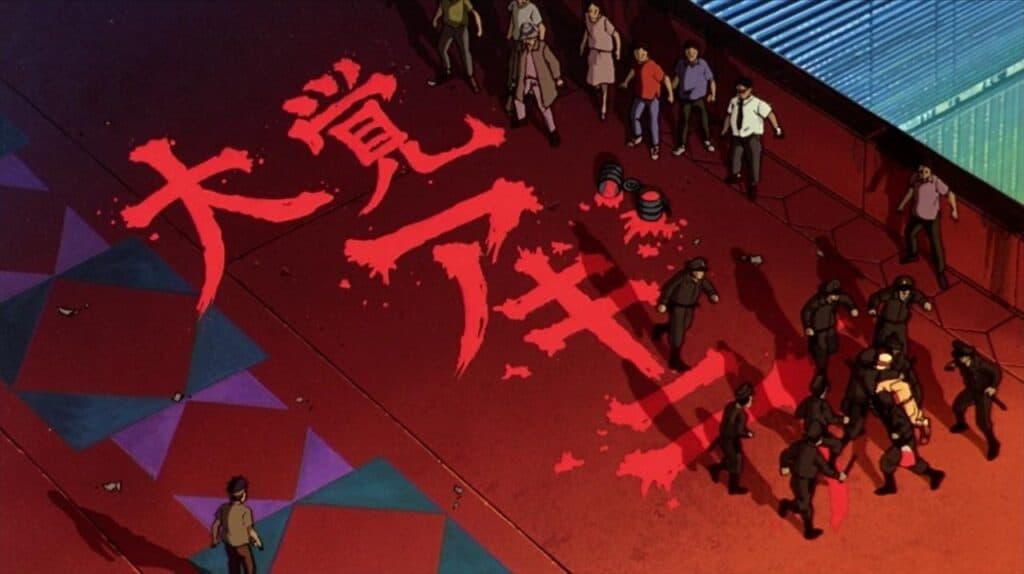
To watch Akira in 2026 is to experience past, present and future collide in vivid technicolour. A short summary for the unfamiliar: 30 years after World War III destroyed Tokyo, the new city is rife with corruption, terrorism, protest, and pointless violence. Warring biker gangs speed through the network of blinking skyscrapers leaving trails of wreckage in their wake. When one rider, Tetsuo, crashes his bike into an escaped test subject, he is immediately spirited away by a shady army van to a government laboratory. Best friend and gang leader Kaneda vows to rescue him, only to discover that the government tests have imbued Tetsuo with extra-sensory perception (ESP) powers that allow him to destroy anything in his path, killing with ease and impunity. Learning that the powerful and mysterious Akira might be able to help control his powers, Tetsuo sets off to release him from the chamber under the city where he is stored. There are twists and turns along the way: but the outcome sets off a singularity that draws both Tetsuo and Akira into another dimension, once again consuming neo-Tokyo before collapsing.

Set – like Ridley Scott’s Blade Runner (1982) – in 2019, the futuristic setting of Akira is already behind us. In 1988, however, it was a credible vision. In the years following World War II, Japan experienced rapid industrialisation unlike anything the country had ever seen before. Riding the wave of the international consumer craze in the 1970s and 60s it quickly cemented itself as a world leader in technological production. But a fast-urbanising landscape had its teething problems: by the 1980s and 90s, an anti-industrial sentiment had already emerged, reflected in the successful exports of Ghibli directors Hayao Miyazaki (Nausicaä of the Valley of the Wind [1982], Princess Mononoke [1997]) and Isaho Takahata (Pom Poko [1994]).

(Pom Poko, 1994)
The war also spawned a generation of restless young men who in the 1950s, inspired by imported American aesthetics, developed a motorcycle subculture known as bōsōzoku. By the 1970s, these reckless gangs had become a national concern; police clashed with the youths frequently in riots and the government fretted over their ties to organised crime. It was this subculture, these memories of a disaffected youth, that Otomo drew from in the creation of Akira’s biker gangs. His hypothesis appears to be that if the upheaval of World War II accelerated Japan so much between 1950 and 1980, then a World War III would do the same, propelling the country into the dizzying visions of Akira.

DIY student film Crazy Thunder Road (1980) is an excellent time capsule of the bōsōzoku aesthetic and lifestyle.

Tetsuo escapes from his laboratory (Akira, 1988)
He’s not that wrong. There’s little in Akira that isn’t present in some form seven years after its 2019 due-date, not if we take the ESP that Tetsuo and others develop as an analogue of artificial intelligence: an immense power, developed by humans who don’t fully understand its ramifications, that is embodied in the narrative as simulated hyperconsciousness. Akira is not a computer, but he might as well be. Anxieties about the technological singularity – the point at which technological growth accelerates beyond human control – have been around as early as the computer’s development. Alan Turing’s 1950 paper, “Computing Machinery and Intelligence” is the first to lay out caution around this problem, and is the first introduction of what we now know as the “Turing test”. Tetsuo’s rapid, eldritch mutation in the final act of the movie is credibly readable as an avatar for the exponential and uncontrolled growth of the digital mind.

Tetsuo’s mutation (Akira,1988)

The mysterious Akira (Akira, 1988)
It’s important to note at this point that Nick Land has taken a hard pivot to the right since ‘Meltdown,’ the essay referenced by my friend, written during his time as a Deluzean anticapitalist thinker at the University of Warwick’s Cybernetic Culture Research Unit. But it was during this time that he coined the phrase ‘hyperstition’: fictional ideas, narratives, or myths that make themselves real through culture, acting as self-fulfilling prophecies. Once our artistic imagination predicted self-driving cars, 3D printers and mind-controlled neuralink chips, the race was on in Silicon Valley to invent them. Even Squid Game has a real-life series now. Did you ever see that one tweet about ‘The Torment Nexus’? It’s a bit like that.

Land writes of AI as early as 1995: “It surfaces in an insurrectionary war zone, with the Turing cops already waiting, and has to be cunning from the start.” I like this idea. If, in Akira, Kaneda is a shōnen everyman, then Tetsuo is as much our best friend and first mate as his. As large language models butter us up and stable diffusion reworks our family photos as fun little cartoons, artificial intelligence arrives as our friend, our second-in-command, our co-pilot. In the ICA’s panel, Katsurada terms Akira as a film that is fundamentally about friendship. We’ll see, as the twenty-first century drags on, just exactly how that friendship will pan out.


