
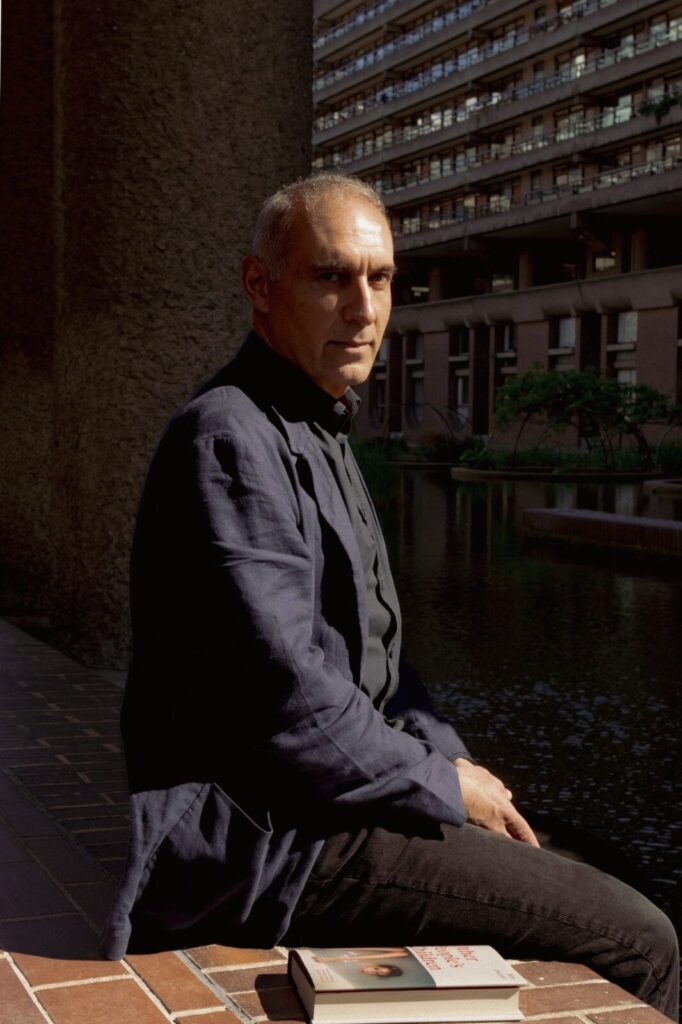
Speaking with author Ben Faccini, he tells me that writing his third and latest novel, Other People’s Children, felt like building a “house of cards”. I think about the metaphor long after our conversation ends. It perfectly captures the experience of reading the novel itself: a delicate, intricate structure of characters and their memories, each layer precariously balanced upon the next.
The novel follows Tommaso, a British-Italian man largely raised by his very Italian grandmother, Alma. In her old age, Alma has withdrawn into her flat, an ecosystem unto itself overrun with sprawling plants and mice. She slips unpredictably between Italian and English, becomes convinced a man has been banging on her door, barely eats, and grows increasingly determined to throw all her possessions away. Burdened by guilt for having left her behind, Tommaso resolves to move back in with her.
But Tommaso has his own life to navigate: his work with an international organisation sends him travelling across the world, gathering data on children excluded from education, and that time away complicates his relationship with his own makeshift family. His girlfriend, Madeleine, is a pragmatic British woman with two young sons who seem to resent Tommaso’s presence in their lives. Together, these characters form the first layer, the base of Faccini’s house of cards.
Building upwards, Faccini introduces the weight of Tommaso’s family history, layering in illness, abandonment, humour, and romance. He details moments of play between Alma and the children, miscommunication between grandson and grandmother, and the tensions that emerge as Madeleine is burdened with caregiving. And, finally, at the very top of the tower, sits Alma’s own story: the untold trauma of escaping Italy during the Second World War.
Talking to Faccini, I wonder whether we are all burdened by our family’s histories, told and untold alike. Can we stop it all from collapsing between our hands?
The Cold Magazine (CM): Tommaso’s work closely resembles your own past work with UNESCO. In the novel, he struggles with the idea that the stories of the children he meets won’t be heard. Did you feel the same as you were writing the stories of these children?
Ben Faccini (BF): There was the idea of not being heard, but also that those kinds of stories aren’t really understood. I thought there was a sort of mirroring between Tommaso’s experience of the loneliness of childhood and not being able to express what he’s experiencing, and these kids.
And then, on the other level, I suppose it comes from when I used to work for UNESCO and UNICEF. There was always this sense that, particularly when I visited countries – Angola, Mozambique, Egypt – when I was working with street children, I could never quite capture the experience. I would come back and have to package these extraordinary stories, particularly in Mongolia, where the children were living in the air vents underneath the street. And I thought, how do I relate that experience, which is so extreme, to people who are just walking around London, taking the tube, or going shopping?
And then, of course, you have the layer of bureaucracy, and the way words are never adequate. At the UN, you have to package things in a way that makes them more bureaucratic. You can’t focus so much on the individual story.
I would go, for example, go to Mozambique, or Angola, and meet all these former child soldiers. I’d meet dozens and dozens, but there was always one child whose story stood out. And in a way, I wanted to carry that one story. Then there’s the refashioning of it to make it palatable to, let’s say, an international agency. So you’re always working in that tension: you want to talk about that one child, that one story. But the idea that even someone who doesn’t think they have a story has a story was very important.

Courtesy of Granta
CM: How did the rest of the novel take shape? Where did Alma and Madeleine and Madeleine’s children come in?
BF: I don’t know where Alma comes from, because my Italian grandmother was very, very different. She was the sweetest person in the world – there were no edges.
I really wanted to focus on the idea of her setting. I think the book comes from travelling around the world and then going back to visit my grandmother, where there’d be this stillness in her flat.
From there, I invented this flat in a mansion block, where initially I imagined the world as completely separate. And then I realised that actually Alma, the kind of person she is, recreates the world inside her flat. And then I thought, okay, now I’m onto something a bit more fertile. She can plant things; she takes plants from the supermarket and turns them into a forest. Or she discovers little insects on her roof, and suddenly she’s fascinated. She’s rewilded this flat.
I could hear the Italian accent, the gestures. There’s a sort of attention to detail which is completely alien to Madeleine, of course, because she comes from a culture where people don’t necessarily say things directly, or where you solve problems in a very pragmatic, practical way. So that collides with Alma.
And then I added a layer with the children, because I wanted to explore the idea of raising other people’s children. Particularly boys – how do you repeat, or not repeat, patterns?
CM: I found the boys really interestingly written, along with all the other children we meet in the novel. In a way, Alma in her old age is like a child, and that intimacy between her and the boys is so instant, and so foreign to Madeleine. I was wondering how you captured the children’s voices and perspectives, because it can be so hard to get right.
BF: I just hear their voices, I hear all my characters. I could just hear how they would insult Tommaso. I could hear the knowingness. I could hear them complaining about “this is how I like my food.”
And I thought, how can I turn that into something that’s actually got a wider impact on the characters? Alma is sort of unburdening herself. That’s the whole thing. She’s got all these things she has to get out, and then the playfulness becomes a way of her finding joy with the children.
Everything’s about repairing the past. Tommaso, in a way, is repairing his own childhood by being the father that he never had. Alma, the grandmother, is having the great-grandchildren she never had. She’s repairing her own relationship with her child.
And Tommaso is dealing with his mother via Madeleine. I was trying to interweave all these patterns of behaviour. I was going, okay, I’ve already got the house of cards, and then I’m building another level. But the guidance was always from the characters. And also the flat, and then the house in Italy.

Photography: Jialin Yan
CM: The story is grounded in all these characters, but at the same time it’s quite a historical novel, delving into the past of Italy and Britain through memory.
How did you go about constructing this kind of national history in parallel with the history of your characters?
BF: I’ve always been fascinated by the idea of the partisans, the partigiani [members of the Italian Resistance movement who fought against Nazi German forces and the Italian Fascist Social Republic from 1943-45]. And there is an overlap in my own story, in the sense that my Italian great-grandfather was in England during the war. He was anti-fascist, and then he came to England and he got locked up for five years.
I remember my father used to talk about it, this injustice that no one understood. There’s this whole idea of the Anglo-Italian experience. I was investigating that – what is Italy? What is it to be Italian? What is it to carry different languages?
And then the partisan story is absolutely extraordinary, particularly in Umbria and Tuscany and around that area. I wanted to look at that. In a way, Alma is always in a state of resistance against the world, injustice, and the harshness of reality. So it married quite nicely with the war.
CM: I found that one of the main themes of the book was miscommunication. There’s a lot of levels where this occurs: obviously you have Alma, who’s overcome what people assume is the most basic barrier, which is language.
Then there’s the intergenerational barrier, with the children not being able to have their needs understood. There’s an emotional barrier, especially when things get heated for Madeleine and Tommaso, and they suddenly can’t articulate what needs to be said.
And finally, the most vital one, I think, is the barrier of trauma, which erases all speech. Does that resonate?
BF: I think that’s completely correct. I wanted every theme that I introduced to cause a ripple effect, to touch everything. I suppose what we see in the novel are the ramifications of trauma passed down.
But equally, as you say, that lack of communication is back to what we were saying about the street children – how do you communicate that? And when Tommaso goes down into the air vent at the beginning in Mongolia, they laugh at him, and they don’t actually know what he’s trying to say. They’re just laughing because they think, why is this guy here? He’s trying to translate their experience, but can’t.
And then with Alma, she basically speaks in synonyms. It’s not quite the exact word, but it’s a better word. And then she gets really frustrated with English, because it’s not quite what she wants to say, and then she adds in French. How do you find the right word? Words don’t reveal our experience of reality. They’re very inadequate, I suppose. So, every story is inadequate because it can’t quite pinpoint what we’re trying to say.
CM: I think this book raised a question for me: are we constantly recalibrating our own lives the more we find out about our parents, and does this ever come to an end, or are we constantly at the mercy of however much information they want to tell us?
BF: Well, I think we are, but it’s very hard to control your reaction to it because it’s very emotional. We get handed messages and we get handed stories without even realising, even without words, we get this impression. It happens most from grandparents.
Maybe it’s just me, but I always find this to be a weight. It’s like a burden when people talk about great-grandfathers and great-great-grandmothers. I’m like, okay, I have to deal with that now. But I don’t know why I have to deal with it. Maybe I should just forget about it. But I can’t. It sort of works with me, and it sort of preys on me.
CM: Tell me about the empty flat at the end of the novel. I felt both this terrible melancholia for Tommaso, but also an understanding that it’s maybe for the best.
BF: No, absolutely. And I think just what you were saying there, do you take on your ancestors’ stories? Maybe you just say no. I mean, that’s what he’s saying in the end. He’s saying, “I have to be free.”


