
How C.G. Williams Is Reinventing the Gallery Model
Written by Joshua Beutum
Standing by an unmarked door in Bloomsbury, I’m met by Caspar Giorgio Williams, the founder of London’s newest gallery space, C.G. Williams. We are directly opposite a snaking line of tourists working their way through what Williams describes as “Queue Gardens”—that is, the white security tents obscuring our otherwise clear view of the British Museum. It’s a sunny Thursday morning.
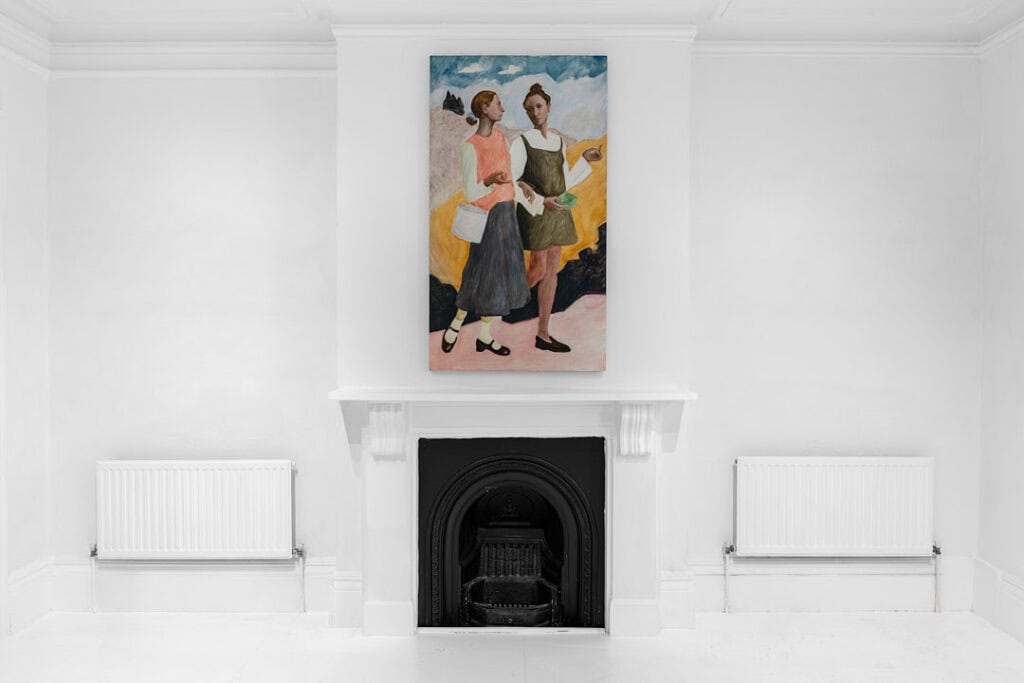
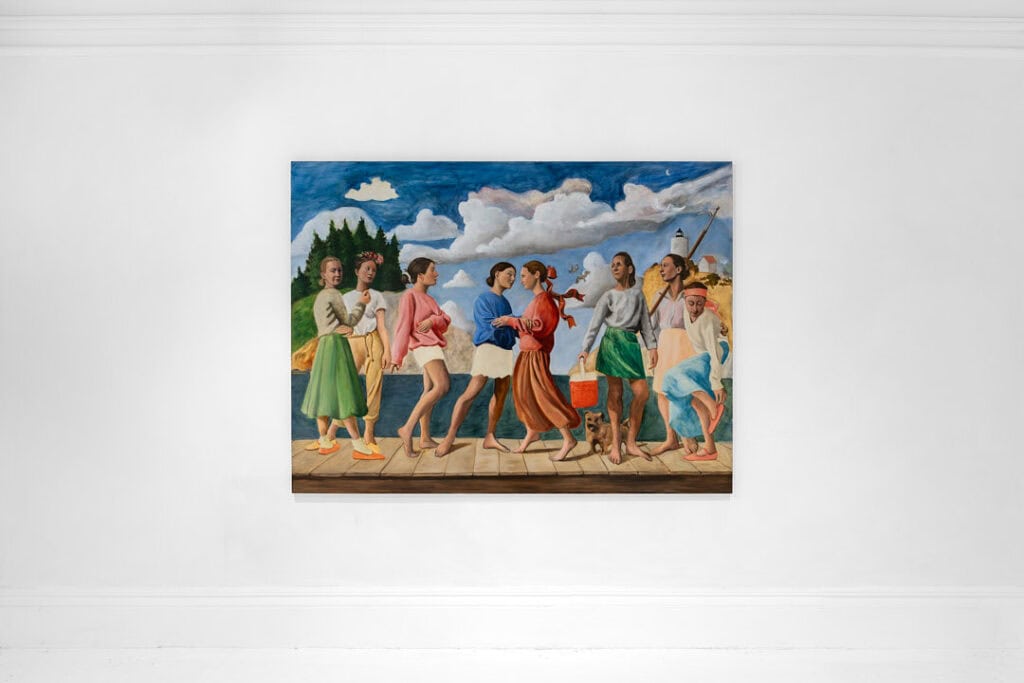
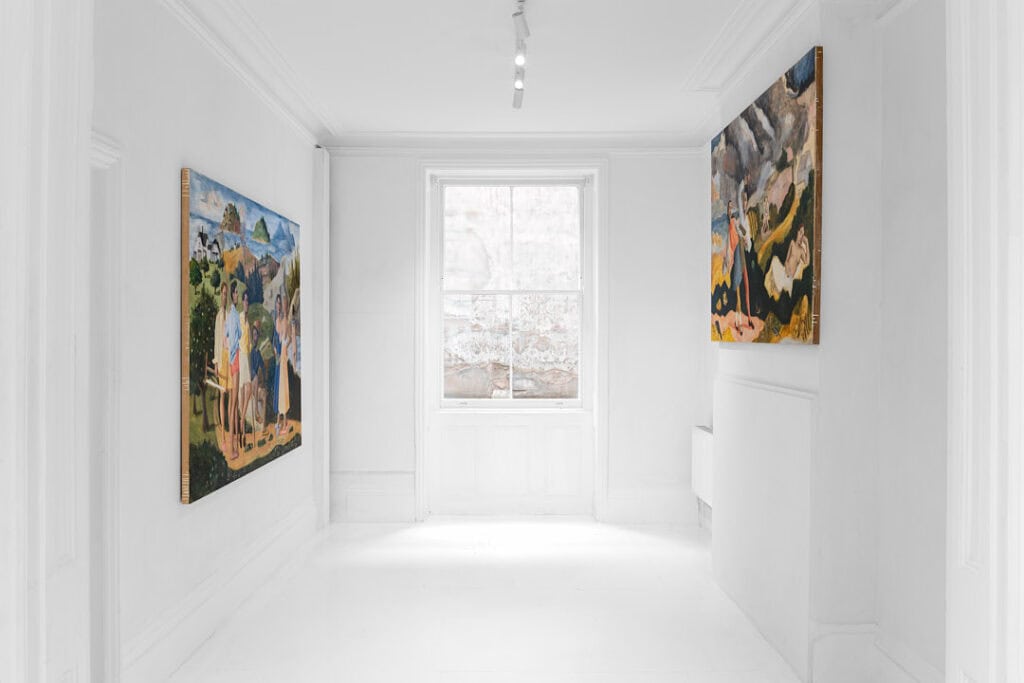
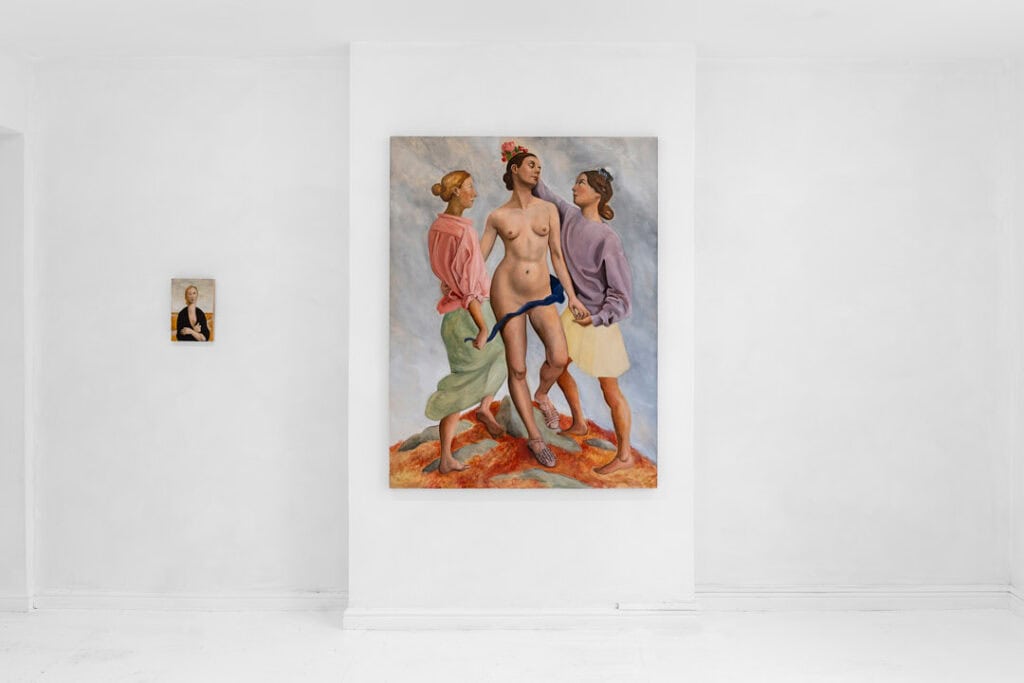
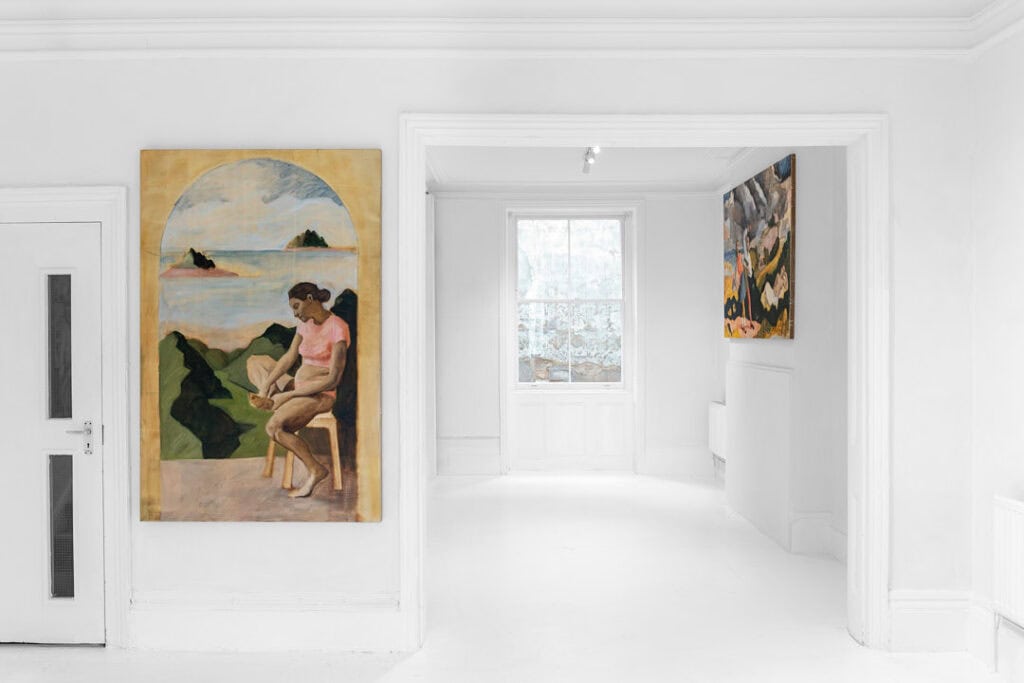
Up a flight of stairs and into a home-turned-office-turned-gallery-space, currently under renovation by architect William Smalley. On the walls are artworks from Beau Gabriel, the London-based, New York-born painter whose exhibition of twelve narrative pieces is the London gallery’s first. The paintings, Williams tells me, depict the story of two sisters, Gwendolyn and Phoebe. One goes on an adventure, finding herself amidst reimaginings of canonical works by artists of the likes of Pontormo, Bronzino, Piero della Francesca, and Balthus. The other, she stays behind.
Williams’ desk is yet to arrive. But sitting cross-legged on unfinished floors feels strangely intimate. That said, the space has already undergone quite a makeover: walls have been knocked down and carpets removed to create a remarkably airy space lit by a double exposure of natural light from windows on either side of the building. In fact, it is only sunlight illuminating Gabriel’s works.
I soon learn that a lead-lined staircase – inspired by the home of former Secretary and Chief Executive of the Royal Academy of Arts, Sir Charles Robert Saumarez Smith – is yet to be installed. “You can buy the lead from the hardware store,” says Williams. “It unrolls just like a carpet.”
This mark of Williams’ personality on the room stands in stark contrast to the growing trend among gallerists to produce clinical spaces defined more by absence than intention. “I like the idea of ringing a doorbell to come in, of having a homely place where someone comes and greets you at the door and it’s me—it’s not an assistant,” says Williams.
He continues: “The purposefulness of not having assistants and being appointment-only means that when people do come, they have time for a conversation, or we can go for a coffee next door. It feels a lot less cold.”
Combining personal touches with nods to art institutions is typical for Williams. Spanning Siena, Venice, and now London, the gallery supports established and emerging creatives with an eye for “the artist as the client”—a uniquely relationship-driven ecosystem designed to foster success by blending high-profile shows with incredibly personal pastoral care.
In Siena, a little over an hour from Florence, C.G. Williams hosts several-month-long residencies. There, completely funded by the gallery, artists can experiment in something of a haven free from the constraints of rent, side jobs, or even material restrictions. According to Williams, “If they want to work with ceramics, I’ll find a furnace; if they want to work with metal, I’ll find a blacksmith.”
He continues: “The goal is to facilitate an expansion of time for an artist where they can just experiment—especially if they’ve just graduated and they’ve been thinking about how to position themselves and what to make”. Williams does not insist on keeping art, nor does he require repayment when pieces are sold.
Three hundred kilometres away, in the baroque gardens of the Palazzo Soranzo Cappello in Venice, is C.G. Williams’ most ambitious venue. There, artworks are exhibited at an impressive scale, woven amongst centuries-old sculptures and fruit trees in the heart of a city known for its particularly discerning and high-profile art crowd. “Venice is about building a presence,” says Williams, “I’m using it as a launch platform for artists.”
And it is certainly a space that lends itself to spectacle. In 2022, the gallery exhibited site-specific sculptures from German artist Lukas Heerich. For these, Heerich set up an intricate series of cranes and tractors on famously precarious foundations in order to install a three-hundred-kilogram bell shipped from Berlin. “The nature of the space and its enormity,” adds Williams, “means that when visitors come, they really need to make time for it.”
Now, the newest addition to the C.G. Williams network is the Bloomsbury Gallery. Soft-opened in March, it is by far the most traditional of the venues—it is a room with a door and walls and soon, hopefully, an office for Williams. In a major metropolitan hub, it’s also the most visible.
“I’m not attracted to selling for the sake of it,” Williams tells me. “I’m interested in placing work with people who believe in art, who live with art” He continues: “That’s my service to the artist, an amazing validation that the buyer loved the piece, not some other value.”
A byproduct of this dedication to his artists is a catalogue that refuses to be pinned down. Discussing his curatorial practice, it becomes clear that Williams is determined to avoid focusing on artists from a specific place, who work in a specific medium, or who have a specific attachment to a particular theme.
“I have an interest in queer artists and artists who work with nature, but that’s reductive,” Williams says. “It’s important to be completely open because a gallery is principally a system of belief—I’ll put artists on a plinth and showcase the work because I think it’s good, and that’s the best thing you can do for them.”
In this vein, the upcoming programme includes an impressively wide-ranging array of artists. Gabriel’s oil paintings will soon be swapped out to make room for homoerotic nudes from Spanish Artist Pol Anglada, slated to open in early July.
As we edge towards the end of our chat, I can’t help looking onto a sun-drenched patio and feeling like we’re cocooned in something of an oasis. Given a particularly busy week in the headlines, such a space risks seeming indulgent—out-of-touch, even—and I ask what the value of the gallery is, especially in periods of uncertainty.
“Being creative in times of chaos is a great thing,” Williams answers. “There’s a place for overt activism, but it’s also great if our efforts and focus happen to be more about creative acts, rather than destructive or even remedying acts.” He continues, “Creativity gives us something else—another space to live in, another reality with more good things to enjoy, even if they’re drowned out by nightmares.” Above Great Russell Street, C.G. Williams does exactly that: it is a space and an ecosystem where artists and audiences can imagine freely.


