

Savile Row in Mayfair has long dominated the mythology of high-end British tailoring with its inherited prestige. Carnaby Street in Soho, meanwhile, built its reputation on subculture. Mods, skinheads, musicians and nightlife gave the area its identity, not bespoke suiting. Sitting proudly in this intersection is Mark Powell: the legendary Soho tailor who pioneered the “gangster chic” aesthetic, drawing on the sharp silhouettes of the 1960s Mod youth culture.
Powell began his iconic tailoring career in Soho in 1985, when he opened his first shop. Due to his maverick spirit, he knew Savile Row was too polished for him. Over the past four decades, he has become a foundational figure in British menswear by bringing subcultural street style to traditional tailoring.
Hidden within the area are two very different generations of tailoring: Powell and Tilda Jonathan, a young designer fresh from London College of Fashion who represents a newer, evolving vision of the craft. Between them sits a broader conversation about where tailoring has been, and where it might go next.
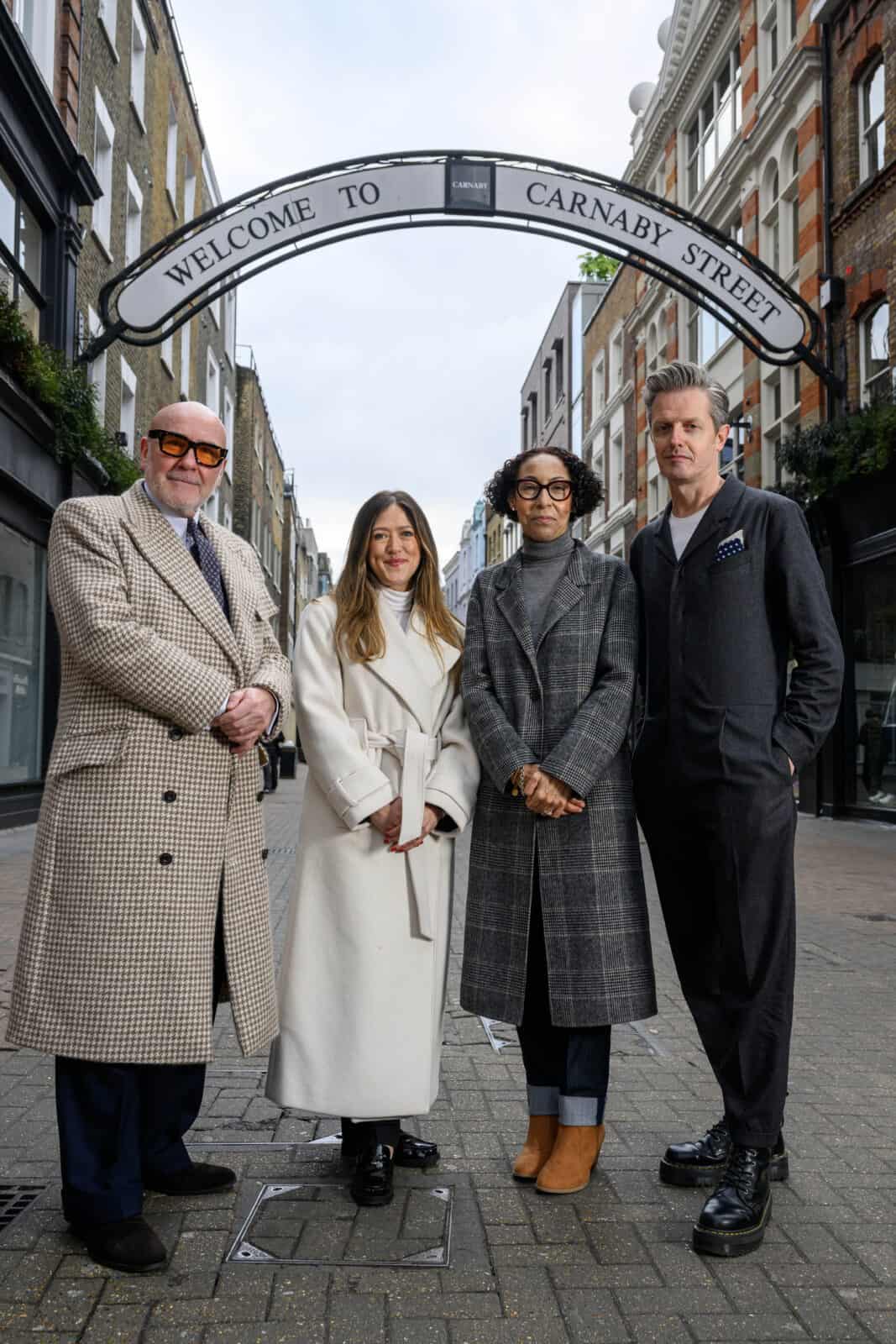
I was nervous before meeting Powell. Not because he was intimidating exactly, but because his reputation arrived before him. Powell occupies a particular space in British fashion mythology: the Soho tailor who built his reputation dressing figures from music and film while remaining outside the polished machinery of Savile Row. A true Eastender, Powell carries himself with a charisma that feels rare in fashion now. I expected someone guarded, perhaps even a little cynical after more than forty years in the industry. Instead, he greeted me with warmth and a cup of tea.
Tucked behind the storefronts and foot traffic of Carnaby Street, a discreet gold sign reading “Tailors” hangs above the entrance to 26 Kingly Street. It would be easy to miss entirely, which somehow feels appropriate. Inside, the building opens into a maze of narrow staircases, worn corridors and studio doors marked with surnames in fading lettering. Outside, Soho moves at the pace of tourists trying to find somewhere affordable for lunch.
In Powell’s studio, located just around the corner at 10 Newburgh Street, magazine covers lined the shop’s walls beside photography books, tailoring references, framed images of celebrities he had dressed and decades worth of collected ephemera. “I’ve always liked people with a bit of swagger, a bit of individuality.” One story folds immediately into another. David Bowie, Soho in the 90s, films, tailoring, celebrities and travel, all with the same level of enthusiasm, often laughing halfway through his own anecdotes.
Powell knows his personality is part of the appeal. Discussing Instagram and fashion’s increasing visibility, he laughs about filming videos where he simply “talks for England,” before admitting that people respond as much to him as the clothes. “They get attracted to the personality,” he says. “They can visit a shop where the person whose name is on the door is actually inside.” In an industry where conglomerates like LVMH now oversee more than 75 luxury brands, that kind of directness feels surprisingly rare.
At one point, Powell reached for a book he had first borrowed from a library when he was thirteen years old, entirely dedicated to Teddy Boys and 1950s style. It was the thing, he told me, that first pulled him into fashion. He still had the book sitting in the shop decades later, which felt strangely fitting. Tailoring, for Powell, has never seemed separate from who he is.
Over four decades, he has dressed figures from Jude Law to George Clooney, becoming known for sharp silhouettes and spear-collar shirts. While Savile Row perfected restraint, Powell built his world around personality. Naturally, our conversation drifted towards British attitudes to confidence and modesty, something Powell has little interest in performing. “When I was 25, I was just as cocky and confident as I am now,” he tells me, laughing. “Modesty is a weird one.” In another person, that level of self-belief might feel unbearable, but with Powell, it was refreshing. Even when he casually referred to himself as a celebrity, there was no ego. He just knows exactly who he is.
“The whole thing’s changed massively,” he tells me, reflecting on the evolution of celebrity fashion and tailoring more broadly. In the past, bespoke clothing operated with a certain privacy. Today, fashion exists publicly and constantly. Collaborations are announced online before garments are even finished, and influencers sit alongside actors and musicians as style authorities. Tailoring, once something lived in, now risks becoming something performed.
Still, Powell has survived the industry by refusing to bend to it fully. Alongside bespoke work, he now produces more accessible ready-to-wear tailoring, though he speaks carefully about maintaining independence and “doing things on my own terms.” Even while discussing rising London rents, there is a sense that Soho remains embedded into the way he understands style itself.
A few doors away from Powell’s studio sits Tilda Jonathan, a recent graduate of London College of Fashion, who holds the Golden Shears 2025 Award and also won a tailoring competition that awarded her studio space inside the building. Where Powell represents decades of Soho history, Jonathan represents a younger generation attempting to carry tailoring forward without flattening it into nostalgia.
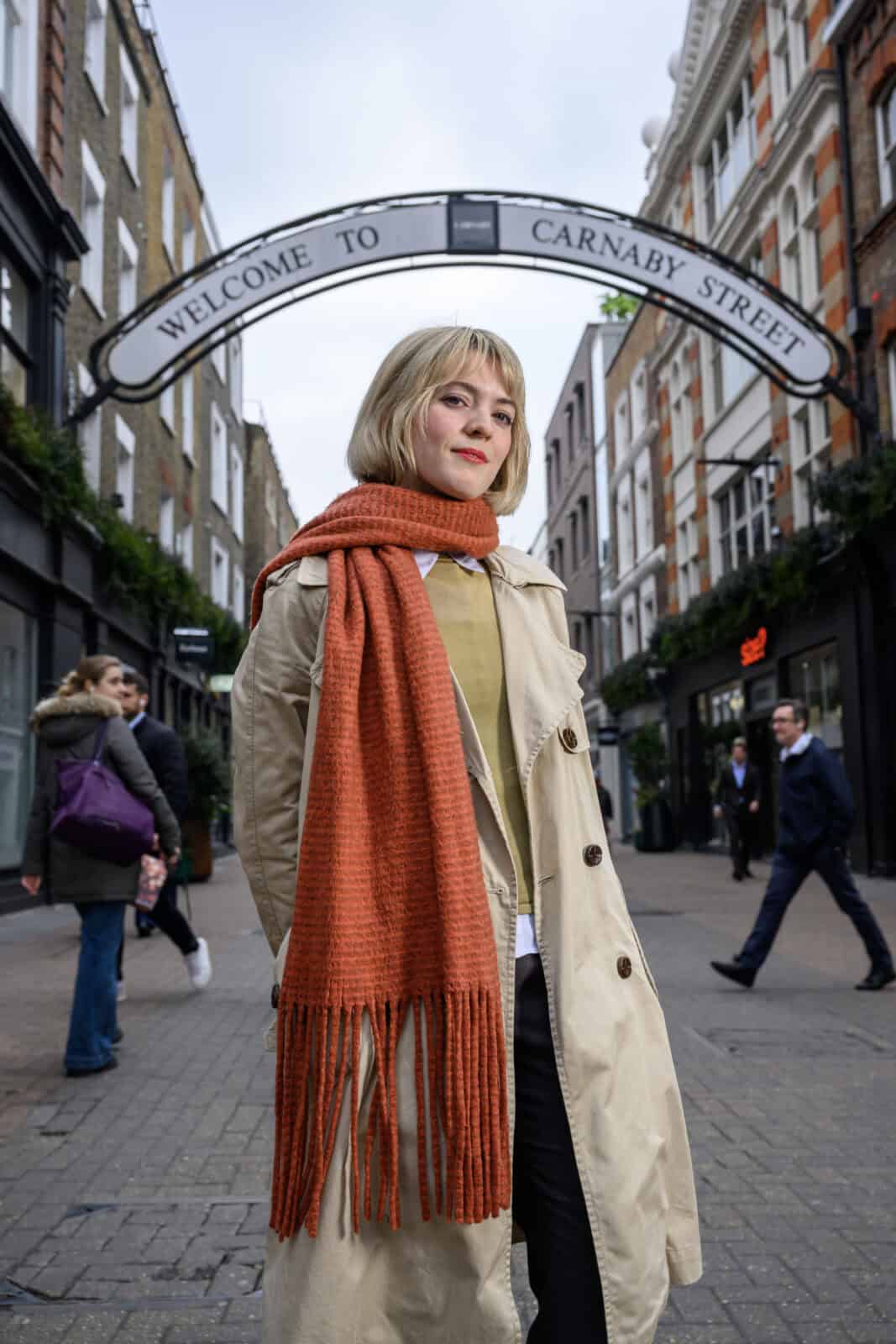
I met with Tilda early in the morning – at least early for me – but she already seemed completely awake, as though she had been up for hours before I arrived. Soft-spoken and extremely humble, Jonathan carried none of the performance that fashion can sometimes encourage, despite being clearly and undeniably gifted. She mentioned, politely, that she had prepared notes for the interview, though once we got talking I don’t think she looked at them again.
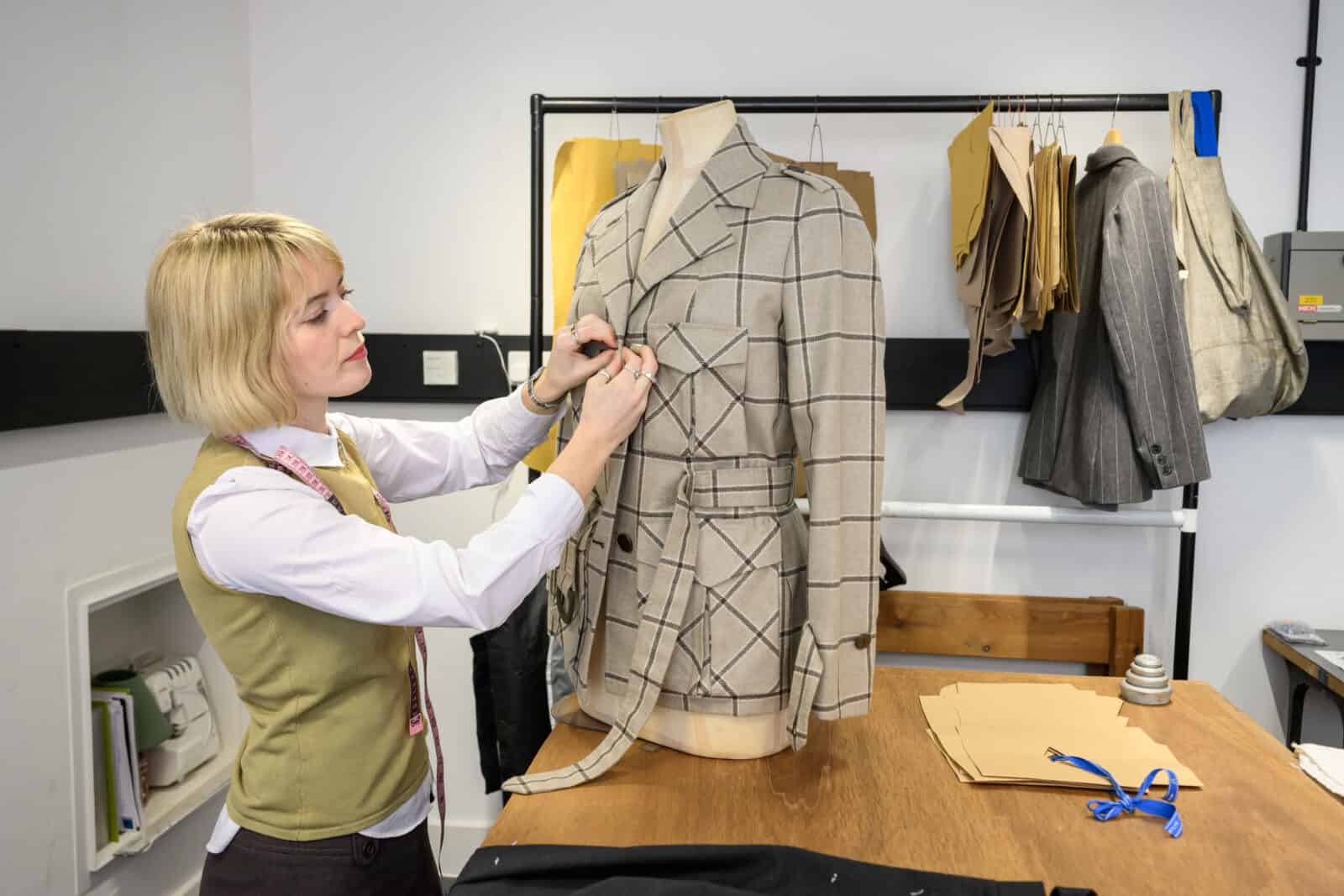
Her studio is shared with another designer, fabrics and half-finished garments spread across the room in organised disorder. Unlike the mythology often attached to fashion, Jonathan describes her practice with surprising practicality. She tries to maintain a nine-to-five routine, though admits that tailoring rarely respects office hours. There is very little romanticism around the workload involved in making tailored clothing properly.
“I’m obsessed with craft,” she says, describing hours spent watching videos of Savile Row cutters and costume departments at the Royal Opera House. We spoke about why tailoring became the discipline she chose to dedicate herself to, but what we really connected on was a shared appreciation for the analogue. Jonathan speaks about craftsmanship with genuine reverence – not in a nostalgic way, but with curiosity and respect.
It is the smaller details she seems to love most. A proper workbench, she explains, should always be made from solid wood. Then there is the iconic Brother sewing machine, described affectionately among tailors as “a beast”. Listening to her speak about these tools, it became obvious that tailoring, for Jonathan, is a precision ritual.
Jonathan’s approach also reflects a wider shift happening within contemporary tailoring. Historically associated with rigid ideas of formality, the craft is increasingly being reinterpreted through androgyny and more fluid ideas of identity. She speaks passionately about wanting tailoring to feel accessible rather than intimidating, while still preserving the technical rigour that defines it.
“I remember after lockdown there being this whole thing of, like, no one’s gonna wear suits anymore,” she tells me. “Everyone’s working from home, no one’s gonna wear tailoring.” She pauses slightly before dismissing the idea altogether. “I think that’s so diminishing – reducing suits to just office workers and bankers. There are so many other people who want to wear stuff like this.”
Importantly, 26 Kingly Street does not feel divided between old and new. If anything, the building functions through exchange. Jonathan describes older tailors lending equipment and sharing knowledge accumulated over decades. In an industry often criticised for gatekeeping, the atmosphere inside the building feels unusually communal. There is respect flowing both ways.
That sense of continuity matters. British tailoring occupies an uneasy position within contemporary fashion. As fast fashion accelerates and trend cycles move online, consumers are buying around 60% more clothing than they did in 2000 while keeping garments for roughly half as long. Craftsmanship is at risk of becoming aestheticised, yet younger designers seem increasingly drawn to its permanence.
Soho itself mirrors that tension. Much of the area’s independent creative culture has been pushed out through rising costs and redevelopment, replaced by global retail chains and carefully branded versions of “cool”. Spaces like 26 Kingly Street survive hidden in plain sight above the crowds below. Their existence feels increasingly fragile.
But perhaps that fragility is exactly what makes this all feel so important. An industry known for its precision and discipline is now opening itself to younger designers, passing down techniques and knowledge that might otherwise be lost. Powell’s sharp independence and Jonathan’s optimism exist within the same region, connected through a shared respect for the discipline of making clothes properly.
Back downstairs, the gold lettering outside catches the light modestly. Most people walking past will never notice it. Inside, though, tailoring’s past and future are in constant dialogue, passing skills from one generation to the next.


