
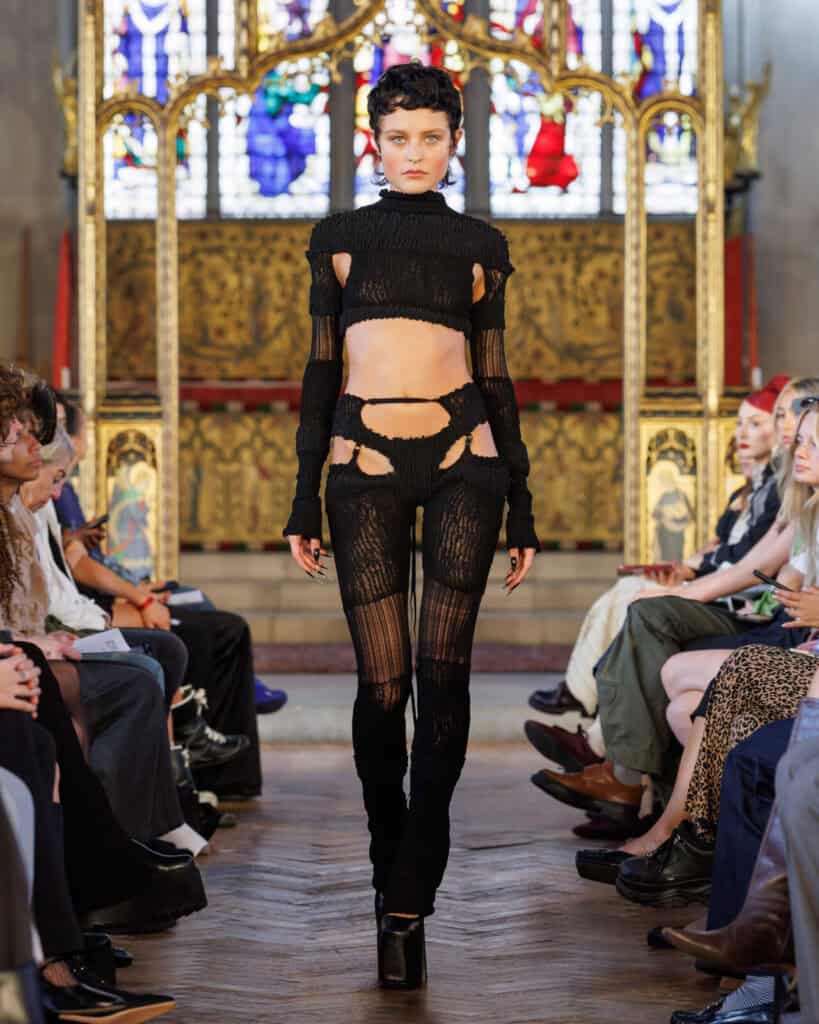
Dreaming Eli is the London-based label founded by Sicilian designer Elisa Trombatore, a brand shaped as much by emotion as by construction. After completing the MA Fashion programme at Central Saint Martins in 2021, Trombatore launched Dreaming Eli that same year and soon secured a place on the London Fashion Week schedule. The label operates on a made-to-order model, producing small quantities from its London studio using deadstock and upcycled materials, with lifetime repair services offered as part of its commitment to longevity. Each piece passes through the studio slowly, shaped by hand and by time, carrying the imprint of process as much as design.
The brand is best known for sculpted corsetry, sheer layers, exposed construction details and silhouettes shaped around the body’s movement. Trombatore’s designs sit close to the skin. You see boning, seams, lacing and fabric tension. You also see softness, drape and translucency, often in the same look.


I spoke to Trombatore just after her Spring/Summer 2026 show at London Fashion Week, staged in St Cyprian’s Church. Titled My Name Is Amore, the collection unfolded at a measured pace. Models moved slowly through the nave, their steps steady, allowing time to register the details: tweed left raw with fraying seams, ribbons traced across bare skin in criss-cross patterns, vinyl biker jackets layered over lace and sheer mesh. Corseted bodices hugged the torso, while body-con dresses and jumpsuits followed the line of the hips. The palette stayed close to the body: blood red and skin-warmed cream.
The Cold Magazine (CM): Your collections often read as emotional portraits. Do you see Dreaming Eli as a way of giving form to internal states?
Elisa Trombatore (ET): Yes, absolutely. Each collection starts from something deeply personal. Dreaming Eli is a way for me to give shape to emotions, to understand them through texture and form. Each piece becomes part of my story, a reflection of what I’ve lived and felt. It’s how I stay honest with myself and with the people who connect to the clothes.


CM: When you begin a collection, what comes first: a feeling, a fabric, a silhouette, a reference?
ET: Designing has always been my way of making sense of change. When I’ve gone through grief or transformation, creating helps me find meaning in what feels chaotic. I take emotions that are painful or confusing and translate them into something that can live outside of me. Fashion allows me to transform heaviness into something that carries strength or beauty through materials and silhouettes. Over time, Dreaming Eli has become a timeline of growth, every season marks another stage of understanding myself, as a woman and as a designer.
Between collections, that timeline shows up in construction. In My Name Is Amore, tweed was deliberately undone, seams frayed and edges left raw. Corsetry softened into body-con dresses and jumpsuits cut close to the skin, following the line of the waist and hip. Ribbon traced the spine of dresses and ran down the front of trousers, crossing bare skin in a criss-cross pattern that suggested stitches pulled tight.
CM: The body sits at the centre of your work. What do you focus on when you build structure and silhouette?
ET: The body is everything in my work. I’ve always been fascinated by how it moves. Pole dancing has taught me a lot about that, about strength, control, and release. It’s such a physical form of self-expression, and I think that translates directly into how I design. I use structure not to restrict the body, but to highlight its power and presence. I want my pieces to move with the body, not against it.
CM: You dance pole. How has that changed the way you think about clothing?
ET: It makes you pay attention to weight, balance, grip, and exposure. You notice what catches, what slides, what holds, what shifts. It also changes how you look at strength. A body can look soft and still be powerful. That stays with me when I am cutting and fitting.
CM: Corsetry comes back season after season. What keeps pulling you to it?
ET: That tension is where I feel most at home; at place. I’m always moving between the need for control and the need to let go. Some days I’m drawn to structure, to precision, to clean lines. Other times, I want everything raw and soft, to let the materials breathe and come alive.
CM: You grew up in Sicily. How does that background show up in Dreaming Eli?
ET: Sicily is always with me. The island has this mix of beauty and intensity that I relate to deeply. Growing up there also meant seeing how women were expected to behave or dress, and that has shaped my desire to challenge those ideas through my work. My collections often speak to that duality: strength and softness, passion and restraint. I think it’s my way of rewriting what femininity means to me.


CM: What did you absorb from those expectations around femininity and dress?
ET: You carry the rules even when you leave. I felt them around me growing up, in what was considered acceptable, respectable, desirable. I think my work comes from living with those pressures and then taking them apart through clothing.
CM: Do you draw on nostalgia when you design?
ET: Yes, definitely. Nostalgia comes naturally to me because I’m very connected to where I come from. I grew up surrounded by stories, traditions, and the kind of beauty that feels timeless. The past is always present in my work, but it transforms as I do.
CM: Dreaming Eli operates on a made-to-order model. Why has that pace mattered to you?
ET: It’s definitely a challenge. The industry moves so fast, and there’s always pressure to keep up. But I’ve learned that staying true to the rhythm of Dreaming Eli is more important than chasing speed. The slower process allows me to stay connected to what I’m making. It also keeps the emotion behind the work alive. I’d rather create less but with full intention.
CM: What does that slower process look like in practical terms?
ET: I try to always return to the human side of what I do. Draping every piece myself, when I’m in the studio, touching fabric, fitting it on a real body, that’s when it becomes alive again.
CM: What do you want the wearer to feel when they put Dreaming Eli on?
ET: I want anyone who wears Dreaming Eli to feel free in their own skin. The pieces are an invitation to express emotion and desire without restraint, to step into whatever version of themselves feels most real in that moment. I want them to feel empowered and that they feel seen.
CM: Do you think clothing can carry memory?
ET: Yes, completely. A garment can hold memory of who you were when you wore it, how you felt, what you were going through. When I design, I think about that. I want each piece to carry those emotions forward, to become part of someone’s story.


CM: If one of your collections were a season, a memory, or a dream, which comes to mind?
ET: My Name Is Amore feels like a dream that comes after a long night, that soft, calm light after struggle. It’s about surrender, about letting love in without losing yourself. It’s a moment of relief and maturity, like finally being able to breathe after holding it all in for too long.
CM: What are you learning to release creatively, and what are you leaning into now?ET: I’m still learning to let go of perfection and the instinct to control every detail. I’ve realized that imperfection often holds more truth and emotion. What I’m embracing now is trust in intuition, collaboration, and the natural rhythm of the process.


