
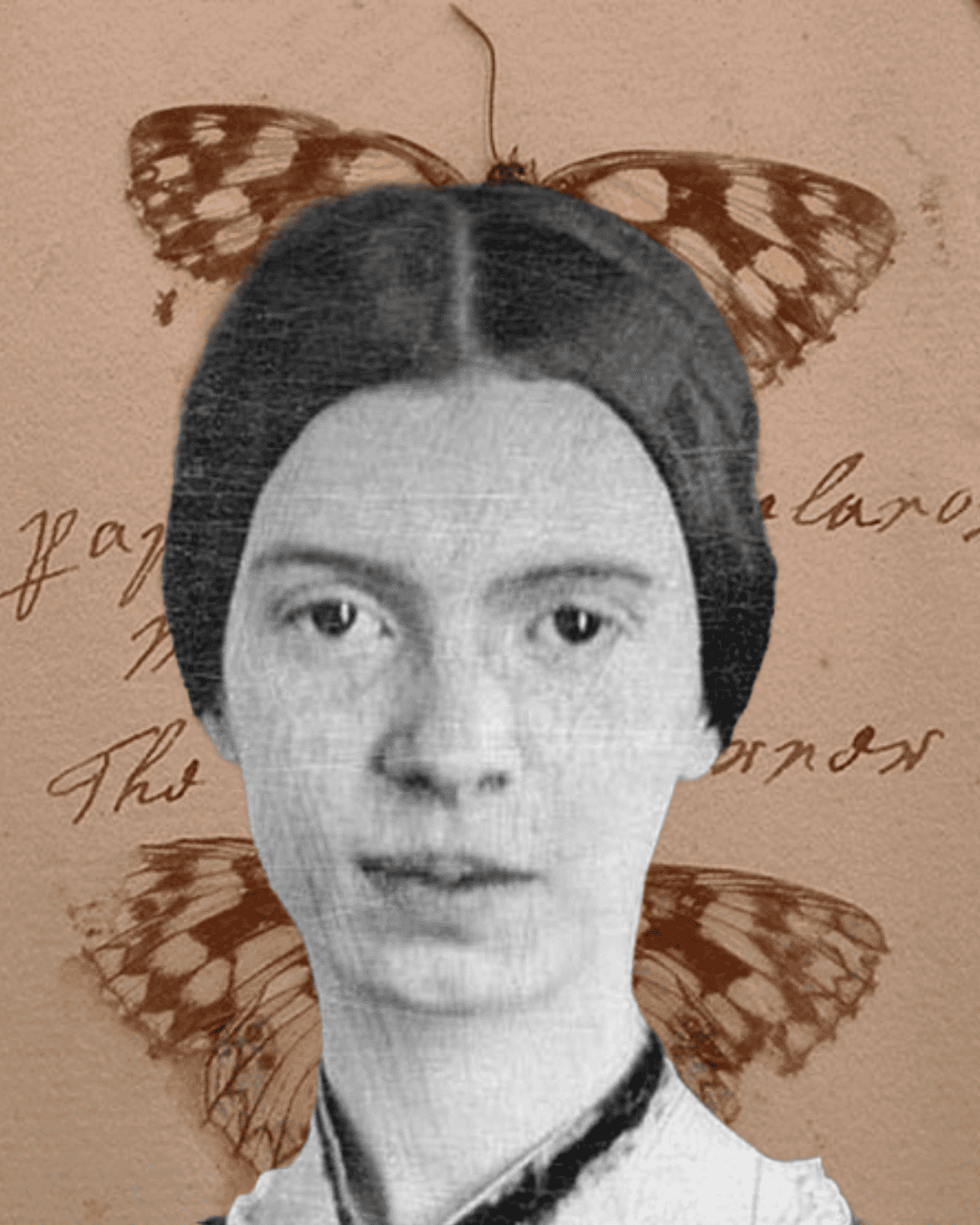
One-hundred-and-forty years ago today, Emily Dickinson’s body was carried through a field of buttercups to her final resting place. The poet had spent much of her life envisioning and pondering this moment and, after a lengthy sickness, probably greeted it with grace.
Almost a quarter of the 1,800-plus poems she wrote deal with death in some way. Even in life, Emily was surrounded by death. Her religious upbringing adorned her mind with images of the subject and she experienced the death of the world in the harsh New England winters. Her writing was often dark, but also inquisitive, interested and teasing about the nature of the dark subject.
But in our more secular and modern world, death has become somewhat of a taboo. Very few are greeting death with grace in 2026. A fear of it manifests itself in plastic surgery fads that are aimed to extend youthfulness and in “clean” diets that promise long life. We’ve seen billionaires like Bryan Johnson spend millions annually on an extreme anti-aging regimen with a long-term goal to reverse his biological age and live indefinitely. Kris Jenner’s age-defying facelift was front page news and diet trends like the Blue Zone diet that have seen people replicate the diets of the world’s longest living people.
But what Emily Dickinson did was treat death as a real thing, there to be seen, accepted and ultimately learnt from.
From an early age, Emily seemed focused on death and its mysteries. At age 22, she wrote to a friend, Jane Humphrey (or Jennie) that she “thinks of the grave often”. But why? Readers have been speculating on the death-drive in Emily’s work ever since 1890, when the first posthumous collection of her poetry, Poems by Emily Dickinson, was published by her friends Mabel Loomis Todd and Thomas Wentworth Higginson. This volume introduced her work to the wider public, and included the iconic poem, “Because I could not stop for Death”.
It was death’s “tremendous nearness” that shaped her writing and actions in life. In another letter to a grieving friend, Emily writes, “death is an intimate friend, not an enemy”.
But Emily was also someone who valued life, her friends, relationships, love and the natural world. She was a keen gardener and, during her lifetime, was more known for this than for her secret passion of writing. Her many letters to Susan Gilbert Dickinson, her sister-in-law, lifelong confidante, and “biggest heart”, show someone deeply enamoured with life. “Hope is the thing with feathers” remains one of the poet’s most popular lines.

Manuscript of “Hope is the thing with feathers”
She wrote about life and death, equally, in their full greatness – “The life we have is very great. The life that we shall see, surpasses it, we know, because it is infinity”.
This is why death plays a starring role in her poetry. Emily knew that life and death were two sides of the same coin.
Much like Emily, I’ve had time to ponder over death. A depressive breakdown aged 23 and the loss of my nan dominated my 20s. It was a harsh winter in 2017 when I felt the “Gentleman caller” (as Emily refers to death in “Because I Could Not Stop for Death”) on my own back. After two weeks of intense anxiety where I trudged around in a mist, on Boxing Day, a sharp pain pounded out of the basin of my neck and into my head.
I woke the next day in a deep hole of depression, unable to eat, dress or speak. It was a week before my 24th birthday and that shadow was watching me. Emily’s poem – “I felt a Funeral in my Brain” – perfectly encapsulated what I was feeling. She writes:
I felt a Funeral, in my Brain,
And Mourners to and fro
Kept treading – treading – till it seemed
That Sense was breaking through –
And when they all were seated,
A Service, like a Drum –
Kept beating – beating – till I thought
My mind was going numb –
Numb was exactly what I was feeling in the months after my depressive episode. To know someone else had experienced this and was able to put it into words was a revelation for me. Not only did someone else understand me, but I discovered that Emily’s poetry could help my broken mind.
In the years since, I have been able to shake off the shadow, but I was forever changed by my experience with depression. Having faced my own mortality so young, the rest of my twenties and, now, my early thirties, have been spent quite cosy with the concept of death.
I now know what it is to stare into the abyss, not scared but grateful and intrigued. When my depression had subsided and I was then faced with the grief of losing a loved one, poetry was my armour. It seems natural that I’d feel at home in Emily’s world, where the lines between life and death are continually being redrawn and reconsidered.

Emily Dickinson’s gravesite in West Cemetery, Amherst, Massachusetts. Photo by Lisa Beth Anderson
Physically my brain can accept what happened but it never made sense that someone could be gone. Gone where? How do I get them back and keep them? “I need to ask my nan about her recipe for apple pie” was my first thought when I sat in her empty seat in her living room.
It was Emily’s poetry that helped me come to terms with my loss of self, losing a loved one and the presence of death in my life. In her words, death is an evil, unwanted guest and a trickster but he is also a friend, a lover and a trustworthy driver, ready to take you home comfortably when you need it. She taught me that the inevitability of death doesn’t have to be a source of despair. We can choose to accept death as a natural evolution of life, with open arms.


