
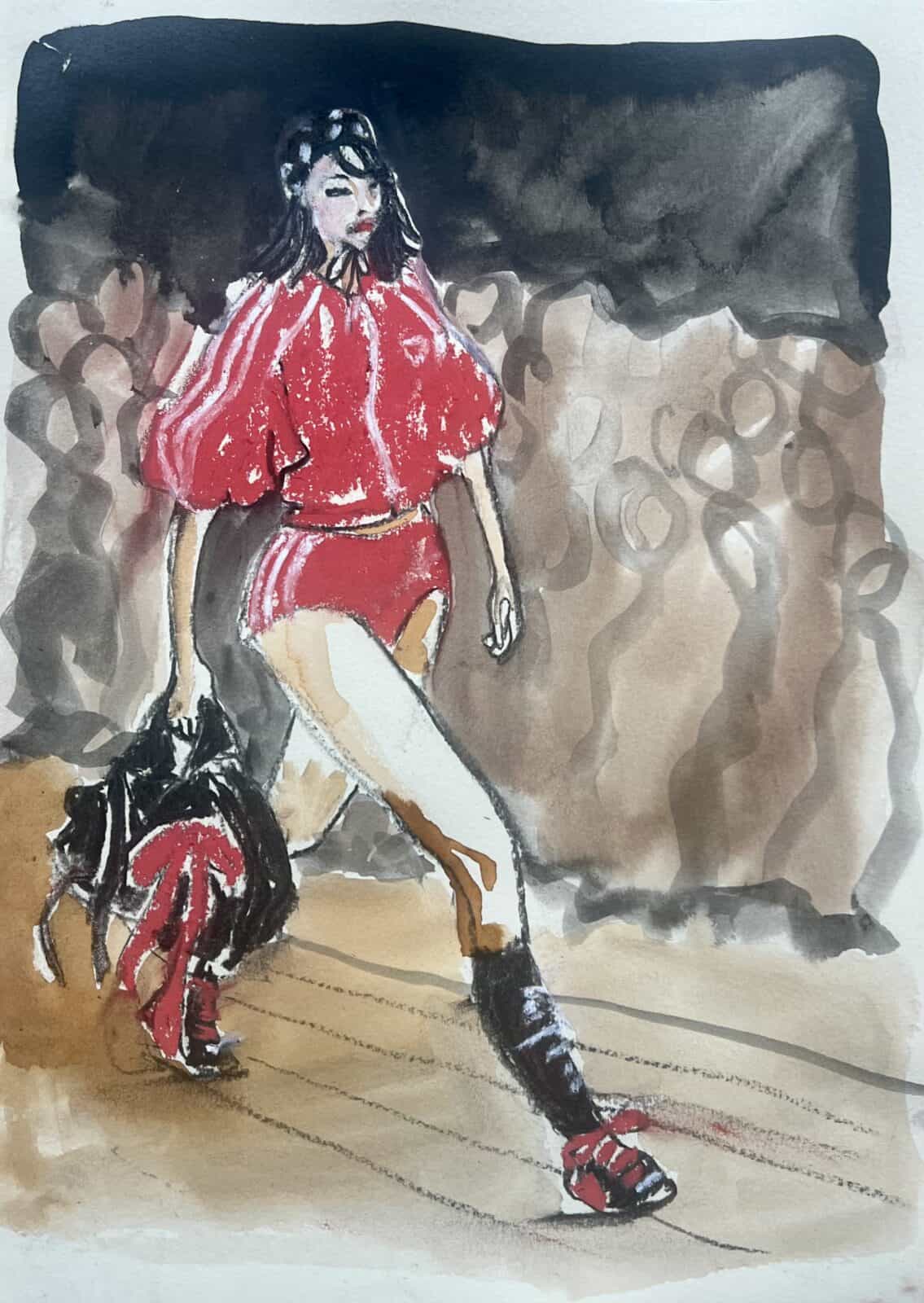
Fashion week is often captured through camera lenses and smartphone cameras. As photographers cram their way into photo pits, pushing and pulling, arms outstretched to get the best possible shot, there’s another kind of documentation happening concurrently. This comes through the varied perspectives and illustrative styles of physical artists.
In previous seasons I’ve witnessed the subtle use of drawing pads, pastels, and pen ink in place of iPhone cameras across presentations and runway shows. I’ve shared queues with these same creatives awaiting entry. As the doors open, artists and other attendees share a similar intensity when it comes to securing the best view. Which makes sense, their work relies on their ability to adequately position themselves so as to witness the undulating layers wavering past and sartorial curation from the closest manageable vantage point.
London Fashion Week AW26 was not much different. Except for the fact that I found myself repeatedly crossing paths with these very illustrators, seemingly many more than previous seasons. It appeared as though this style of documentation had taken another form, with the push offline, towards more physical media. That said, it felt fitting to take some time to chat with five different London-based illustrators and artists who documented this most recent season.
Instead of taking the time to snap images, they worked tirelessly, to document the looks as they unfolded in real time. Each artist was able to offer a little more insight into what it is that they appreciate most about the ways art and fashion blend in their practice.
Elyse Blackshaw | @elyseblackshaw
Erdem

The Cold Magazine (CM): What do you think fashion illustration brings to fashion week?
Elyse Blackshaw (EB): Designers are celebrated from their unique perspectives and ideas. When we look at fashion, we can of course read into the narrative of the collection, but we are also encouraged to view and interpret it through our own lens. Live fashion drawing embodies not just the visual aspect, but the music, storytelling and atmosphere of the show. I’ve always seen fashion illustration as an alternative to press photography during fashion week.
CM: Why do you think it’s important to show the live blending of art and fashion to the runway/presentation?
EB: In the media, fashion illustration disrupts the repetitive photographs and reels we may see. It reminds us that artistry is what is always at the heart of each collection. It almost acts as a full circle moment – starting with a sketch and finishing with a sketch. In a world of evolving technology and AI, live art and fashion symbolises human connection in real time, and the continuation of hand craft processes.
CM: What was your favorite show of LFW AW26?
EB: I was particularly moved by the Yaku presentation and performance due to its multi-sensory aspects – the fabric pins given to attendees, the choreography and audio narration. It transformed Yaku’s conceptual fantasy into a tangible reality, seeing the clothes not just worn but lived. The empathy created towards the models / characters, alongside admiration was really clever. I was totally immersed in Yaku’s world. I love when shows move away from traditional runway and embrace performance and dance.
Saasha Akighir | @saasha_a
Yaku Stapleton

The Cold Magazine (CM): What do you think fashion illustration brings to fashion week?
Saasha Akighir (SA):Having an artist whose style and vision aligns with the brand captures a unique POV that can really help to elevate the work, and give another avenue to tell the brand’s story. Sometimes an illustrator is able to situate the art in a place that the runway cannot, and to me that helps to better build the world.
CM: Why do you think it’s important to show the live blending of art and fashion to the runway / presentation?
SA: It brings a dynamic element because you have to immediately show what stands out the most. If the fabric swishes and the model bends their body strangely you have to get that in an instant or rely on a memory. I think this adds an extra layer that the presentation may miss or a camera can’t emphasise. Also being able to paint a guest and give them something immediately to go home with makes them feel like a part of the show, they are a part of the documentation.
CM: What was your favorite show of LFW AW26?
SA: Angus Tsui and Robert Wun.
Louise Boughton | @louiseboughton_
Patrick McDowell

The Cold Magazine (CM): What do you think fashion illustration brings to fashion week?
Louise Boughton (LB): I think illustration brings a unique element to capturing the energy of fashion week. Each drawing is different and reflects the artist’s style and individuality. When drawing quickly, it is possible to capture the essence of the show and the silhouette of the garments in just a few lines.
CM: Why do you think it’s important to show the live blending of art and fashion to the runway / presentation?
LB: I think it is hugely important. Live drawing can be an innovative way to record the narrative of the show, the moving garments, the guests and the models. Artists can interpret different looks with varied media and approaches and having an artist drawing live is intriguing for guests. It’s an extension of the creativity already present in the show.
CM: What was your favorite show of LFW AW26?
LB: I really loved the Patrick McDowell show this season. The garments were exquisite. Beautiful tailoring, gorgeous silhouettes, the fabrics were luxurious and so skilfully structured. It was amazing to draw them live.
Emma Tsilele | @junk.portfolio
Chopova Lowena

The Cold Magazine (CM): What do you think fashion illustration brings to fashion week?
Emma Tsilele (ET): There are details that can be captured through illustration that give a more honest depiction of a show’s tone, through the illustrator’s lens– therefore, making art out of the art. This ‘honest depiction’ does not have to be rooted in actuality, but can have the artist’s own spin on the source material (which adds a level of depth), while still remaining faithful to the subject matter. This artform can be deeply immersive and insightful to the viewer. Unlike photography, for example, where the artist cannot influence the final image outcome as much, illustration is active, allowing the artist to realize their vision of what is in front of them by simply observing their subject.
CM: Why do you think it’s important to show the live blending of art and fashion to the runway / presentation?
ET: It is important to blend these two artforms because illustration can be used to capture a moment in time, and its atmosphere with an added level of artistic flair. This is because the illustrator can immerse themself as a viewer in order to develop an outcome that correctly represents, yet subverts expectations. An illustrator can reflect and react to the environment, energy, and the garments in real time, while simultaneously injecting their own unique aesthetic.
CM: What was your favorite show of LFW AW26?
ET: I loved the interactiveness of Chopova Lowena’s AW26 Presentation. Being able to study the garments up close allows viewers to fully appreciate the craftsmanship behind the collection. Chopova Lowena’s garments are very maximalist and heavy on the pattern mixing, which could potentially ‘distract’ viewers from analysing the details–as normally they cannot see these garments in close range IRL. So this idea of a live interactive presentation is genius as it brings focus back onto craftsmanship and welcomes viewers into Chopova Lowena’s world.
Tracey Smith | @fashionbunnysmith
Simone Rocha

The Cold Magazine (CM): What do you think fashion illustration brings to fashion week?
Tracey Smith (TS): Illustration can capture the atmosphere and vibrancy of fashion week in a very different way to photography. It’s an immediate, personal response to what the illustrator sees and each illustrator brings something totally unique.
CM: Why do you think it’s important to show the live blending of art and fashion to the runway / presentation?
TS: For me, a catwalk show is never just about the clothes. It’s a whole world of people and inspirations, with art often influencing the designers, so fashion and art always go hand in hand. Having live illustrators at catwalk shows gives another point of interest and a new perspective on the whole event. More designers should invite illustrators to their shows!
CM: What was your favorite show of LFW AW26?
TS: I didn’t get to attend many shows in person this season, but I was lucky enough to go to the Yaku presentation which took a show format and I have to say that I am always blown away by Yaku’s story telling and world building. It’s an incredibly immersive experience and was my favourite moment of LFW AW26.


