
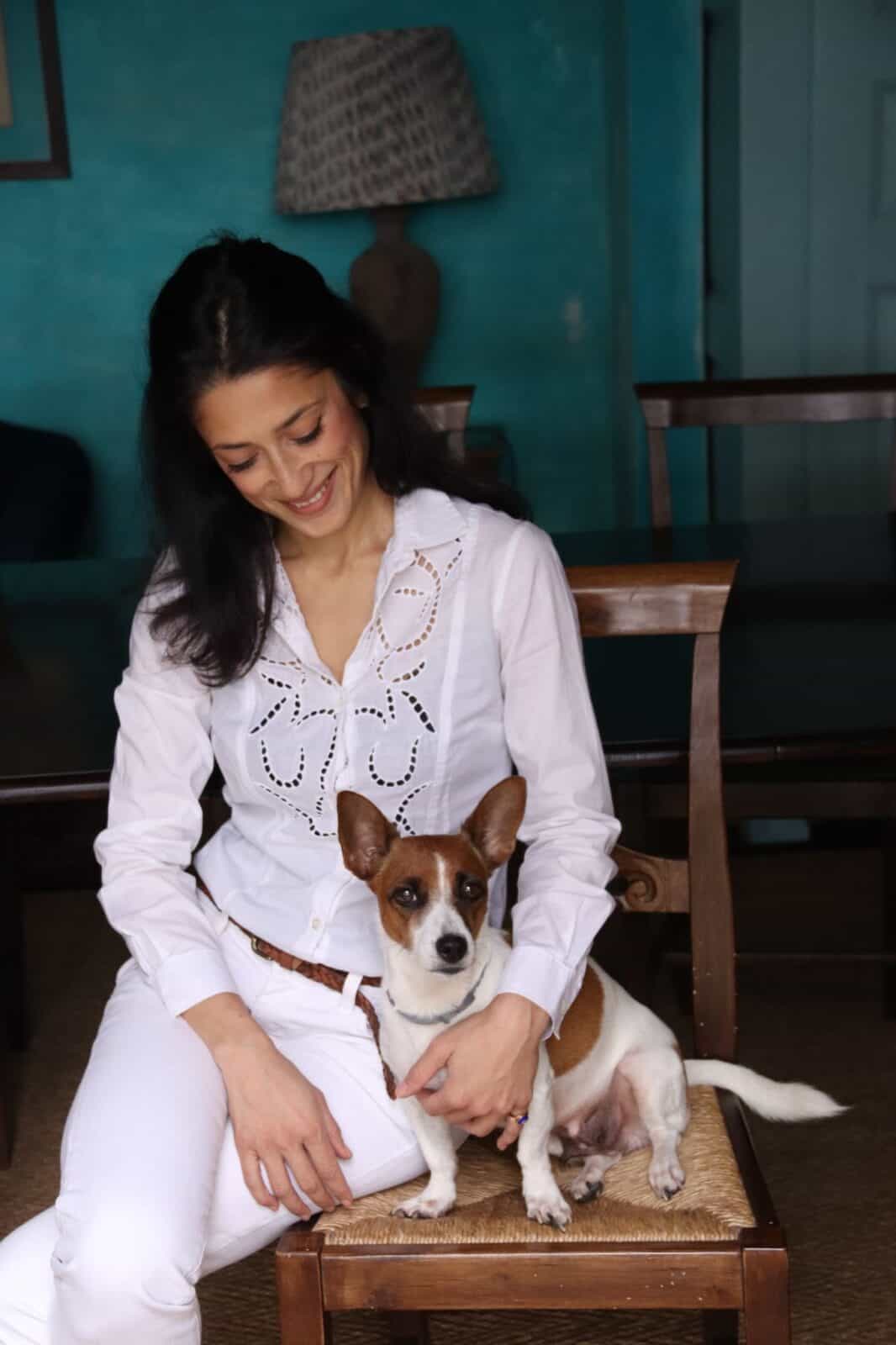
They say dogs are a man’s best friend, and writer Fatima Bhutto has plenty, both in her writing and in her home. When we speak, she glances off-camera at her two dogs Coco and Tokyo, and laughs, predicting that one of them will erupt into a bark at any moment.
On the contrary, they are silent, well-behaved throughout, calm in Bhutto’s presence. They run like a current through her latest memoir, The Hour of the Wolf, which was published by Daunt Books in February 2026. Bhutto was still a teenager when her father was shot dead outside their home, a political killing that shattered any illusion of safety. Grief came with the ache for something softer than the world she inherited.
Years later, when she meets a man who promises love and stability, it proves intoxicating and she falls hard. Beside her throughout is Coco, her small, fiercely devoted Jack Russell terrier. But when he turns his cruelty onto Coco, what she might have endured for herself becomes unthinkable for her companion.
The Hour of the Wolf maps Bhutto’s journey through his manipulation and the painstaking efforts she takes to escape. I sat down with her to discuss her writing philosophies, about the books and thinkers that have stayed with her, and most importantly, her love for her dogs.
The Cold Magazine (CM): I wanted to talk to you about your writing process. The Hour of The Wolf evolved out of an essay for Granta Magazine. At what point did you realise that it needed to become something larger?
Fatima Bhutto (FB): Actually, it was already a booklength piece when Granta Magazine had published that excerpt. It was a very different book at the time. I had been working on it for 2 years and it wasn’t coming together in the right way. I couldn’t understand why. It was at that point that my agent sent the section to Granta and that gave me another push to keep on writing.
It was always going to be a book length creature. I like that it’s a short book as, since Covid-19, my attention span is so damaged and I cannot read like I used to. You also feel like you can inhale a book that is slimmer.
CM: So what was it about that section of the memoir that you wanted to make into an essay? Why focus on your relationship with animals and Coco’s pregnancy?
FB: I think before Coco’s first pregnancy, I was always attached to animals. I always haddogs. Coco’s suffering during her first pregnancy took me aback. I could see she was in pain. It made me see life differently, I always had a longing to be a mother. It was this incident that planted the seed in me to write my book. I couldn’t shake thinking about it.
CM: You just called The Hour of The Wolf a creature in itself. Do you think writing is an evolving, organic, practice that grows almost naturally inside you?
FB: It’s definitely a living, breathing thing. I always feel that about whatever I’ve written. It always takes on a life of its own. It has to be a moving, changing thing because it lodges itself somewhere inside of you. It becomes all you can think about. Even when you’re asleep. It colours what you see around you and becomes a shadow somewhere. I do believe that books really are creatures.
CM: There are obviously lots of creatures within your memoir. The entry point of the work feels like this mythic encounter with Coco and a deer. Did you always know this was going to be the book’s beginning?
FB: I didn’t know until the puppies were born that I was going to turn it into a book. I remember when the birth happened, especially the first bad one. It was Covid and we were going through this really weird moment with staying in touch with friends on zoom. We were in Italy at the time and I decided to start taking little notes in a notebook about her pregnancy and the upcoming birth. I would send myself voice notes to keep me up to date and afterwards, when they were born, it was so captivating and entrancing that I wanted to record it.
In January 2021, I decided to sit down on a desk, in a room, to begin something longer, something more serious. It began with the deer, a snapshot of a period in Oxford with me that felt rooted in my connections with animals. It was so otherworldly, like a talisman or a sign.

CM: How did you balance the stream-of-consciousness elements and the philosophical, scientific and religious reflections in the book?
FB: I like the theory that animals do have proper feelings. I find studies by Francis Deval very convincing. I was always worried that I wasn’t serious enough to write about animals. So when I started to write on that desk in Italy, I thought, how am I going to make this serious? That was my own insecurity. I don’t actually care what scientist X in university Y has said about our interactions with them because it’s not a book about that. It’s about how personal, private and intimate relationships with animals are meaningful to us.
The religious sentiment and all the other stuff was just generally what I was feeling, and I didn’t understand because, in this period of total uncertainty for me, I wanted answers so badly. It’s like the more I wanted answers, the more they were out of my reach. The deer, the wolf and the religious stories kept appearing to me. I wanted to know why, and it was really much later that I thought – the joy of this is the revelation. I don’t have to know why. It’s quite wondrous that this story appears when I wanted it to and when I needed it to.
CM: Did you ever feel whilst writing about this toxic relationship that writing was a kind of therapy? Or did you find that it was worsening your trauma?
FB: I never thought it was making things worse. Oddly, though I don’t inherently think of writing as bringing closure or healing, it did make me feel better. When I wrote Songs of Blood and Sword about my father’s life and assassination, I thought that it would make me feel better but it did the exact opposite. It just brought everything up to the surface again and made me feel miserable.
I thought it would bring me a kind of justice but it didn’t. With The Hour of The Wolf, I didn’t come to write it with those expectations. It did allow me to look back at things in the cold light of day and celebrate those moments of beauty that brought me so much joy, those small acts of tenderness and kindness that mean so much to me.
CM: Do you often share your writing with your friends or does it stay private?
FB: I am very secretive. I suppose it is due to the kind of childhood that I had. I’m especially private about my writing and will never tell anyone about what I am writing. Even Allegra, who is the friend mentioned in the book who stays with me in its composition, didn’t really know what I was writing. I kept having to be secretive around her.
CM: How does your experience as a journalist influence your writing?
FB: I think it’s a very delicate balance. Good journalism, great journalism, or at least memorable journalism, is always powered by the writers. It is about their attention and their focus. The writer must focus their attention onto something they are absolutely unwilling to let go of until they have exorcised it from themselves by investigating it.
In The Hour of The Wolf, I didn’t feel that as I was writing about my own dog, my own experience and about myself. I think you are allowed to pass through the subject material when writing a personal essay or memoir and you shouldn’t really do that in journalism. You are the conduit in your own writing. I mean, wouldn’t most people want to write a book about their dog? Maybe, I don’t know. It was important for me to grapple with the reasons behind why I was writing this book. The moment this book took shape was the moment that I, as a person, connected with it.

CM: Would you say that dealing with animals allows you to explore elements about humans that you couldn’t find the words for?
FB: I didn’t really think of it that way at the time. At least, not consciously. But it occurs to me after the fact, that the reason I was so interested in my dog was because I was fascinated by my relationship to purity, to care, and to tenderness. These things mattered precisely due to the fact that the relationship with this man was the total opposite of that.
CM: Did you find that your relationship to your writing is almost an animal one? As if, it was a wild uncontrollable idea or impulse behind the plot of the story that gradually became domesticated as you went on writing it?
FB: I was always fascinated by looking at dogs and thinking what will come after. They arrived through years of evolution out of wolves. The most wonderful thing about writing is that you spend your time thinking about things like this. I guess that looking back, writing is about investigating a primal, feral idea and making it into something. It’s such a luxury to be able to do that.
Fatima Bhutto’s The Hour of the Wolf, published by Daunt Books, was released in the UK in February 2026.


