

Edinburgh-based playwright Conor O’Dwyer is as proud of being gay as he is of being Irish. His theatre work has been called joyful, defiant, and unafraid. He blames his Libra moon.
Whilst we speak, Conor brings down the statue of Oscar Wilde he has on his bookshelf, an emblem of the two communities he best represents. Extending his permanent grin across his face, he says he has absolutely no idea what the statue is made of before quickly apologising for “flexing” the writing award he won at The Dublin Gay Theatre Festival for his debut theatre show.
Homo(sapien), his first stage play, is the coming-of-age story of Joey, a certified Bad Gay. Joey has never had sex and has never tried drugs, but all that is about to change. Fearing that he will die a virgin, Joey embarks on a misguided, queer odyssey to “get his hole”.
The Cold Magazine sat down with O’Dwyer to discuss his inspirations, and what it was like growing up queer in a small Irish town dreaming of a career on stage.
The Cold Magazine (CM): What were your early inspirations for writing?
Conor O’Dwyer (CO): I started playwriting accidentally but have always loved writing in different forms casually, even English essays during school. Up until Covid-19, I was strictly an actor, predominantly working on screen. That was until my agent dropped me when the industry completely shut down during that period.
To be honest, I feel that, even before then, my experience as an actor was often one of disempowerment. You would audition for things and it felt like the fate of your career was dependent on other people’s acceptance of you. In frustration, I turned to writing. When I moved to Edinburgh in 2021, the desire to write followed me.
Before, when I moved countries, it was just about chasing the arts industry. But with Edinburgh, I found a place that helped me write plays as I was surrounded by upcoming professionals in the theatre circuit.

CM: When did you start writing Homo(sapien)?
CO: I had done comic sketches on YouTube over the pandemic. These were around two or three minute long commentaries and satires on gay hookup culture. After I had done maybe 50 sketches, I eventually thought these could be turned into a show when we came out of lockdown.
I remember one of these being a dick versus brain sketch. It eventually evolved into Joey’s sex drive having a Scottish accent and camp Jesus in Homo(sapien) when I combined it with the type of humour that I have with one of my Edinburgh friends. It’s just really filthy and stupid.
CM: How would you categorise the genre of plays you write?
CO: There’s this amazing playwright who has always inspired me called James Ley from Glasgow. He’s mid-career, established, a very good name in Scotland and a brilliant writer. He’s into this theme of queer joy which uses comedy but also is incredibly emotional and raw.
He has this play called Wilf, which is about a man who gets out of a toxic relationship and then projects his love and affection onto a car. It combines deep emotive undercurrents with scenes where a man appears grinding on a car’s gear stick. This is the type of writing that has inspired the way I like to do theatre.
CM: How did growing up in Ireland influence your experience of the performing arts?
CO: The Irish school system was a tricky one for me. My school wasn’t very supportive of the arts. It was all-boys, known for leading in maths, science, and sport, but there was no focus at all on educating the students in art, drama, and music.
I found my outlet outside of school with speech and drama classes, and took part in performing arts on Saturday. Eventually, I joined Galway Youth Theatre and experienced classic Irish writers’ work for the first time like Martin McDonagh’s Leenane Trilogy and Oscar Wilde.
CM: Is Homo(sapien) a personal narrative?
CO: It’s more complicated than just saying that the plot is true or not true. Let’s compare writing a play to planting a tree.
If the soil is my actual past then the tree that grows in that soil is the fictional play. For the most part, the plot of Homo(sapien) is fictional, but the truth of the play and its essence, is very much my own lived experience of growing up gay in Ireland.
CM: Tell me more about your experience growing up gay in Ireland.
CO: I think there is this rhetoric, with older queers, that the younger generation has it really easy. I definitely think to some degree we do. We’re much less likely to be imprisoned or to be attacked. Thankfully, there’s less of these external oppressors, but I think there is a more sinister institutional push back against homosexuality through culture and religion.
I definitely did struggle growing up gay. I was filled with that internal conflict that Joey, my protagonist, experiences, especially the way he absorbs so much of the culture around him without noticing how it is changing him.
There’s a quote in the play by Nelson Madela from his autobiography, Long Walk to Freedom. It goes, “The brave man is not he who does not feel afraid, but he who conquers that fear”. My mum actually wrote that on a sticky note and put it in my room when I was 13-years old. I saw that everyday before I went to bed. My parents really did instill into me a real sense of courage which helped later on.
CM: How has it felt leaving Ireland as an Irish artist? Is this something that you explore in Homo(sapien)?
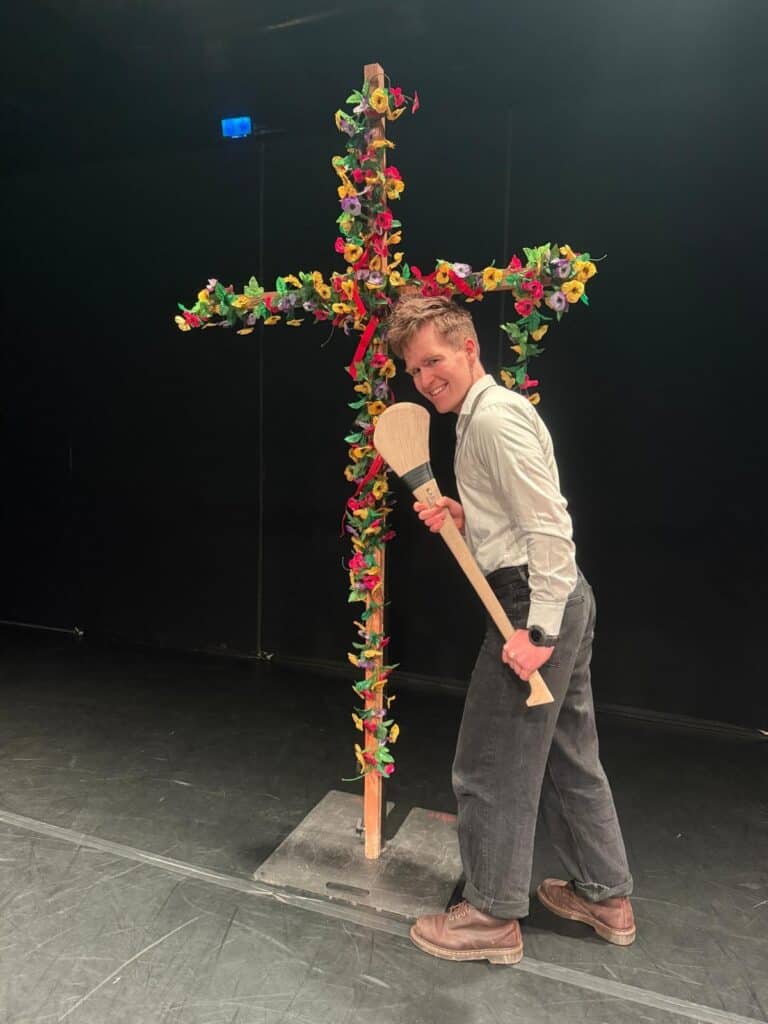
CO: Homo(sapien) ends with its own beginning, when I appear at the church door taking the shackles that I’ve put on myself off and then moving forward towards the future. In an earlier draft, I was going to lean more heavily onto the immigration side of things but it ended up as being more a subliminal theme. There is a lot of escapism and idealism, especially surrounding London, in the play.
CM: How do you approach writing about gay identity in your work?
CO: I want to do away with the trope in the media and art that shows queer people all having some tragic fate awaiting them. I want my work to be funny, to have peace, to not sit and fantasize about being in pain or being attacked. These things have not been my overall experience of being queer.
CM: Religion is treated with a lot of empathy in Homo(sapien)? Was there a draft where you treated the Catholic Church with more venom?
CO: There were drafts of the play where religion plays a larger role than it does in the final one. I think my intention with the end of this play was for it to end in a state of peace.
Joey has to make peace with religion, community, and the question of staying in or leaving Ireland. He has to make peace with sex, his sexuality, with everything. I think that, though the Catholic Church is guilty of many things and has many of its own issues, it also has incredible value.
CM: What’s next for you after Homo(sapien)?
CO: I have two more plays in the works and I want to continue to develop queer joy in theatre. We are trying to embark on a big tour of Ireland, England, and Scotland with Homo(sapien).
Currently, I am working with Framework Theatre Company in Edinburgh on a play called The Things is You Can Only Lose Once. They have commissioned me to write a piece which they will develop themselves which is exciting. It’s about this transgender character who has recently transitioned who wants to have sex for the first time post-transitioning who meets a bisexual man that wants to have sex for the last time before ending their life.
Finally, there is this third play which is about the character Mary in Homo(sapien). I think it was important for the protagonist in the play to be self-centered but I want to explore other people’s experience in other works.
Homo(sapien) is playing at Eastgate Theatre, Scotland, on the 30th of June and on the 28th of August at Pitlochry.


