
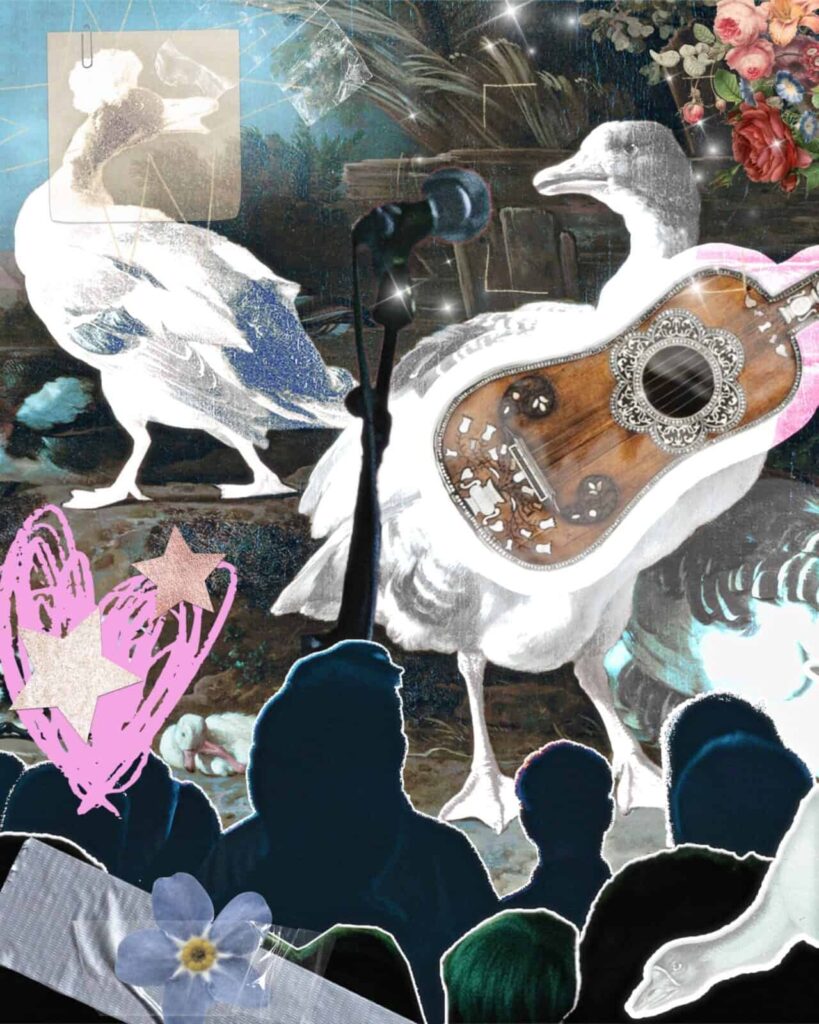
Geese’s sudden catapult to stardom was nothing but a “psyop”, headlines are screaming. But the indignant panic about the American art rock band’s authenticity says less about the “underground” of the band itself than the fear that indie is dead.
Geese was heralded as “Gen Z’s first great rock band”, the “saviours of rock ‘n’ roll” and our generation’s Nirvana late last year. They were applauded for doing it the old-fashioned way (word-of-mouth and relentless gigging in basements) instead of TikTok. Nostalgia for Lou Reed’s avant-garde scene of the 1960s hit us. But perhaps it should have raised alarm bells that Geese burst onto the scene overnight.
Hell broke loose when Wired published an article titled “The Fanfare Around the Band Geese Actually Was a Psyop”. It detailed how the digital marketing agency Chaotic Good pushed online hype campaigns to make them go viral. The agency achieves “trend simulation” through thousands of pages and burner accounts to drive impressions on whatever they want. The agency recently scrubbed its website following backlash over its “fake fan” promotional tactics. Britain’s own great Gen Z rock band, Wet Leg, is also a client.
That’s when the penny dropped. We are mistaken if we think that simply by avoiding AI-generated music, we are avoiding AI in music. Today’s stars are chosen not for the mythical energy possessed by the legends of the eighties, but by businesses manipulating algorithms.
A psyop (psychological operation) is a campaign by governments and militaries to win the hearts and minds of the public through propaganda. This time round it was to manipulate indie masses around the world. Geese was apparently the ultimate “industry plant”: an artist whose sudden rise to fame is secretly manufactured by record labels or marketing teams to appear organic.
These marketing tactics are standard industry practice these days, but when Geese were outed, fans felt betrayed. Unlike most mainstream bands, fans felt Geese had an authentic underground spirit – that raw energy that feels oddly transcendent. You either have it or you don’t, and Geese had it in abundance. Geese got scapegoated because, unlike popstars, they were held to romanticised indie standards that are barely achievable in the streaming era.
Within less than a few months, Geese had gone from relatively unknown to the face of Gen Z rock. Then, the moral panic broke out. Burner accounts were found. A sense of what was true was gone (ironically, Geese’s lyrics go “You can’t keep running away / From what’s real and what’s fake). It exploited people chasing early discovery, that feeling of being “in the know”.

What has come out of Geese-Gate is that the outrage was clearly never about marketing, but the fear that the underground is extinct. To be clear, the underground still exists, but most people aren’t plugged into that scene. Geese was the everyman’s way to feel like they were – to live vicariously through the sound of the Brooklyn basement.
The success of Geese sold a dream. Remember when rock was mainstream? It drew its last breath in the early 2000s with bands like Green Day and the Arctic Monkeys before being supplanted by pop, rap and EDM. Nowadays, rock in London is limited to small venues like the Shacklewell Arms. When “underground” band Geese blew up, it gave bands everywhere hope that their gigging would someday pay off. Hey, maybe we weren’t born in the wrong decade after all! Rock isn’t dead. Lyrics don’t have to be algorithm-friendly. The British sibling duo The Molotovs have played over 500 concerts and truly put in the graft – surely they are on the brink of success?
But now we’re left with this fear: bands gigging their ass off won’t get anywhere. That is, unless they pay an agency to manipulate the algorithm. The meritocracy that elevated Bowie is over.
We are living in a time where the thirst for authenticity is unmatched. We saw it last year in the gold rush to Copenhagen alt-pop, characterised by humble, lo-fi, “genuine” tracks made by groups of friends (but maybe that, too, is just an industry plant?). In a world where everyone is connected via satellites blurting reels into our eyeballs, it rarely feels that you ever discover something for yourself. Yet in the music world there are still many who cling onto their so-called authentic taste. None more so than the indie kids, the ones who thought they discovered The Smiths when we were 14, stomped around school in Doc Martens, and saved their gran’s pocket money to buy plastic vinyl players from HMV. When the so-called band of our generation was finally brought to the masses, they were all over it.
The issue with this, however, is that if we trace back and define what underground really is, we can find a long-lasting myth. Growing up as a Gen Z kid, you’re bound to have been told by the older generation that they went to the coolest raves before it really went mainstream into club culture, that they used to have a Velvet Underground vinyl, or that they were at the Sex Pistols gig in the Lesser Free Trade Hall. But the problem lies in that the early raves were attended by very few, that The Velvet Underground only sold around 10,000 copies when they first were around, and that only 35-40 people were at the Sex Pistols gig.
Underground isn’t a fixed identity. It is the moment before visibility arrives. The problem is that platforms now shorten that moment so aggressively that people barely experience it before it disappears. But for some reason it’s an anxiety that has produced so many fabricated memories, along with an obsession with having been there.


This doesn’t mean underground indie has vanished. In London right now spots like MOTH Club offer spaces for indie to thrive with regular and affordable nights. This generation however may just find these nights out via an Instagram story not word-of-mouth or a vibrant poster. Here lies the issue with Geese-gate. Music culture inherently has a performative proximity to coolness and when you take it away people feel robbed. This was not invented by the internet or algorithms. It just became a place for companies to industrialise it.
This industrialisation killed accidental discovery. Scenes now arrive already visible and, when it is revealed, it leaves a bitter taste in the consumer’s mouth. Scenes no longer spread slowly, they are not locally contained or difficult to access. If they are engaging and catch lightning in a bottle, then they will take off. The algorithm accelerates the growth period. Bands like Geese arrive immediately aestheticised and ready to be consumed. Social media then becomes the performer of culture; from within it there is a new ecosystem for artists to grow.
But the outrage with Geese does not come from the fact they have benefited from it. Rather, it is that the listener cannot handle that the surprise has gone. Once the wool has been pulled over their eyes, they don’t know what to feel. The question becomes: do I even like Geese? If they are a psyop, then I shouldn’t, right? If you liked them before you knew they were a “psyop”, then what has changed? Stop mourning authenticity that surprises you. Culture no longer exists slowly enough for people to discover it in absolute darkness. It often will come to you already lit up.


