
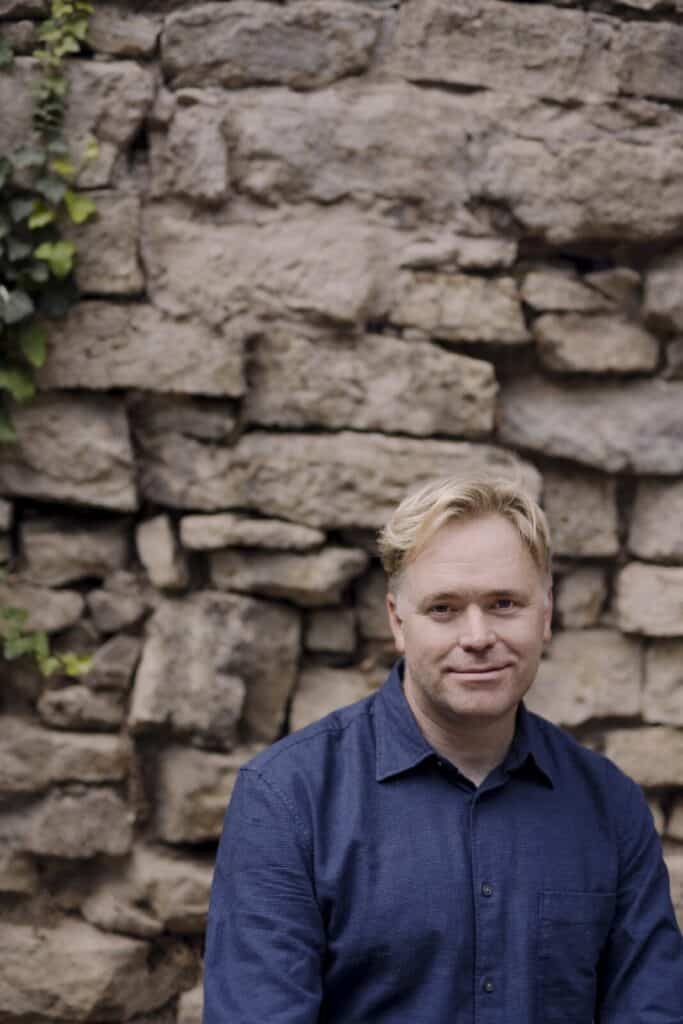
Graeme Richardson chuckles to himself while remembering how grateful he was to be published by a company that he has been publicly rude about. Richardson, a priest and The Sunday Times’ poetry critic, published his first collection, Dirt Rich, with Carcanet in January this year. Today, he sits petting his spaniel Yuri. A bookshelf filled with family photographs slants behind him. Book titles peep out from behind the photos, only just illegible from this distance over Zoom in his home in Germany.
It took him two pamphlets, endless encouragement from editors, and an inescapable love of the dirt, the mire, and the local lads of the Nottinghamshire landscape of his youth to overcome his hesitation about publishing within the “poetry biz.” It was this mucky uphill battle that led to his debut.
As we approach the halfway point of Escapril, Savannah Brown’s competition for young poets, Richardson talks about his frustrations with the industry, and the complications poets often face when submitting to magazines. Brown, the American-British author who went viral for performing her original poetry on YouTube, created the festival to encourage her followers to write more poetry.
Richardson, however, is skeptical about the way the poetry business is heading and the split between performance poets and those seeking to publish their work in written form. I sat down to talk to him about his writing practices, how he is tired of poems being forced to fit on A4 paper, what he calls “school project” poems, and restrictions on length. He’s still slightly bummed that he had to give in with his first full body of work, accepting the trendy page requirement.
The Cold Magazine (CM): Why did you wait this long to publish your first collection? Why did now feel like the right time to take the plunge?
Graeme Richardson (GR): It’s not true to say that I have waited. I am sceptical of the poetry business. I think that’s partly why I am the poetry critic for The Times, as they didn’t really want someone who wasn’t a sceptic.
It all seems very arbitrary to me. For example, if you were a Martian, when you came to look at what people do in poetry in Britain, you would be really surprised by some of the rules – like the fact that the length of poetry nowadays seems, very oddly, to coincide with the size of A4 paper.
Future scholars may well write PhDs about when A4 began to dominate the poetry world. Even the most prestigious prizes for poetry, such as the T.S. Eliot Prize, adhere to these rules that a poetry book should be 48 pages long. I mean, how many historically great collections would be disqualified. This includes some of T.S. Eliot’s best work.
CM: What were your hard rules while publishing Dirt Rich?
GR: I really didn’t want to have anything in there that I’d written because I thought somebody else would like it. I don’t have a poem in there which forces an engagement with the outside world. There is a role which integrity must play in the life of poetry, and I think that it has kind of been lost somewhere along the way.
I’ve never really wanted to do a long sequence about a historical figure. I don’t want to write a school project poem. I’m very grateful to Carcanet for publishing something which has really been about the pursuit of integrity. I didn’t want to do a themed collection, but it turns out that I have done it anyway.

CM: Critics and commentators have spoken about how these poems delve underneath the landscapes of your youth. Do you think it is something which holds the work together?
GR: It’s certainly featured as a large part of my life. I can only say that it has come out entirely organically rather than in any directed way. The earliest poem in this collection, “Bramley Seedling,” was written in January 1996 and that’s just under thirty years of work.
Others were written while I was in the music faculty at Oxford in 2008, in one of those boring meetings where you just doodle away. These things happened by virtue of keeping the poems I like and getting rid of the ones that I think are slightly effortful. It’s all about belief and integrity. I think one of the most important things you can say to a writer is that you believe them.
CM: Do you think attempts at creating community in the poetry world, like Escapril, are important?
GR: I’ve met a lot of poets, but I am happy secluding myself with my work and being a recluse. It’s important to have friends as a corrective, to show you what is good – often in ways that make you uncomfortable. Creating this collection from Germany, when it is so rooted in the English countryside, has been both a difficult and interesting process. It genuinely came from being homesick and lonely.
I’m married to a German and live there now in Europe. I think, as a poet, in terms of language, I have been thinking about Brexit and everything going on in politics, and I find it a kind of separation.
CM: You are very open about sexuality in your collection. Do you think people will be surprised by this, given your career as a priest?
GR: I don’t personally find any problem with it at all. I mean, in a sequence for a 2006 pamphlet, I put together three or four explicit poems and didn’t face any backlash. It slightly amazes me that I applied for a job in the church, and no one came up and said this was the guy who wrote about blowjobs. But it didn’t happen, and I’m glad.
I worry that, as well as being largely humourless, a lot of contemporary poetry is really prudish about sex. I don’t want to be seedy or icky, but 20th-century poetry is remarkably explicit in places. One of the poems in my collection draws on a memory of being a teenager on a summer job working at a church and just feeling kind of ridiculous trying to hoover the cathedral while feeling incredibly horny. I have to keep it as me, aged 19 to keep the poem somewhat acceptable and not creepy. There is something tragic in the way that the church has treated the body over the years and it’s a tragedy that has unfortunately affected women and the LGBTQ+ community the most.
CM: Would you say that there is a method behind your writing practice?
GR: As I said, the A4 construct doesn’t have anything to do with poetry or literature, really. I write in my head and, to be honest, I don’t believe a poem unless I can recite it. If not, it goes in the bin. I think it’s a tragedy that there is this divide between poets who publish and performance poets. People construct how their own art is undermined, as both sets really need to learn from each other. Poetry has always been something you carry around in your head.
CM: How does this eventually translate to the recording process and writing a poem down?
GR: I have some poems in the book on floppy disks. I think one thing I learned quite early on was that if you’ve got a computer which stores everything you write, then it helps you remove the critical faculty, as it becomes the audience.
Yet it’s not an audience at all, really. It doesn’t exist, and I’m sceptical about the computer- based medium. It has to work in people’s heads on the basis of music. We remember song lyrics, so I should be able to remember a poem.
Anybody can write a poem on their computer and pretend it’s a published PDF. I get publishers sending me PDFs, as I don’t have room for physical copies, but I could self-publish one of these books and it would look exactly the same. My favourite collection of my time is Zaffer Kunial’s England’s Green, and that book works because it is about poetry being oral. Kunial grew up with two languages, as his mother is English and his father is from Pakistan. He accepts that poetry is oral, mental, and on the page.

CM: When does inspiration come to you most clearly during the process of writing a poem? Is there a sweet spot?
GR: I don’t think you lose anything by saying that poets are probably talking bollocks when they talk about the process of making a poem. Some poems come slowly and others come incredibly fast. I finished one piece 14 years after I started it, and I don’t think there is any kind of magic in the creation.
One of my least favourite genres of poetry is the kind of celebrity book where someone who hasn’t read much verse, but has a massive ego, decides to publish a book. It is so important to read before writing, as otherwise you will come up with second-hand ideas or clichés about what people have already said.
My final rule of writing is always to be dissatisfied. Art needs a kind of divine dissatisfaction, and I feel like a lot of people in the creative sectors are lacking that. If you are too easily satisfied with your work, it will never be good enough.
Graeme Richardson’s Dirt Rich, published by Carcanet Poetry, was released in the UK on 29 January 2026


