
The sartorial nucleus of the ancient Silk Roads is arguably Tashkent, Uzbekistan. Since the 2nd century BCE, cultural exchange flourished at the mid-point between Europe and China, which has now woven the capital into a bustling diorama home to over 3 million people. Set against this vibrant backdrop is a new wave of intrepid creatives re-shaping the fashion industry that has been built upon for millenia.
One of these rising starlets is Asal Sharopova. The founder of the brand no.sugar, which will be spotlighted at Tashkent Fashion Week thanks to securing a finalist spot at the Next Designer Award empowered by Visa scheme. Intending to fortify Central Asia’s creative economy, the initiative launched in 2023 and reaches far beyond a design competition. Bauyrzhan Shadibekov, CEO of Visa Fashion Week, describes the scheme as a “strategic platform” to provide young designers with greater visibility and “real opportunities for professional development”.
It is no surprise that Sharapova emerged as one of the 16 finalists this year. Sharopova’s work is imbued with personal history; the brand itself is derivative of her own character. In Uzbek, the name Asal has Arabic origins and translates to “honey”, something culturally symbolic of saccharine sweetness, purity and innocence. In actuality, Asal Sharopova has not always meshed with her given name. “I have a very direct and strong character, so my close friend jokingly called me no sugar,” she tells me. Thus, the mononym was born.

It acts as “a kind of manifesto of sincerity” to herself and how she wants to navigate through the world. In our correspondence, she tells me that no.sugar is about “rejecting the sweet illusion in favour of real experiences and meaning.” This mirrors a broader consumer sentiment globally. Whilst conversations circulate on whether AI is conducive to craftsmanship and authenticity in the fashion industry, no.sugar states that reality need not be decorated or exaggerated with false joviality. Instead, one must understand the importance of real, human experience.

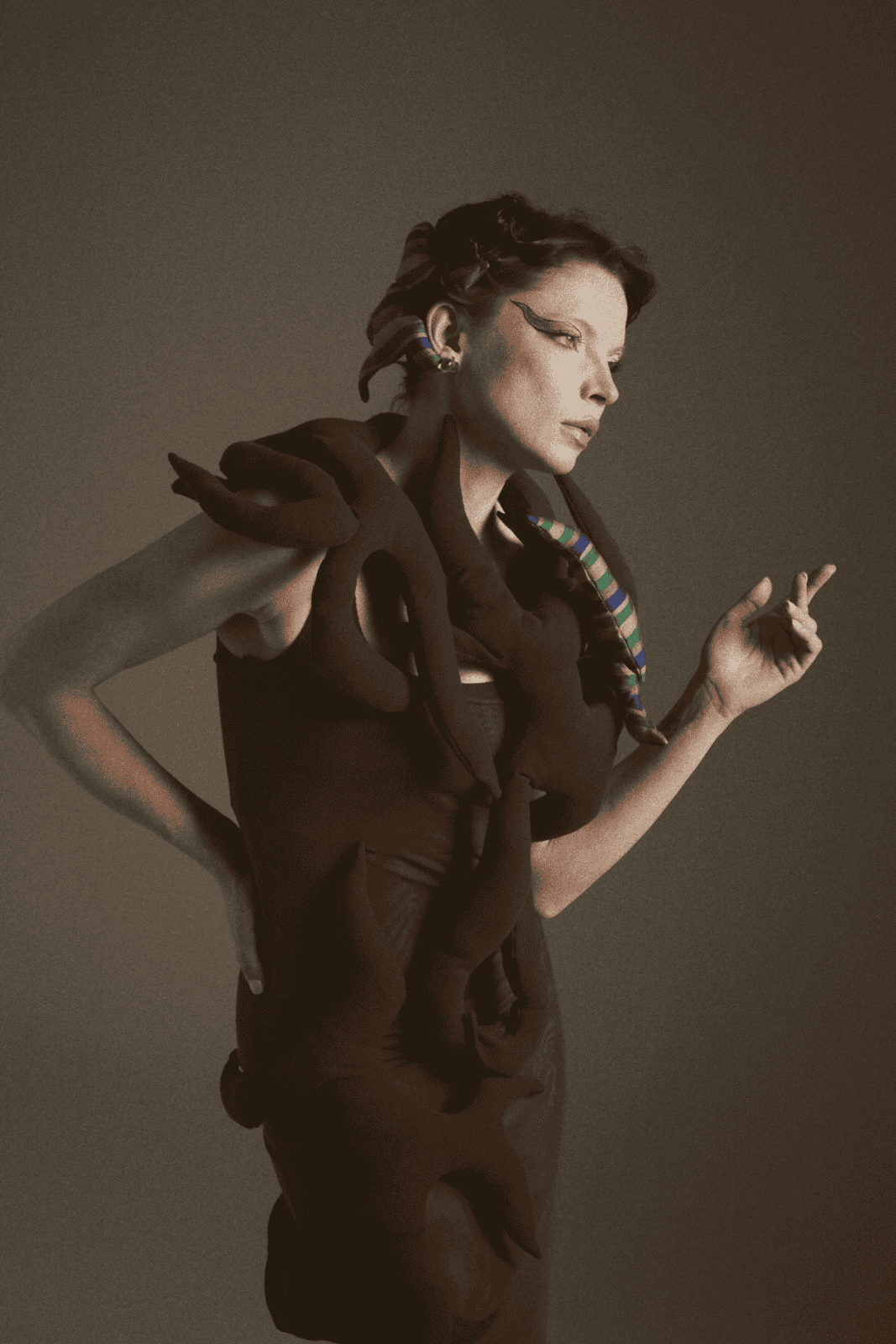
The collection that solidified her finalist status in the Next Designer Award draws from a similar concept of individuality and history. Titled Roots, Sharopova uses garment construction as a vessel of self-expression and conflict as a source of growth. One look features a quilted, terracotta jacket with a tie at the waist, reminiscent of a traditional chapan. It is paired with a deep brown, satin skirt. Encroaching the ribcage are twisted, swollen roots.
“They are a visual metaphor for the inner tension and suppressed emotions we carry inside us,” she explains. “In our culture, there are many restrictions and unspoken rules that affect creative people. Through my work, I am able to express topics that are often silenced, like vulnerability, trauma, and discrimination.” Sharopova’s early works saw these tubular roots manifest as strangled protrusions, but alongside a personal journey of pain to acceptance, their turgidity has been discarded for less resistant, juvenile forms. In turn, this visual evolution symbolises the introspection that comes from connecting to one’s self.
The creative process itself is grounded in tactility. “I don’t try to transfer my emotional impulse onto paper, I find it impossible without physically working with the material first,” she states. Garments initially take the form of ‘blobs’ of colour, like phosphenes that flit between the iris and a closed eyelid. Repeatedly draping and manipulating fabric across many iterations allows for a clearer visual language to develop. Due to her affinity for fabric construction, Sharopova’s work is sometimes misconstrued; an initial sketch might differ greatly to a final outcome. “Over time, my teachers understood that my process is more intuitive,” she says. Instead of seeing a sketch as an end point or ultimatum, it gently guides the design so all variations can be considered and built upon.

Bekasam stripes are recurring motifs in the collection Roots, too. The silk and cotton weave is a traditional Uzbek fabric predominantly worn by men, but has since been adopted by a younger audience. Thick, vertical streaks of iridescent emerald, cobalt blue and gold peep beneath the hems of outerwear or occasionally perch on the perimeter of entangled roots. Satin, silk, knitted mesh and sintepon all occupy space in Sharapova’s design language too.
All of these materials are sourced from local Tashkent markets, namely textile cornucopias Abu Sahiy and Chorsu Bazaar. The former is renowned for its wholesale goods and sprawls over a whopping 60 acres, whilst the latter is one of the capital’s largest farmers markets – Sharopova frequents it for its abundance of traditional fabric patterns. In this way, the collection is steeped in Uzbekistan’s material rituals. Sharopova doesn’t conflate this with her use of contemporary silhouettes however. Take the green silken bodice stamped with fluttering layers not dissimilar to the narrowing slices of a hill on a topographic map, or the aging ripples of a tree trunk. “It’s important to rethink our cultural heritage and reveal its depth through a modern design language.”


