
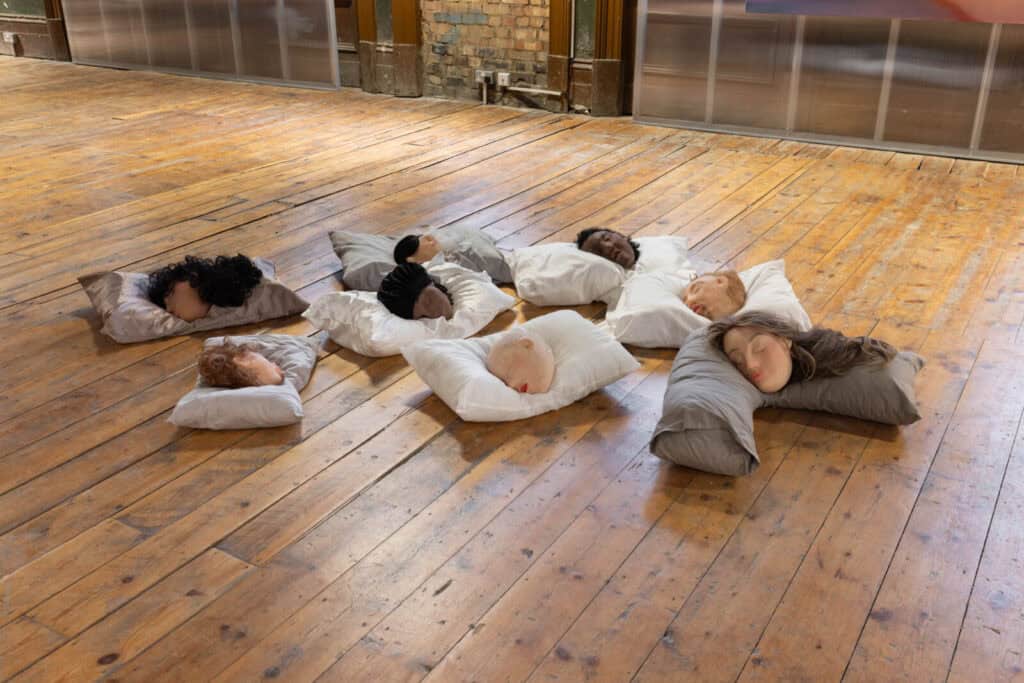
At one point during the opening night of PELT, a silicone skin face mask dropped from someone in the crowd and lay briefly on the gallery floor. For a moment, the jellified face appeared to belong there, next to the disembodied heads of Poppy Cauchi’s SLEEPERS, resting calmly on pillows nearby. When it was eventually returned to the owner, the moment underscored the exhibition’s uneasy collapse between artwork, body and object.
Skin is no longer something we simply embody. In an era rife with injectables, filters and incessant cosmetic innovation, it has become obsessively managed — stretched, smoothed and disciplined into an ideal surface. PELT enters this zeitgeist by de-contextualising skin to a cruder, more detached, and eerily externalised form.
Set beneath the exposed vaulted ceiling of the Old Waiting Room at Peckham Rye Station, layered Victorian-era brick and plastered walls display the artworks of 20 international artists examining skin as a material for collective memory, meaning and transformation.

Landing at the top of the well-trodden stairs, Roger Weiss’ hst241023_27ph immediately emerges into view. Seeming to burst out from the windows behind, Weiss’ large scale photographic portrait collage confronts the viewer head on. It is a dichotomous portrait, one side hysterical, the other stoic.
The painstaking clarity of the mugshot-like images resists obscurity, whilst file names printed directly onto each image expose the technological processes that distorted them. In doing so, the work exposes identity skinned into layers, with inner instincts fractured yet present, and outer surfaces mediated by systems of control.
The exhibition’s curatorial logic is mirrored by its surroundings. Stripped back, yet densely storied, the space’s surface reads as a kind of pelt: sediments of accumulated meaning and use, where external and internal histories linger. This unresolved, liminal atmosphere is highlighted by the grotesque amalgamation of bronze, cat guts, skin and car parts in David Cooper’s sculpture, No Comment.

Where Weiss presents a procedural, technologically mediated negotiation of identity, split between inner and outer tension, Cooper’s work reads decidedly internal. His materials are representations of bodily residues: visceral fleshy fragments are exhumed and fused with industrial elements, producing a body that feels neither fully organic nor fully machinic. The sculpture collapses the distinction between exterior and interior, flesh and infrastructure. As the name implies, No Comment resists interpretive closure, forcing viewers to encounter the work instinctively rather than reflectively. As a result, Cooper destabilises the concept of skin as a fixed boundary, instead framing it as a liminal, inverted and porous threshold.
Other works breach skin through absurdity rather than rupture. In Jamie John Davies’ The Leafes of Treowes Do Turn to Greet Him, the body is not turned inside out, but subtly unmoored. The oil painting depicts random fragments of the human body: an old man’s toothless smile and skin rashes neighbour incongruous found imagery that resists easy deciphering. All removed from their aesthetic and symbolic frameworks, unsightly aspects of the human body appear strangely neutral, highlighting the fragile nature of embodiment.


In a silent dialogue with this sense of absurdist detachment lies Poppy Cauchi’s SLEEPERS: a collection of eight disembodied heads sleeping on pillows. Familiarity is created through references to domestic objects like pillows, and Cauchi’s masterful use of latex to mimic skin. Yet the act of watching the sleepers feels intrusive. Their uncanny, skin-like surfaces paired with their suspended, disembodied forms blur the boundary between self and object, revealing the turbulence of everyday existence. The soft layered colours in Boo Saville’s Cocoon mirror the sleepers, with a blurred figure evoking a sense of memory and perception, highlighting the exhibition’s concern with the boundary between self, object, and the world.
Across PELT, skin takes on a dual role as a material and a boundary through which identities, memories and the human experience are explored, collapsed and inverted. The exhibition’s liminal spaces and uncanny surfaces create a sense of atemporality that contrasts sharply with the inevitable aging of our own skin – perhaps a quiet reminder of why we obsessively manage it.
From disembodied imagery to layered paint and fragmented forms, the works collectively blur the line between interior and exterior, self and object, leaving viewers suspended in a space where the body itself becomes an interplay of presence and absence.


