
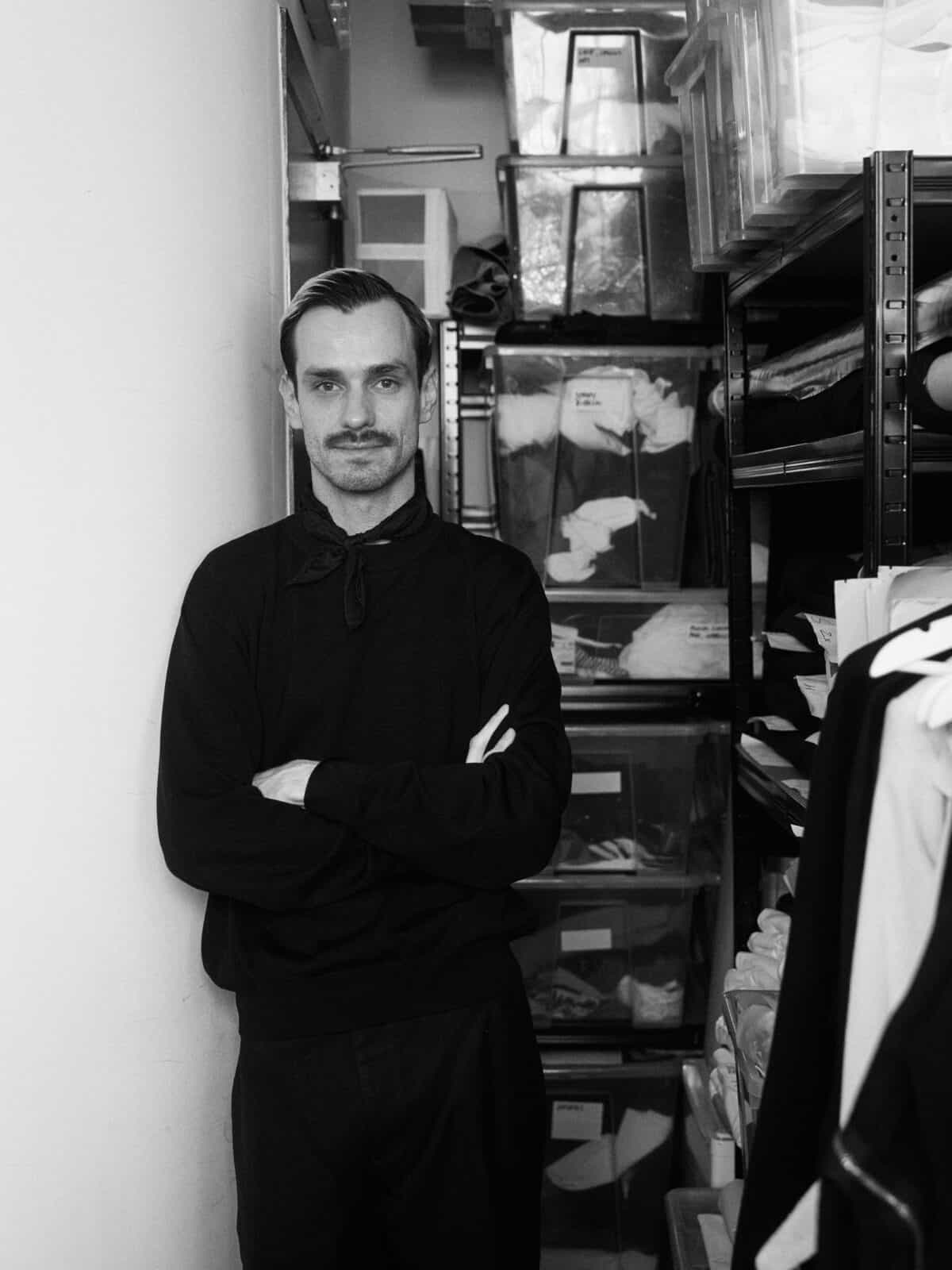
Technicality and authenticity define the namesake menswear label PHILIPPDORNER We joined the German designer in his London studio to find out more.

I met Philipp Dorner in his North London studio on an early December morning. The space was compact and shaped by daily use; garments engulfed the room, marking different stages of his practice. Fabrics were positioned strategically between work surfaces within easy reach for those moments when ideas hatch. Leaning against the wall atop his desk were two working boards with copious amounts of textile swatches pinned to it. Both composed of various forms of latex, grainy leathers, copper accents and crocheted details, all seemingly merging together on a 2D landscape, attached to drawings that formed the early groundwork for his AW26 collection.
Dorner, a menswear designer from Germany, brings a methodical foundation to his work, shaped by both his upbringing and experience within some of the industry’s most exacting tailoring environments.


Being a young designer in London is rarely straightforward, but Dorner approaches the capital with measured optimism. Rather than resisting its competitiveness, he sees it as a condition of growth. “London is competitive,” he says, “but there’s also an openness that allows start-up designers to exist, especially compared to cities like Paris or Milan.” Since graduating in 2021 with first-class honours, the designer has embraced this openness with clarity and confidence, steadily whittling out his place within the industry.
That same sense of carving out space on his own terms shapes how Dorner navigates London, defining the deeper philosophy behind his work.
“The biggest misconception is that you need a lot to start. You can have very little—you just need to know how to use it in the right way.” he stated as we began chatting, adding that “Some designers showed their first collections on their living room floor. You don’t need a studio—you just need to start.” It is in this sentiment that Dorner showed me his understanding of how, oftentimes, London feels defined by its theatrics and rapid output, but he demonstrates that his work is deliberately measured; explicitly resisting the fast pace of trend-driven fashion and instead prioritises its manufacturing process above all else.
When the terms queer or queering come up in fashion conversation, it usually alludes to certain groups and the communities that surround them, whereas for Dorner, it means something a little different. “Growing up different became my strength, and my design language reflects that,” he told me, “For me, queering fashion isn’t necessarily about sexuality. It’s about doing something in your own way and not following generic codes.” In other words, his clothes are for those who stray away from social norms and defy the prescribed conventions imposed on them by society… And perhaps that is where fashion, at its most meaningful, resides: in individualism, and in the freedom to articulate personal identity through the act of dressing.

Dorner has, in a way, perfected the art of material integration. And by that I mean, blending two unique textiles together to create something new and practical in two ways. Latex and leather result in smart casual for example. They are both part of this balance—positioned between conceptual thinking and construction—that sets him apart within London’s emerging-menswear scene that appears to be lacking in some dynamic as of recent.
Another recurring motif in Dorner’s work is what he terms “material juxtaposition,” his signature approach of combining contrasting fabrics to reveal unexpected harmonies. This might mean pairing latex with cotton or embroidering traditional tailoring fabrics with plastic beads, creating a dialogue between textures that wouldn’t normally coexist. From his most recent collection, SS26, emerged a white t-shirt intricately embellished with beads in a captivating gradient, transitioning from deep blue at the hem to crystal at the neckline, dispersing delicately as they ascend the garment. It stood out to me as a showstopper piece; therefore, I had to ask about its story.
The piece draws direct inspiration from Dorner’s experience at Therme Vals in Switzerland, realised by the renowned brutalist architect Peter Zumthor. Observing how the sun shifted throughout the day and how light refracted across the concrete and water, he sought to translate that dynamic interplay into a single garment. “I wanted to capture that changing visual moment in one piece, almost like a 24-hour time-lapse,” Dorner explains. To achieve this effect, thousands of beads were sewn individually at varying angles to reflect light from every perspective, resulting in a t-shirt that weighed approximately 10 kilograms and required 150 hours to complete.

Having worked across houses like Thom Browne, Brioni, and Hugo Boss, his understanding of fashion is rooted firmly in construction, precision, and process, saying, “Each brand taught me something different, and now I can combine all of those things in my own way.”
“I always had a passion for making things,” he explains, adding, “I started tailoring because I always wanted to become a designer, but my mum taught me that I had to learn how to stitch first before going into design.” This insistence on intrinsic rigour surfaced repeatedly throughout our conversation, and it is clearly reflected in the meticulous construction of his work.
After refining his craft through Germany’s fashion education system, Dorner relocated to London to study menswear at the London College of Fashion. It was here that a creativity previously restrained by structure was finally given the space to evolve. The shift from a rigid, production-focused approach to a more conceptual framework allowed his design language to expand and circulate more freely, without losing its integrity.
When asked whether his upbringing shaped his experience of studying in London, Dorner is unequivocal. “Yes, definitely. Even though LCF is considered technical in comparison to Central Saint Martins, for me, it was still very conceptual compared to fashion schools in Germany, which are almost run like factories. That grounding helped me enormously, especially during internships. Knowing how garments are constructed is invaluable.”
“The most fun part for me is being in the studio and making things. I’m more comfortable backstage; my work should be on stage, not me.” – Philipp Dorner

After presenting his AW26 collection, Dorner’s practice continues to expand through a focused selection of projects, including work for film. The collaboration has sharpened his interest in the space between costume and fashion, “I don’t want to make costumes, but I also don’t want to make a standard suit,” he says. “That space in between really excites me.”
At a formative moment in his career, Dorner is building a name for himself and as his practice continues, it becomes more evident that Dorner is contributing to a broader shift in how contemporary menswear can be made and hopefully, finally understood.


