
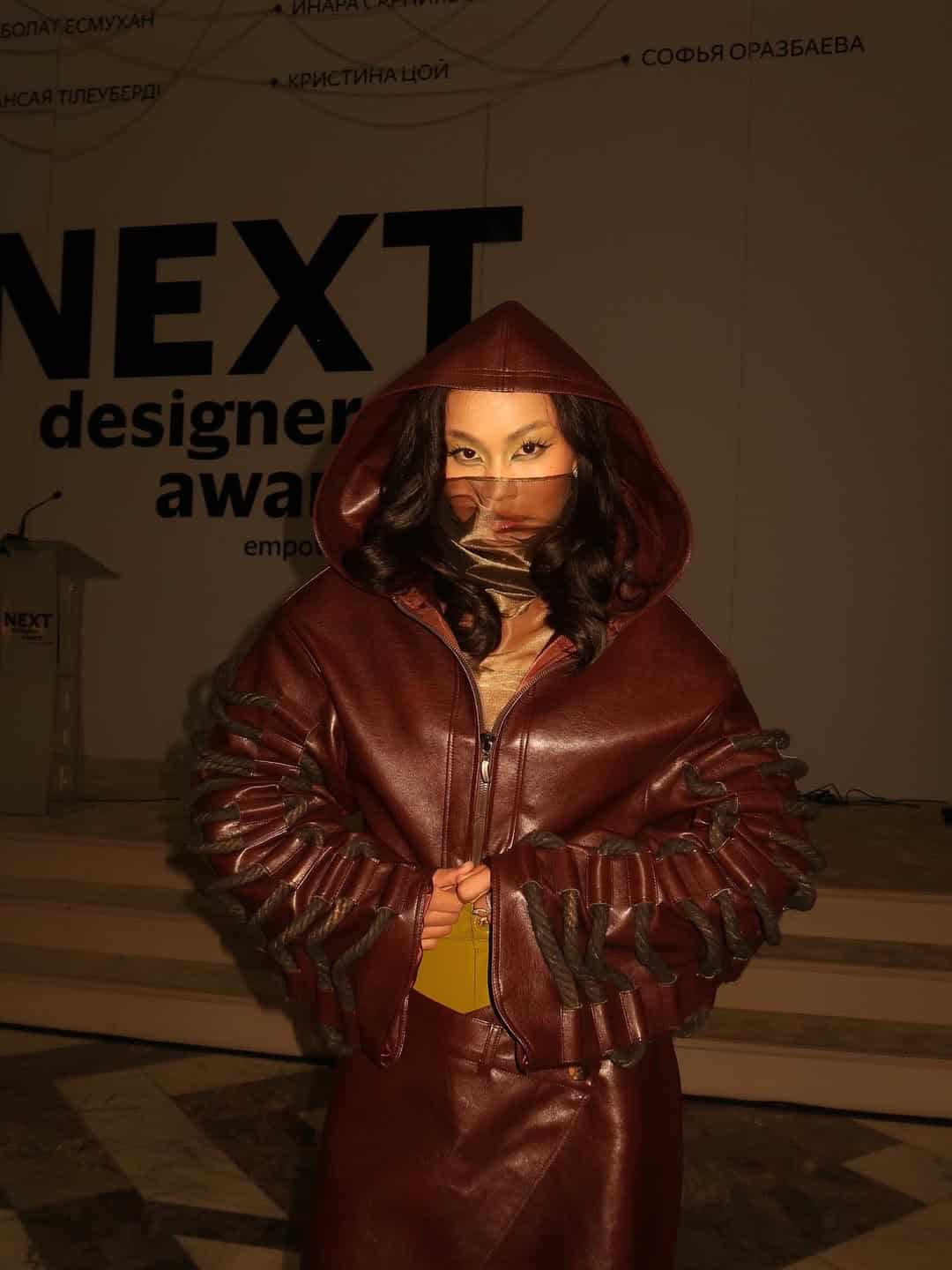
A lot of artists’ work begins with uncertainty, with a question, an itch that is impossible to ignore. For Sakh Nurai, that question arrived at the age of 12, watching a runway show that was happening somewhere far from home.
“I just remember thinking – wait, do WE have this? Does Kazakhstan have its own designers, its own voice in the world of fashion?” she recalls. “That question genuinely bothered me. It stayed with me for years”.
Now, Sakh Nurai is standing on the precipice, ready to present her latest collection at Visa Fashion Week Almaty – a fashion showcase for Central Asian designers – to an audience that is finally paying attention. Her eponymous label SAKH focuses on a woman’s inner strength, softness and confidence. It came from a desire to bring Kazakhstan’s nomadic cultural identity into the modern world. Creating pieces that connect the women that inspire her to their roots and the power of those that came before them.
“It still doesn’t feel completely real honestly,” she admits.

That disbelief is unsurprising, this moment was never promised. The journey from curiosity to actively shaping an identity she once questioned took years, often without much light at the end of the tunnel.
“Before, creating a show with 20 looks felt like something other people did – not me”, she says. “Now it is just part of my life”. This shift came directly from the scale and pressure of the platform. “It pushes you to grow whether you are ready or not – and I think it is exactly what I needed”.
Her latest collection, TAMYR – meaning “roots” – is an emotional excavation, reaching deep into history, both personal and national. “TAMYR isn’t just a collection for me. It came from somewhere deep, a feeling that I couldn’t ignore”.

That feeling was anchored on the legacy of Kazakhstan’s nomadic roots, a cultural inheritance of resilience and adaptation that still sits at the heart of the Kazakh psyche, despite their more sedentary modern life. “Our nomadic ancestors were always moving, always adapting: new lands, new climates, constant change. But they never lost who they were. That idea is in every single piece of this collection”.
At this collection’s core are images of nomadic Kazakh women. “In the 18th and 19th centuries, mothers gave birth by biting onto a rope, bringing life into the world with nothing but their own strength. That image has never left me.
“There was another figure who struck me in a totally different way. A warrior girl, an archer, who rode into battle with her newborn. She fought for freedom. For me, these women are the whole collection”.
The strength of these women is foundational, but it is balanced with warmth and softness. “Since I was a child I’ve been drawn to contrast”, Sakh explains. “The way a woman can be completely delicate and completely unbreakable at the same time. That tension has always moved me deeply”.
These feelings are echoed in another inspiration for the collection, the work of Kazakh pop mega-star Zhanar Dugalova. “There is something in it that goes beyond words. A spiritual code that you just feel. That is what I want people to feel when they wear my clothes”.
Rather than merely reconstructing historical garments, Sakh Nurai uses the past as an archive, reshaping it whilst holding tight to that spiritual core. “I don’t recreate historical clothing piece by piece, I weave its story into the present. It is not a museum exhibit, it is my living memories”.
This prevents the work from falling into the realm of costume; it is not meant to look exactly like its nomadic inspirations, but aims to invoke the same feelings those images do in Sakh. “I imagine a woman who holds both the soft and the strong. She is grounded but free. I want her to put on one of my pieces and feel something shift, like she just remembered who she is”.
The driving force behind Sakh Nurai’s road to success has always been the environment and conditions that inspire her. “There were moments where I thought, this is too big, this is not for me. Then somehow it just… happened”, she admits. “I think what surprised me most is that the conditions you are in really do shape what becomes possible. The right environment changes everything”.
That environment is becoming increasingly collaborative, with a growing network of designers. Labels like QANAKER and Rassul Social stand out for Sakh. “The way they work with concept and material is really compelling”, she says. “They are using clothing to say something, to communicate real ideas. I respect that deeply”.


It harkens back to that initial question a twelve year old Sakh asked herself. Kazakh fashion is no longer questioning its existence, and is asserting how it is viewed globally.
For Sakh, the future is expansive but measured. “I want to go international, but not at the cost of losing what makes me me and what makes the brand the brand. It was never about just getting bigger. It is about staying intentional and true to myself”.
The balance she strives for in her own brand mirrors Sakh’s hope for Almaty Fashion Week. “I want it to be a real gateway into global fashion for Kazakh designers. That potential is already there, you can feel it”.
This atmosphere of possibility, the feeling you are at the start of something truly powerful, brings a crackling energy to Almaty Fashion Week. “It feels like we are all figuring something out together, the energy is electric. Designers are growing in real time, finding their voice and pushing each other forward”.
That is the real story here, we are looking at a real movement not simply a collection of independent designers. This is a scene in motion, it is a question, once asked by a twelve year old, being answered on a runway.


