
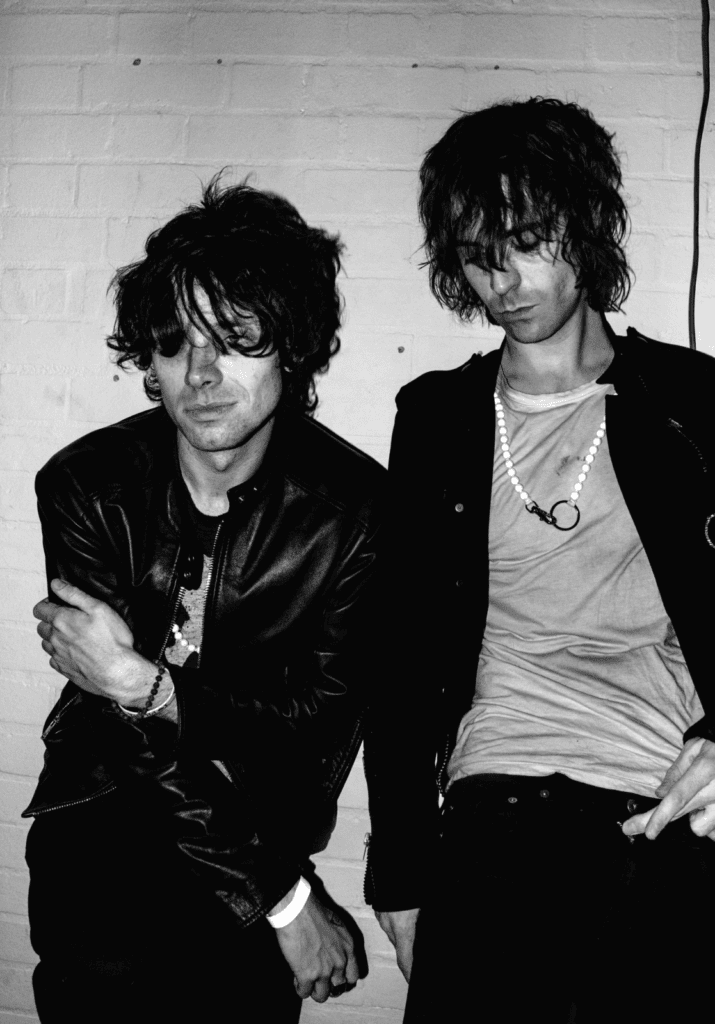
If there’s one band that comes to mind at the evocation of indie sleaze, it’s probably The Hellp. Though, this is a label the LA-based pair detest: “we’re almost ashamed of it… we don’t want to be remembered for that.”
Formed in 2015 by fashion photographer Noah Dillon, who recruited Chandler Lucy to the project a year later, the duo’s hyper-American, house-party electroclash – as well as the devotion to a certain 2000s, Hedi Slimane gothic – has made them fashion-bro favourites, omnipresent figures at the intersection of the two spaces and championed by the likes of 2hollis and Yves Tumor.

Ahead of the pair’s hotly awaited London headline show, The Cold Magazine caught up with the pair to discuss their foot-to-the-accelerator trajectory and breaking out of pigeonholes.
The Cold Magazine (CM) Both of you grew up in somewhat restrictive communities — Noah in a hyper-religious household in rural Colorado and Chandler in the Californian wine country. Is there a moment when you first realised your dreams were bigger than the small-town life?
There was a moment when I was a teenager, and I didn’t know where my life was going and I felt like I was going to be stuck in between a rock and a hard place. I realised that right then and there there was so much more I could accomplish so I put my head down and got to work.
CM: You met on set for Hot Mess, working in very different roles to the ones you are now. What were your first impressions of each other, and how did you realise you shared a vision?
We actually didn’t immediately clock – we were about six hours into working together and we bonded over an A$AP Rocky song, and then we just kind of went full steam ahead from there. I had already started the band with a different person and released the first record, but I was actively auditioning people to join at the time.
I knew at that point I wanted it to be a bit more electronic but still have that look of a three piece rock band. I asked Chandler if he could play the drums, so he picked up drumsticks and learned and it really all fell together. We both moved to LA around the same time and just kind of dove into the project. We really both looked at it as an artistic endeavor, more than just starting a band, and now we’re just kind of on this ever-evolving journey with it.

CM: The Hellp seems to transcend the boundaries of music. It comes with its own visual language, its own type of chaos, and a slight ‘fuck you’ to the institution. Do you consciously build that wider world, or does it happen organically through the process?
The key to The Hellp is that we’re continuously evolving. As we grow and mature as individuals, so does The Hellp. Like we said, this is really more than just a band, so we definitely push the bounds of everything we do with it – we see it really as this larger than life artistic and creative outlet. It comes natural but we’re also conscious about what we put out and how that evolves – it’s like we’re polishing this unpolishable stone in a way that only we can. What we create is so uniquely ours and deeply personal to us that it could never come, as it is, from anyone but us.
CM: It would be hard to discuss The Hellp without a reference to the dreaded phrase, ‘Indie Sleaze’ – a combination of slightly nostalgic rock and ‘Hedi Boy’ style clothing. How do you feel about your work being pigeonholed into this category?
We definitely agree that it is a dreaded phrase – especially because we approach this as a true artistic project for ourselves. We grapple with this association a lot; we’re almost ashamed of it. We don’t want to be remembered as that. We see The Hellp as so much more than just two white guys with a particular “uniform” in a band, we don’t want to be, and aren’t that guy. When people look back on what we’ve done we want them to recognise us as artists – we aren’t bound to one particular genre or vibe or look, we’re constantly changing and evolving our sound as we grow. We purposefully set ourselves up to do whatever we want, artistically and sonically – unpredictable, unfiltered, and without bounds.
CM: You have a slate of high-profile fans, ranging from British designer Mowalola to Frank Ocean and The Dare. Is it hard to balance your underground bent with this attention?
No, it seems that any attention garnered is natural. It doesn’t feel deserved, but it feels exciting and not a nuance.
CM: Today, there’s a pretty standard formula for success: “Fashion Week appearance + chorus gaining traction on TikTok = celebrity”. You’ve spoken about how algorithms (and this approach) are damaging the music industry. Is this something you actively resist? What is your solution to the increasing sameness of the music industry?
We definitely resist this. It’s great that it works for people but we’re artists – we feel there is much more substance to what we do, we are influencing culture and moving the needle. Our sound and evolution is influenced heavily by our own personal growth. We knew after LL we had kind of maxed out what we were doing and whatever we did next needed to be distinctively different, or else we’d fall into that pattern of sameness. You’ll find that Riviera is much more mature, emotional and brooding than anything we’ve done before. The only way to stay relevant and escape that feeling of sameness is to constantly grow and change, so that’s what we do.

CM: Is fame good or bad?
Fame is the ultimate double edged sword, it’s something different. It can be a great weapon or a great adversary, it just depends on how you use it.
CM: What does making a second album teach you? How has your approach evolved?
The main approach for the album. It didn’t teach me but I taught it how to be more mature, more methodical, more restrained and more balanced in a less juvenile way. We were trying to make a contemporary album that was more mature than previous Hellp work. As much as we try to whip something into shape, there always ends up being something you foresee or that something you could foreseen. The final product is what teaches you. No matter how far you go or hard you try, the work will always surprise you.
CM: Listening to Riveria, there were several moments where I stopped and thought, “I know this” — especially the reference to John Denver’s ‘Country Roads, Take Me Home’ on the aptly titled ‘Country Road’. How do you approach sampling? Where do you locate yourself among the lineage of artists that came before you?
Country Road is actually an interpolation not a sample. In terms of where we are on the pathway of artists. We have opened a show for Yves Tumor at the Whisky A Gogo, and every notable artist or rockstar has stood on that stage so you feel like you are contributing to a part of a legacy. It’s an honor to play in the same venues that so many legends and icons of the medium have been able to stand on. We have big shoes to fill, but it is an honor to try.
CM: Lyrically, Riviera reads like a realisation that the world is complicated, confusing and messy. It’s almost an acceptance that we don’t have to know where the road is leading, but a trust that it is leading somewhere. How did your experiences between projects and in the music industry shape this overarching arc?
Riviera is really about our whole lives, and this feeling of disillusionment in all of the spaces we’ve been in. It’s like looking over the horizon and seeing lights in the distance and knowing there’s something more ahead of you. It’s the story of the disparate Americana that we’ve felt, and that we know so many people feel right now.
Those uneasy feelings are translated so heavily into the sound of this album, but there’s this ever-present feeling of hopefulness throughout – those lights in the distance, knowing that there’s still a road to be travelled on. In a way it’s really reflective of The Hellp as a whole – at the very beginning, it just never felt like it was working, like we were just keeping the wheels on the bus, but then in 2020 / 2021 it started to click and the audiences really started connecting. Riviera is a deeply personal album to both of us, but it carries such universally shared emotions.
CM: How do you translate your sound to a live show?
It is a bit more aggressive and integrates how a studio track sounds, and there is always a surprise to the live sound, and it won’t sound identical to the studio version. If you change the song, and the space it’s being heard, it creates a one of a kind listening experience. For example, we often blend Katy Perry’s ‘California Girls’ with our song ‘Vertigo’, which always gets the crowd crazy.
CM: What’s next for The Hellp?
Continued evolution. We’re never going to stop.


