
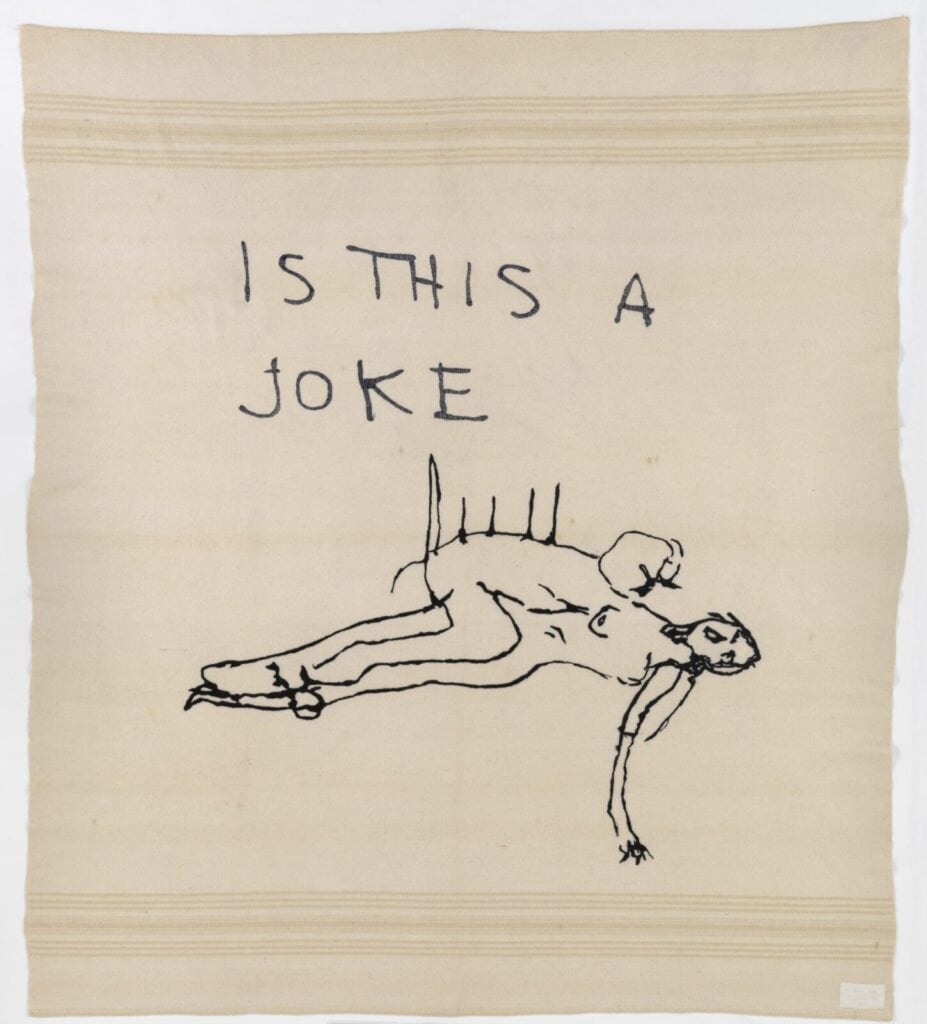
The first question we must ask ourselves before we embark on any review of Tracey Emin’s solo at the Tate Modern is as follows: is it even possible to write anything interesting about her anymore?
For three decades the critical conversation has swung wildly between adoration and disgust, often within the same pages. Emin has been hailed as “one of the most truthful and substantial artists of our century” (Jonathan Jones) and dismissed as “an ignorant, inarticulate, talentless, loutish exhibitionist” (Brian Sewell) – both, funnily enough, in The Guardian. Her work has been described as a “deconstruction of the myth of the artist” (Rachel Esner) and the latest incarnation of the artist’s “tortured expressive soul” (John-Paul Stonard). For Rosemary Betterton it exists “between truth and disclosure on one hand, and performance and artifice on the other”; for Martin Gayford it is “pretty nondescript to look at.” Emin has spent thirty years functioning as a kind of Rorschach test for the British art world: whatever one believes about contemporary art tends to reveal itself in one’s opinion of her (she is also, as one acquaintance recently put it, “absolutely foul to sit next to at dinner parties.”)

My Bed won the Turner Prize 30 years ago. This matters because A Second Life is the final hoorah of Maria Balshaw, and is therefore a useful benchmark by which to judge just how (and why) both institutional and public attitudes towards Emin’s particular brand of YBAness have changed. Balshaw, first female director of the Tate, has reigned over the institution since 2017. I suspect history will remember her rather as it remembers Obama: the tail end of the progressive comet of the 2010s, a visual manifestation of all our well-meaning leftist politics that ultimately failed to produce anything of real note. Like the US administration that ended just before her appointment (contemporary art is always exactly one cultural cycle behind), what we’ve seen at the Tate over the past eight years statistically resembles an alignment with public opinion, but was still very much an institutional art program that tracks prevailing taste rather than directing it.
Emin’s retrospective therefore marks a kind of apogee – a cultural climax in both the sexual and astronomical sense; the moment a long cultural orbit reaches its furthest, most exposed point before the inevitable petite mort. By the mid-nineties Tate itself was already wringing its hands about how quickly they were going to have to learn to speak the language of this trajectory. As Nicholas Serota would later put it, “much modern art is, at first sight, unnerving.” But is it, in the eternal words of Justin Bieber, too late now to say sorry?

The original reason for her unpopularity comes down to a mix of factors. Britain in the nineties was still nursing the cultural hangover of Thatcherism. After the austerity and ideological rigidity of the eighties, the irreverence, vulgarity and hedonism of the YBAs (Young British Artists) became the perfect cultural expression of neoliberal Britain: ambitious, media-savvy, unapologetically commercial. Critics who believed art required technical authority saw works like My Bed as proof that the art world had abandoned all standards, and the fact Emin and her kin emerged alongside the explosion of tabloid culture and celebrity media in Britain only helped the alleged case for – as Thatcher would have put it it – the rise of the “permissive society.” The sensationalism of scandals and drunken TV appearances gave Emin’s critics the proof of decline they believed the decade demanded. There was also, of course, a healthy dose of good old-fashioned sexism and classism; I sincerely believe the only reason Sewell ended up friends with Hambling and not Emin was because the former was posh and the latter was not (a shame, Sewell would have benefited greatly from Emin as a fag hag).

On an institutional level, however, we must look beyond to explain how we’ve reached this moment of belated enthusiasm. In the nineties, institutions didn’t know how to justify the work yet. Museums had inherited modernist criteria (form, innovation, medium specificity), but YBA art often operated through installation, autobiography, conceptual gesture, narrative context. The old hostility towards our girl Tracey partly reflects a theoretical lag between artistic practice and the language available to defend it; her new celebration is essentially the institution admitting, belatedly: alright, we get it now.
The great irony is that Emin was never especially transgressive in the first place. My Bed looked scandalous only because it mirrored the culture around it so faithfully. The confessional turn, the collapse of privacy, the merging of spectacle and intimacy were already the dominant aesthetics of the decade; if anything, the scandal surrounding Emin functioned as a kind of cultural méconnaissance. Critics who denounced her vulgarity were responding to a reflection of their own society and their own post-Thatcher anxieties, not some great shift in formal novelty. It’s a little disingenuous to pretend any reaction to Emin’s art is driven by aesthetic rupture: the nineties were already saturated with the aesthetics of confession and exposure; Emin simply dragged those logics into a space that still imagined itself to be governed by modernist decorum.

The same thing is happening today. The museum that once struggled to justify her now finds in her exactly the right mixture of autobiography, sexuality and feminist resilience through which to demonstrate its own ideological credentials. Emin is, formally and functionally, a perfect talking head for what has become the dominant vocabulary of contemporary art. Does this make her art bad? Not particularly. I really like her paintings. But it also doesn’t make it good. What it does do, however, is make it historically useful. In the nineties she looked like cultural decline; today she reads as institutional virtue. The work itself has barely moved. What has changed is the story the art world now wishes to tell about itself.
What is left to be seen is whether the critics of the nineties were quite as hysterical as we now like to imagine. Perhaps Emin was not the cause of cultural decline but one of its earliest symptoms. We are watching the orbit complete itself. Cultural movements have their apogees, and cultural climaxes their aftermaths. This retrospective may simply be that moment of collective post-nut clarity, the final scrabble at the bedsheets as the art world finally pauses to consider what it has been enthusiastically circling for the past 30 years.


