
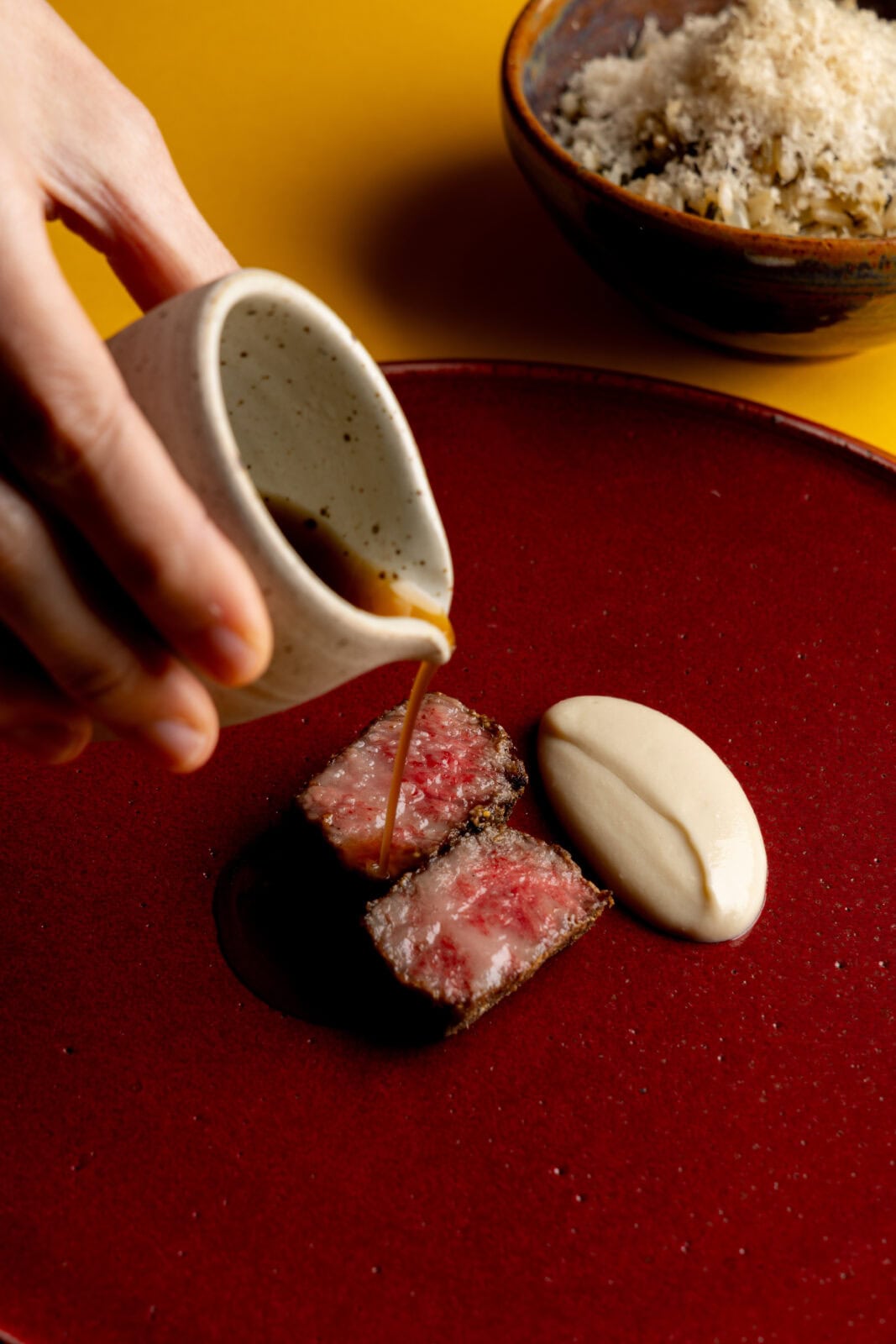
I did not arrive at Gaa expecting to feel at home. Two Michelin stars usually come with an exaggerated ceremony. A sense of distance. The kind of reverence that makes you sit a little straighter at the table. Instead, I found myself stepping into a restored wooden Thai house, greeted by the chefs cooking that evening, settling into a dining room where polished wood, curved ceilings and soft lighting create an atmosphere that feels both welcoming and meticulously considered.
Gaa, the Bangkok restaurant led by chef Garima Arora, earned its first Michelin star in 2018, and its second in late 2023. Those accolades settle quietly into the background of the experience at this establishment. From the moment you enter, it becomes clear that the atmosphere has been shaped with intention.

The structural design sets the tone immediately. Originally from Ayutthaya, the sixty-year-old house was carefully relocated and reconstructed in Bangkok using traditional Ruen Thai joinery techniques, allowing it to be dismantled and rebuilt without losing its integrity. Inside, undulating curved ceilings shape the space. A striking string installation runs throughout the interior – inspired by Sai Sin, sacred white threads used in Thai rituals embellish the already awe-striking architecture. The atmosphere feels grounded and intimate, defined by a familiar warmth.
For Garima Arora, this sense of place is essential. “The architecture is absolutely integral to the experience,” she tells me. “The house gives us a grounding soul. It creates quiet sophistication and a real sense of place.”
That grounding presents as a through line in everything Arora does. Before becoming a chef, she trained as a journalist, learning how to observe carefully and tell stories with intention. The culinary industry came later.
“It wasn’t a single flavour that made me choose food,” she says. “It was a realisation that time is of the essence. Food connects beyond words. It’s rooted in emotion and discovery.” It felt like another language through which she could communicate.
After leaving journalism, Arora trained at Le Cordon Bleu in Paris and travelled extensively, working with chefs around the world. Thailand sharpened her vision. “Throughout my time here, I was constantly reminded of the similarities between Indian and Thai culture,” she explains. “Through people, food, everyday practices. It felt like the right place to begin this dialogue.”

Gaa exists in that overlap. Indian techniques are applied directly to Thailand’s hyper-seasonal produce. The tasting menu unfolds at an unhurried pace. Each course is introduced by the chefs themselves, who step forward to explain the dish before returning quietly to the kitchen. The rhythm creates anticipation and reinforces the feeling of being personally hosted.
Early courses introduce acidity, texture, and heat in quick succession. Chaat arrives first, built from yoghurt, tamarind, and crisp elements that fracture as soon as they hit the tongue. The sweetness is brief; spice follows closely behind. Chakna draws from the language of Indian drinking snacks, carrying salt and warmth that settle more slowly. A DIY bhel course places puffed rice, chutneys and herbs atop the table, inviting diners to craft each bite themselves. The crunch softens as it absorbs the sauces. The act of assembling it shifts the pace of the meal, placing attention on touch as much as flavour. Each plate moves with control, the seasoning calibrated so that sharpness, sweetness and smoke land in sequence rather than competition.
When the Summer Curry arrives, the room seems to soften. Blue swimmer crab wrapped in grilled banana leaves is paired with coconut and green apple ice. The dish is delicate and expressive, the sweetness of the crab offset by smoke. It became my favourite course of the night. It felt assured, layered without heaviness, expertly restrained
For Arora, that sense of balance sits at the core of her approach. “The idea was always to celebrate Indian food,” she says. “To show the richness of regional cuisines through a contemporary lens.” That philosophy reaches its most unexpected expression in The Tandoori Story. Durian, a fruit known for its divisive reputation, becomes the centre of the plate. Grilled in a tandoor and paired with roselle saag, a tart leafy green preparation, alongside bread and pickles – it transforms completely.

“Durian surprised me the most,” Arora admits. “It’s bold and controversial, but the tandoor changed everything. It became savoury. Smoky. Umami-rich.” The dish is the direct result of careful thought and technical precision. In that moment, Bangkok is essential to the story being told on the plate. Some dishes hold a specific staying power over others. Their longevity reflects their position in the restaurant’s wider narrative. “A dish becomes a signature when it creates an emotional connection,” Arora explains. “These dishes mark moments in Gaa’s evolution. They remind us why we believed in this vision.”
Between courses, the chefs speak openly. After the meal, we are invited into the kitchen, moving through the space as if into someone’s residence. Stainless steel gives way to warmth, as casual conversation settles naturally across the room.
Dessert presents another noteworthy addition. Lychee sorbet paired with an Indian brown cheese cigar roll. Cool and floral, followed by a richness. A final reminder of how delicacy and depth can coexist within a single course.
Behind the scenes, Arora’s leadership mirrors the experience of dining at Gaa: calm, collaborative, and intentional. “A happy, motivated team creates a better dining experience,” she says. “Empowerment matters more than control.”
She speaks about shifting from being fully hands-on to becoming more of a mentor, navigating the tension between freedom and precision within her team. In an industry often shaped by hierarchy and burnout, her emphasis remains on care. “You need physical clarity for mental clarity,” she adds. “You can only lead and create if you’re mentally sharp.”

Arora is the first Indian woman to hold two Michelin stars for the same restaurant. She views the recognition as part of a broader cultural shift. “It shows that Indian voices belong on the global stage,” she says. Her advice to young chefs remains steady and practical: focus on developing skill.
Alongside Gaa, Arora founded Food Forward India in 2019, an initiative dedicated to documenting the diversity of Indian cuisine. Through this work, she has seen how narrowly Indian food is understood globally. “Most people associate Indian cuisine with curries and naan,” she says. “But our food is built on thousands of years of sophisticated knowledge.”
At Gaa, that knowledge is felt in the details of each course and in the rhythm of the evening. The experience invites attention to flavour, technique, and movement. This is why Gaa belongs in Bangkok. The city allows these culinary languages to meet openly, shaped by respect and shared history, creating something entirely standalone and new.


