
While some people are content within the mundane familiarity of the quotidian, those who are unfulfilled have a harder time grappling with the endless turn of the calendar.
This was certainly the case for Yesmukhan Yesbolat, the founder of YESYES!, and winner of the sixth season of the Next Designer Awards empowered by Visa.
His eclectic pieces are built on the “glittering chaos” of traditional Kazakh celebrations he experienced beneath the canvas army tents in his home village Bakansas. The prize will see Yesbolat secure a coveted spot to stage a runway show at Almaty Fashion Week on the 29th of April, and a $10,000 cash injection to fund the future scaling of the brand.

Yesbolat’s winning Pre-Fall 2026 collection is an ode to his early years spent growing up in rural Kazakhstan. Bakansas neighbours the Endorheic basin of the Ili river that flows from China down to Southeast Kazakhstan, and is often frequented mainly by fishermen.
Yesbolat has not always chased the gritty, dynamic world of fashion. At the age of nine he competed internationally as a cross-country skier, becoming a decorated champion throughout his teenage years. Upon his return to Kazakhstan, he settled into a life as a rehabilitation doctor, focusing on treating elderly patients with joint and mobility issues, and later served in the army.
Recognising a disconnect between his desires and daily life, Yesbolat endeavoured to work in creative production, and scored a freelance job as a show producer for Visa Fashion Week. This opportunity sparked an urge to design that had laid dormant since the bleary, nostalgic days watching his grandmother hand-sew costumes for his plays at school. “I finally had a breakthrough. I realised I didn’t just want to organise someone else’s vision; I wanted to create my own clothes,” he tells us.
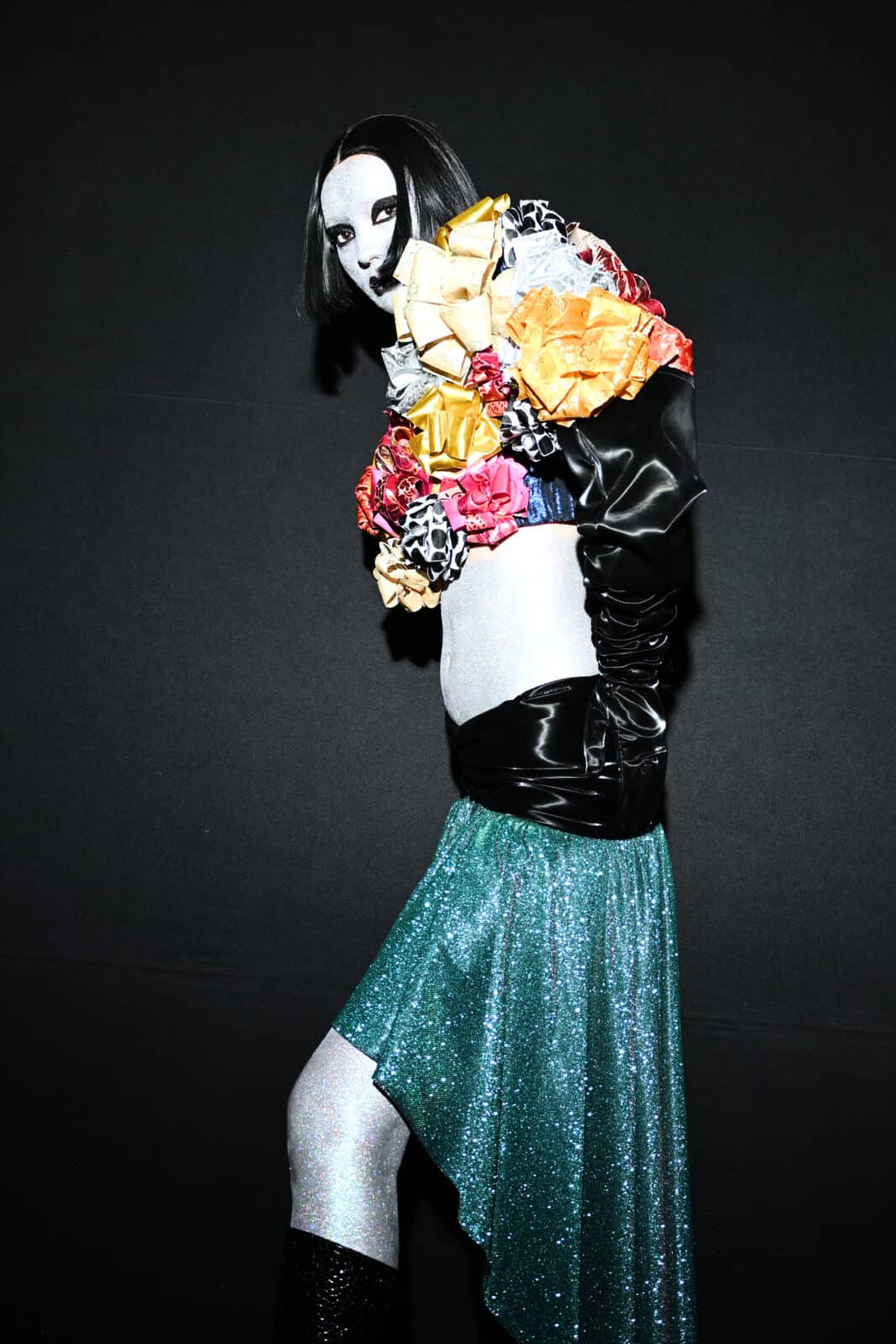
The hero look of the collection is as illustrious as the cultural practices it references. Titled “BITPEYTIN TOY”, it translates to “never-ending celebration”.

The model, Diana Nurzhanova, has a slick half-bob, and is slathered up to her eyeballs in chrome glitter, except for smudges of kohl lining the eyes and a smear of lipstick. A rosette-encrusted breastplate bolsters the upper-body in psychedelic armour, conjuring images of rustling, polyethylene wrappers. Salacious black gloves dip below the elbow. Ruched, asphalt satin clings to her exposed midriff and hangs at the pelvis, which eventually gives way to sweeping cascades of gleaming turquoise.
The look embodies the Kazakh tradition of toybastar, a kind of goodie bag given by a generous host at the end of an event, brimming diverse gifts. Yesbolat vividly recalls the crinkled hands of an apashka (grandmother) handing over cobalt blue Aygen bags, notorious in any Central Asian household, stuffed with souvenirs, cheap toys, cuts of embroidered fabric for dress-making, bottles of drink and candies. “[The word] translates to “the beginning of the toy (party)”, but the paradox is that it is handed out at the very end,” Yesbolat explains. In this way, the toybastar acts as a memento of gratitude and reflection on the event.

The practice of sharing sarqyt is an extension of this memento and fundamental to Yesbolat’s collection as a whole. To mark the end of a feast, departing guests are offered plastic bags of food to savour the occasion. This is “Malibu” salad topped with croutons mixed with melted chocolate and greasy, boiled mutton all in one bag. The flavours congeal together into one lovingly extravagant dish. “For a European, it’s a gastronomic nightmare. For us, it’s the taste of happiness,” he laughs. “This chaos of flavours is our cultural code.”
This randomness in taste and texture is also reflected in how Yesbolat uses materials in his work. Vermillion, flared, latex bumsters are paired with a matching crop top, emblazoned with the slanted YESYES! logo and accessorised with a sheer wedding veil. Elsewhere, a leather jacket with crinkled balloon sleeves mimic slabs of meat whilst a feathered mini-dress oscillates in-situ like ears of wheat. “We transform this visual noise into art. Even a piece of plush or a tiny plastic bow can hold the promise of immense happiness,” he says.

The main source for fabrics and garments in the region is via local flea markets, namely Barakholka in Almaty. Like many global markets, Barakholka is overflowing with imitations of luxury goods. These knock-offs worked their way into Kazakh culture, forming a curious dichotomy between traditional design and logomania. “When you grow up wearing fake Gucci, Dolce & Gabbana, or Prada, a subconscious desire for something elevated is born within you,” he says. “You grow up dreaming of one day touching real, high-end brands.” Although whispers of this sentiment linger throughout the collection, it will be interesting to see how Yesbolat explores this concept as his visual language evolves.
Above all, YESYES! is underpinned by Yesbolat’s unwavering commitment to say “yes” to the myriad of opportunities life flashes before us. The designer has a clear goal of scaling his brand, and dreams of showcasing his designs on a global stage in Europe and China. “Participating and winning in the Next Designer Awards (NDA) is, first and foremost, an important internal validation for me that I am on the right path and can successfully evolve in the fashion industry,” he says. “I am immensely grateful to the competition for giving a chance to creatives like me. NDA is a powerful runway for emerging designers, and I am very glad that a platform of such a high level exists in Kazakhstan.”


