
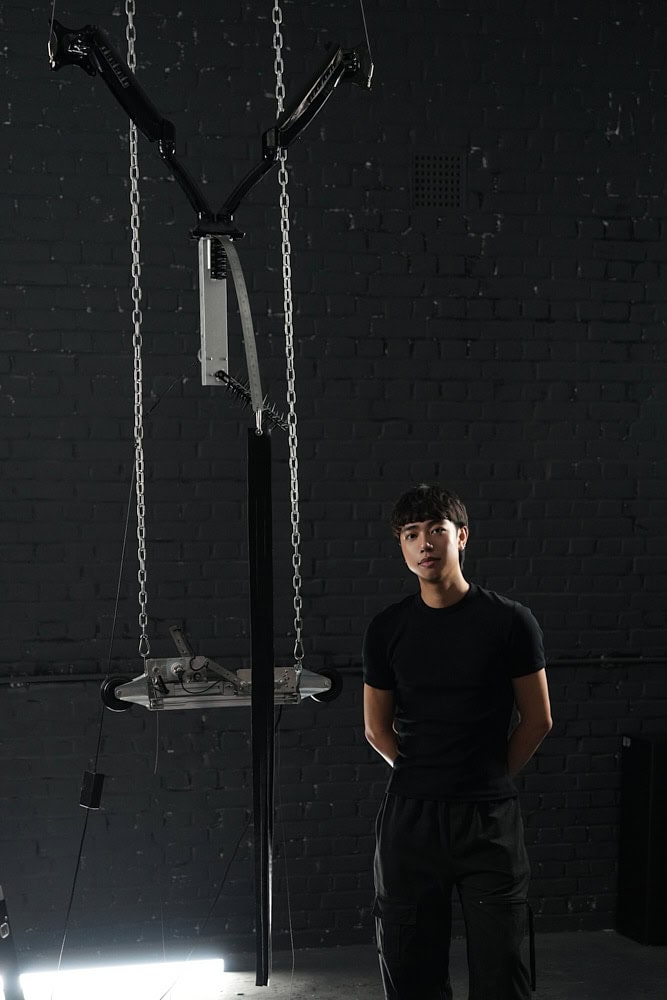
Yihao (Hao) Zhang has been “drawn to making from a young age”. The London-based artist chatted with COLD about the fact that he has always liked working with toys, breaking them into the sum of their parts to be reconstructed, adjusted, and transformed into something brand new. This process allowed him a sense of discovery, which was only further expanded upon during his time in university. “I studied film props and design, which showed me objects can tell stories. During my MA… I moved toward sculpture and performative installation.”


These mediums are what Zhang most commonly works with now, evident in his Exhibition entitled,Rebuilt Babel. This collection of sculptural works is a direct depiction of the resolute ways in which the queer community prevails despite the constant difficulties and hurdles it must surpass merely to exist in a homophobic, and close-minded world. A world that is constantly seeking newness, at the same time it harkens back to archaic ways of thinking. A series of untitled sculptural works invite the viewer in, allowing passersby to engage with each abstract work, placing their own interpretations onto its nameless form. There is a sense of movement in each static work, calling into question the very act of “staying… without becoming settled.”
Oftentimes queer creatives and artists more generally can become reduced to their positionality in the wider LGBTQ+ community. For some, it is a massive marker of their work and the directions it takes. For others it is an inherent way of being, rather than a namecard to place in front of oneself. Zhang elaborates on his queerness in the way it impacts his work. “My queerness is both a starting point and something reshaped through practice. Growing up in China made me feel the tensions between body and social systems, and that tension keeps driving my work.”

As queer creatives there is a pressure to position one’s specific identities against the work, as if calling it out for the sake of the audience’s engagement. But in some cases its this very identity that fuels the background of the work. Inherently present, yet somewhat ambiguous to the average viewer. “I do not always set out to make ‘queer’ work, but the perspective is almost always present.” In an extension of this notion that is inherently imbued throughout much of Zhang’s work, the piece To Touch, Barely, from the wider exhibition, Nothing Holds on Its Own, is an awe-striking reflection of these tensions as they pull and release. Constantly present but not quite within arm’s reach.

Zhang elaborates on this specific work, “I use cold structures and precise movements to stage the tests that happen within intimacy. Touch is reachable but limited. Seeking is both a desire for connection and a way of testing oneself. Departure reminds us of fragility and the need for protection. I do not see this as pessimistic. Impermanence can be a form of survival and creativity.” We are constantly at odds with our embodied circumstances, and the external realities we wish to occupy. Be it a romantic interest, a job or career prospect, even the finishing touches on a painting, or written work.
The weight of these sinewy connecting points, comes down to the space betwixt them. It turns out, the actual touching is not all that significant. Rather, it is the lock up, stilted in place beforehand, that leaves a lasting mark. To present is one piece of the creative puzzle, Zhang also wishes to be received by the world in a way that builds on and starts new conversations. “It is not only being seen, but provoking responses, discussion or continued life beyond the gallery. I notice it in external signs like audience reactions and in an internal sense of being understood. Sometimes it happens instantly, sometimes it builds slowly.”

These conversations of course come back to individual identity and the ways that queerness and community influence one another, as well as the creative world around these same makers. Being connoted as a queer artist is not enough, queer representation in high art spaces matters to Zhang and many others. “Queer visibility in art matters because it legitimises marginalised experience and brings new directions in narrative and form. It challenges institutional power and who receives resources.”
The platforming of queer artists and art presents a direct confrontation to traditional value structures. It also creates movement for radical vulnerability, community development, and an inimitable degree of innovation. “For me, queer presence is both a political demand and an artistic force.”

The artist likens his works to non-static entities, always malleable, able to impact and shift differently depending on the varied circumstances they exist within. This artist is clearly dedicated to disrupting the narrative, albeit in ways that do not scream for your attention. The works are not merely one-note sculptural works, they represent a collapsing of timelines, of new realities meeting the current one. “The present meets the future in the moment the work happens. On-site choices, audience activation and a structure’s mutability create future trajectories.”
Viewership is invited to peer into these temporary worlds. Many of which are derived from live performance art alongside sculptures that are composed of both industrial and natural materials. Each is absorbed by their inherent temporality. This comes to life in the many mixed materials used in his art. “Working across media lets me unfold ideas through multiple senses.” Each material has a distinct influence over the individual work. “The weight of metal, the rhythm of mechanics and the temporality of sound and video layer together to create complex tensions. Mixed media opens more routes for making and for audience engagement.”

As for artists that are beginning their careers, seeking guidance from those more established, Zhang had a word of advice. “Make a lot and do not fear failure. Treat practice as long term training. Experiment, document the process and find peers for critique and mutual support. Look after your body and practical needs. Stay curious and critical. Those matter more than short term wins.” For budding artists and creatives seeking to develop their own unique senses of self, at the heart of these labors lies a crucial skill in being able to pivot. We cannot control the realities that befall us, but we can choose how we react.


