
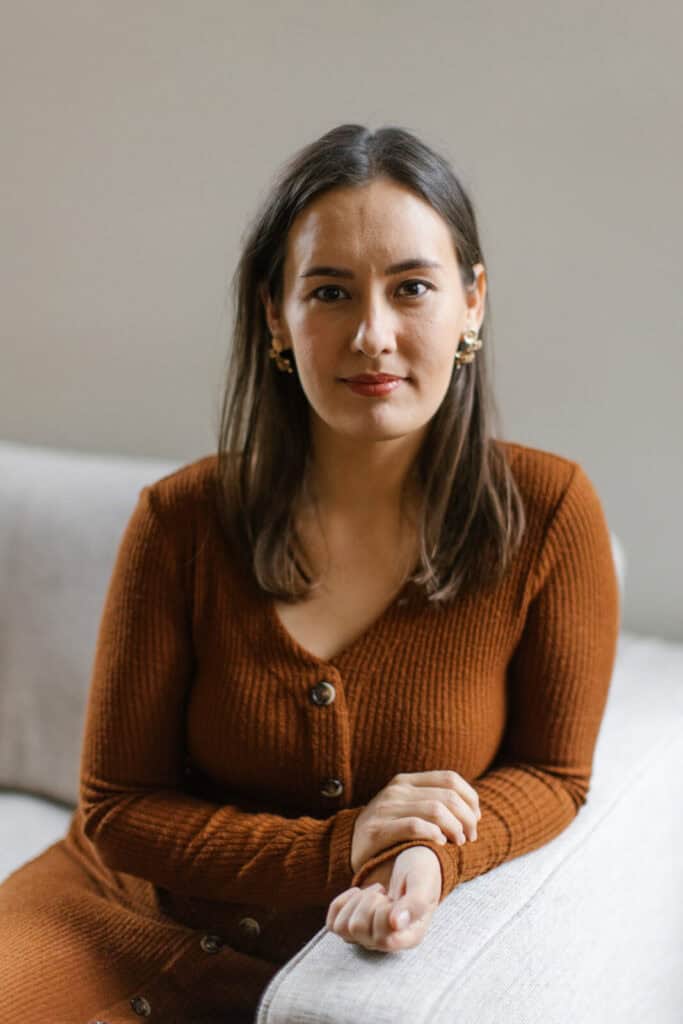
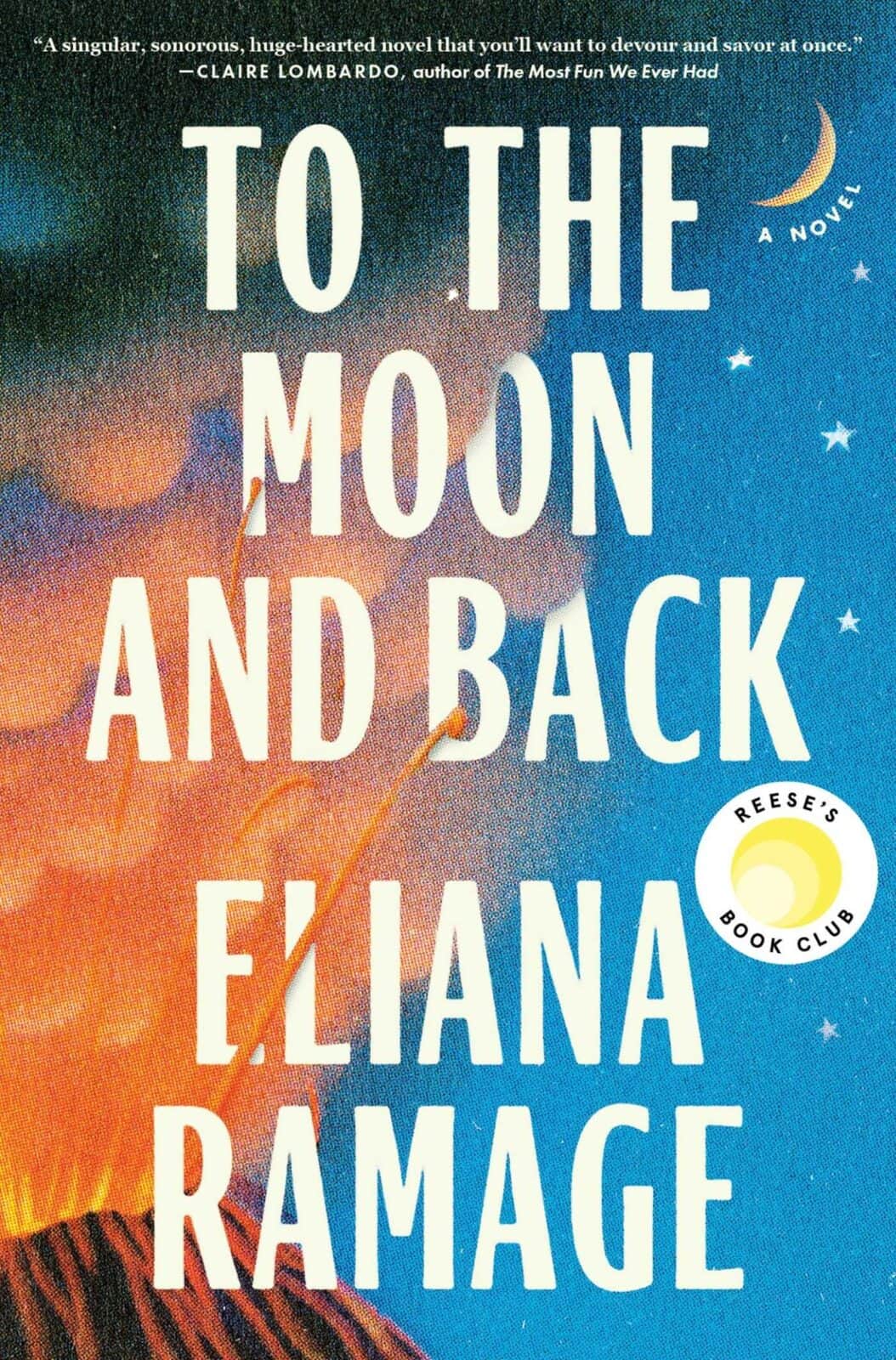
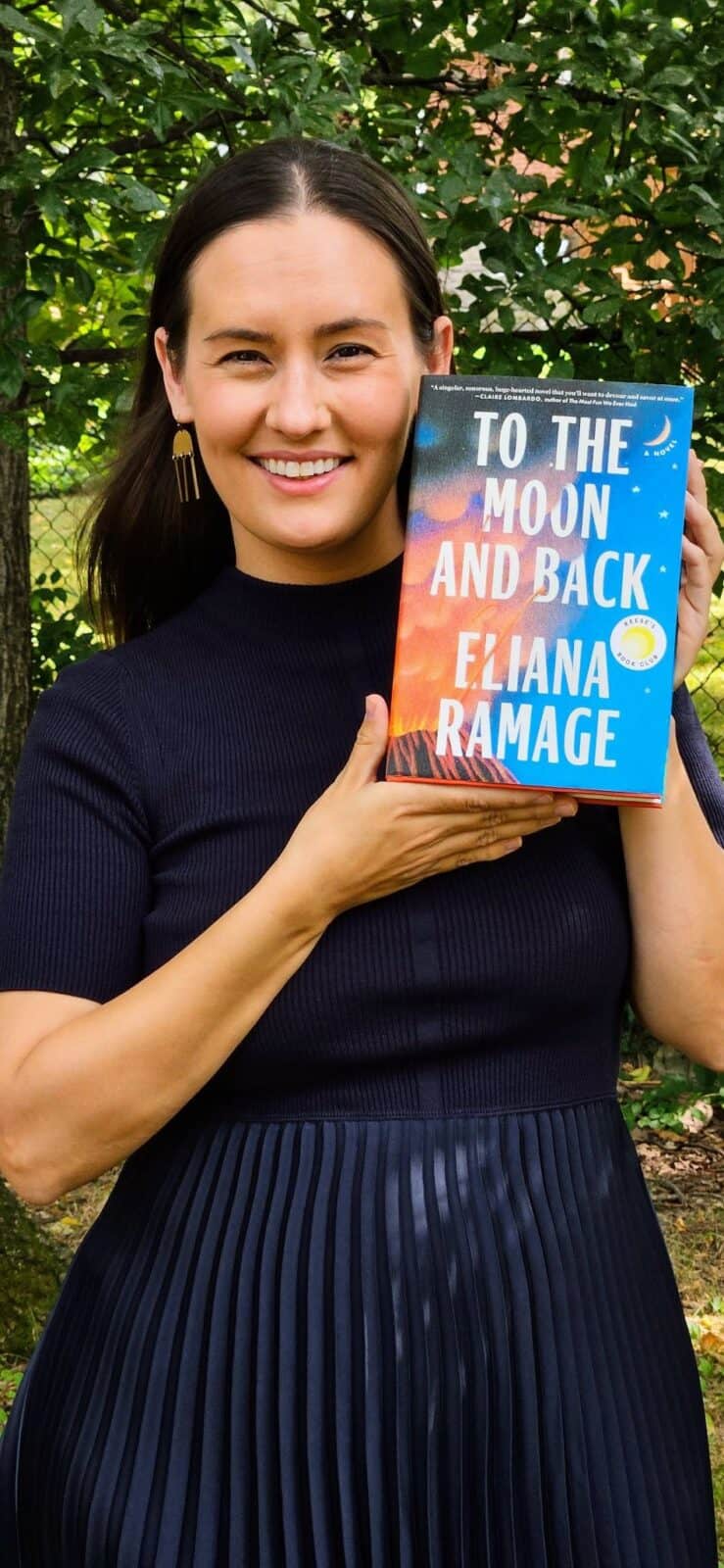
Eliana Ramage is a citizen of the Cherokee Nation, a new mom, a writer, and a queer person. Like so many of us, carrying multiple intersecting identities is a fact of her life. But writing that into a novel, when publishers are often looking for a simple, commercial hook, is a hard sell. And yet, Eliana does it so well that her absorbing debut novel, To The Moon And Back, was a Reese Witherspoon book club pick when it came out in the U.S. in 2025.
Like many Witherspoon picks, To The Moon And Back does not present a sweet, uncomplicated narrative. Our protagonist Steph is salty, controversial, and at times downright wrong.
We follow her journey of blinkered and often selfish ambition that takes her from her home on a Cherokee Reservation to become the first Native American woman on the moon. Along the way, her untempered drive conflicts with the love she is surrounded by, from her girlfriend, mother, and sister.
Now, the novel is out in the UK.
Eliana is the kind of writer I love talking to. Her work is achingly smart, but she’s warm, friendly, and willing to spill secrets. I sat down with her to talk about the multiple identities that coexist beautifully on the page in To The Moon and Back.
The Cold Magazine (CM): Working in publishing, I could so easily imagine Steph’s story receiving notes like, “Can we keep one identity but not the other?”, “Can we tone down the queerness?”, “Can we make Steph more soft?” Like Steph, you carry multiple identities. Did you face resistance in writing about them without leaving anything out?
Eliana Ramage (ER): You’re right that I share identities with many of the characters in this book. I’m not looking for purity; I want to see a character’s changing understanding of herself and of her place among others. If that is a central question of this book, and a central joy of my own life, then the people who worked on the novel with me needed to be interested in that, too. Because they were and are, and they could help me think deeply about that question, it’s a better book.
CM: Steph definitely falls into the trope of “difficult woman”– why did you write her this way? I wondered if it was to do with how queer people sometimes take longer to be comfortable in themselves if they haven’t grown up with acceptance.
ER: I love the way a book almost gets thicker with different possibilities and interpretations once it meets its readers. I really appreciate the chance to realize with you now that yes, Steph did not grow up with acceptance and that would have an impact on the story she tells about herself later. As for what I intended on my own, I just kept going back to Steph’s definition of herself as singularly ambitious. Every time she makes a frustrating decision, or lets someone down in the name of her journey to space, I would hesitate first and ask myself if she might be open to a different way of living. But, for a lot of her life, she isn’t! Once she’s gone down a path, and has already sacrificed so much and distanced herself from the world, it’s very hard to imagine her realistically choosing to back down.
CM: The way you write ambition blew me away. I had never seen it addressed like this before, with so much light and shade; clearly necessary to the journey, but the cause of much sacrifice. Growing up in the 90s, I think we were so used to thinking of ambition in women as a negative.
ER: I, too, have had to get over that 90s-kid affliction! I think I’ve always been ambitious, but before finishing this novel I never would have used that word. But, rather than taking ambition to a place of total acceptance, you do you, let’s all be singularly ambitious, no questions asked, this book helped me hone in on what to me is the most important part of any life, ambitious or otherwise: inviting people in. There is nothing wrong with being ambitious. It’s something I’m finally proud to be. But I want my dreams, and the hours I spend working towards them, to bring me closer to other people. I want them to pull me deeper into the world.
CM: I’ve noticed several novels lately with some masc or masc-adjacent love interest representation (I’m particularly thinking of Ordinary Love by Marie Rutkoski). Can you talk about this in terms of Steph’s character?
ER: There are so many parts that make up Steph, and yet she so often chooses to look away from them and to focus on her goal. Steph does not value the Cherokee language, and gives it up to study Russian in hopes that it might be more useful in space. Similarly, Steph does not value (or think much about) her identity as a more masculine-presenting person. As a reader interested in this subject, I wanted Steph’s gender identity to be more present in this story. But as the author of this book, and someone who knows this character well, I knew that I shouldn’t “make” Steph’s voice engage with something that I knew she didn’t want to choose to engage with. When you do find glimpses of Steph’s gender presentation in the book, it’s rarely spoken or even thought about. But it’s there in ways that felt like natural parts of her life and story, without her choosing to centre it for the reader.
CM: You mention the Cherokee language. Language and translation appear as important themes in the novel. In giving Steph this language, is her mother, Hannah, trying to offer her a better story in the aftermath of such a troubled childhood?
ER: I do think it’s part of Steph’s mom trying to give her a story. She wants to give her the much-needed gift of a stable home, but also the promise of a place where she might feel a sense of belonging. It’s important to me to note that Steph’s mother Hannah does not speak Cherokee herself, and she isn’t from Tahlequah. Someone else, Brett, Steph’s childhood stepfather, loves her daughters and helps her to give them this.
These kinds of complications, of home, or language, or access to culture, are common today for so many Indigenous people. Instead of brushing past that, I wanted to write a novel that really explored how five different Cherokee girls and women might contend with sometimes feeling at a distance from their shared tribal nation.
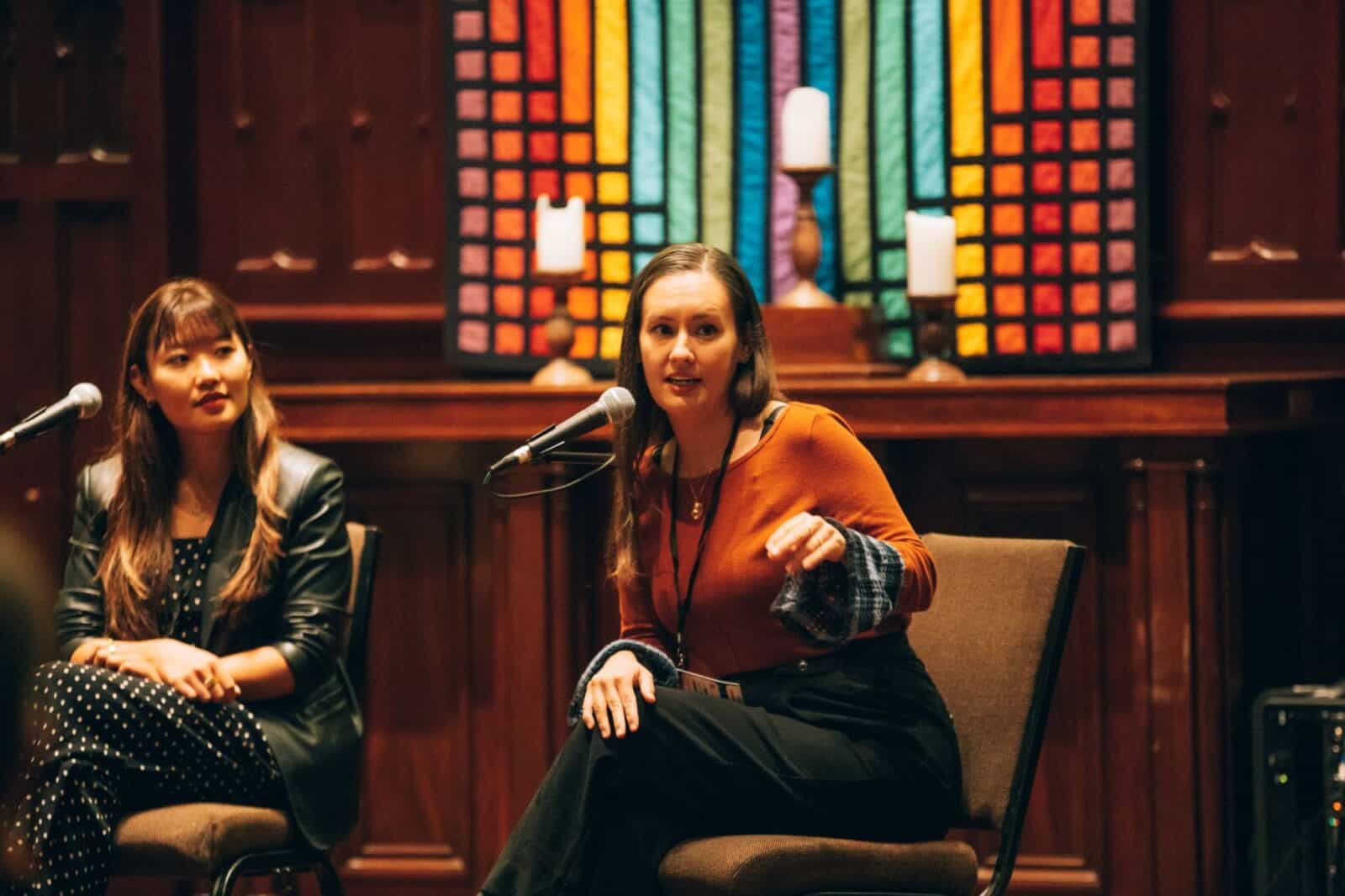
Photo taken by Henry Crommett at the Portland Book Festival
CM: But space precedes language in your novel, and becomes somewhere Steph feels she belongs. Steph’s father is her first contact with the idea of space, but he actually frames it as the end of the world.
ER: When my editors Margo and Bobby read the book, they asked me to step back and explain things that felt really complicated and hard to answer at first. Questions like, “Why space?” When I felt empowered to figure out and then tell them that Steph was not (at first) running to space but from earth, it led to countless small changes throughout the book, like the addition of that scene between Steph and her father.
CM: Steph’s father tells her that, in terms of the universe, it “didn’t matter who you were or where you came from,” contrasting this with her mother being “part-Cherokee and stuck up about it.”
ER: Steph and Kayla were “brought home” to a small Cherokee community when they were very young children, but that home wasn’t where they were born or even where their mother Hannah was born. In order to understand it as home, the way that Hannah does and Kayla does, you have to understand yourself as part of the greater Cherokee story. That’s an ask that is fascinating to me, because, especially for Cherokee Nation citizens who grow up away from Cherokee land, it forces this question of belonging. Through centuries of change, what might lead one daughter to feel that she belongs to her people and another daughter to feel that she belongs to no one?
I had a teacher in grad school say that books hold a central question, and serve as an engine to the story. This was a central question of my life when I was eighteen, and had moved away from my family for the first time. It’s why I started writing this book, and now that I’m a parent of a Cherokee child it’s become only more interesting to me.
CM: Let’s talk about Della, Steph’s love interest. When Steph is a child, she sees signs that say “Della Owens belongs with her tribe”. Later, in college, Steph and Della meet, and become intimate.
ER: As a child, Della was at the center of a highly-publicized custody battle that threatened to separate her from her biological father and take down the Indian Child Welfare Act – a federal law from the 1970s that exists in order to keep Native American families together, passed in response to a long and brutal history of family separation.
In a child custody case like Della’s, because she is eligible for membership in a tribal nation, she should first be placed with a family member. If that is not possible, she should be placed with a member of her same tribe, then with a member of a different tribe, and then with a family like the white family that adopts her. In the novel, Della’s adoptive parents are very loving and they choose to adopt her as an infant through a private agency that ignores the requirements of ICWA.
In my twenties I started to read more about cases that challenged the Indian Child Welfare Act. I kept thinking about children raised outside of their tribal communities and what that might mean for them as adults. Della chooses a college with a strong Native student population, because she wants a chance to learn more about a part of her identity that was not welcome in her home growing up.
CM: Can you talk about the theme of motherhood in Della’s story? Her desire to become a mother felt like a parallel to Steph’s desire to become an astronaut.
ER: I’m so happy it felt like her version of being an astronaut. A lot of this book was written in the years I was trying to have a child myself, in the slow and involved IVF way that can take up a lot of space in life and make you think often about parenthood and the different ways people become family. I’d always known Della wanted to have kids, but years ago I assumed (as I’m sure she did!) that it would happen a certain way. Della’s adult life takes her to places that surprise her. She lets herself be curious about what makes up a family, in a way that is informed by her queerness, her deep adult friendships, her ambition and career as a scientist in her own right, and most of all her prioritization – given her own background – of what a child might need to belong.
CM: Steph and Della have a beautifully complex queer love story. It’s just not simple and it reflects reality more than most fiction. Steph really struggles in her relationships, both because of her ambition and everything about herself that she hasn’t yet come to terms with.
ER: I love your read of how complex love stories in general and queer love stories specifically can be. Meeting each other in college means they get this explosion of being known and understood and loved in a way that means so much to them, especially for people who grew up closeted. But this is a long novel, and they each go through a lot of change.
I care so much about both Steph and Della, and it was hard to come to terms with what I felt
would be their best and most truthful ending. I started writing this at 18, and at that point in my life I think I would have seen the current ending as something of a failure of these characters. Now, years later, I want to be accountable to Steph and Della as individuals, to Steph and Della as people who change and grow over many years, and to Steph and Della as people who show up for one another. Della’s ending was one of the hardest parts of the book, and it took me the longest to decide on. But it’s also what I’m the most satisfied with.
Eliana Ramage’s To The Moon and Back, published by Doubleday, released in the UK on 17 March 2026.
Abigail Tarttelin is the author of three novels, including Golden Boy.


