
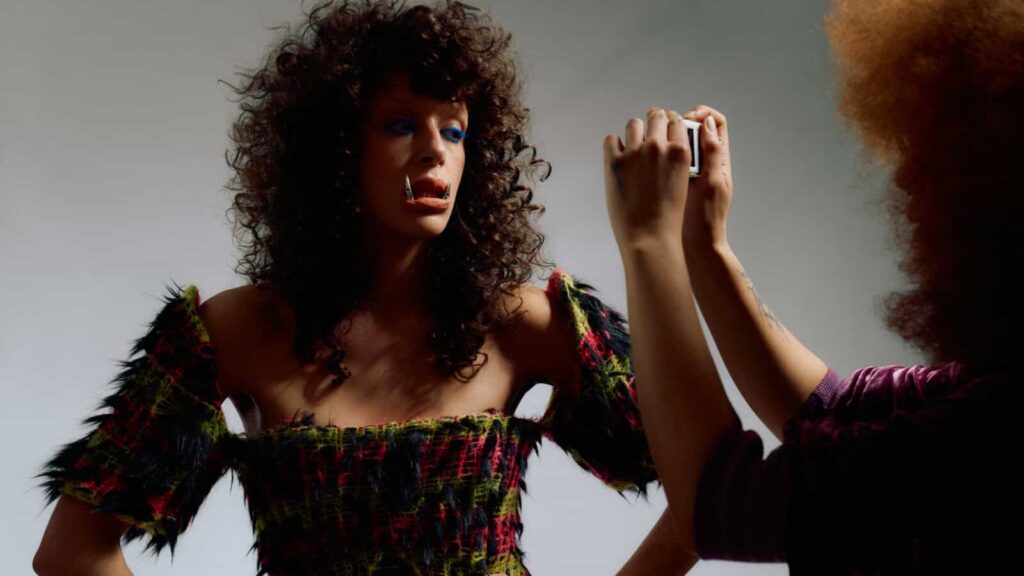
Scar Kennedy, a Central Saint Martins graduate hailing from Leicestershire, works with experimental knitwear and an unconventional approach to craft. Her practice focuses on the relationship between clothing, identity and fantasy imagery, with a particular focus on shapes and materials that challenge more traditional representations of femininity.

With Orc-ish, Women, Kennedy draws from the figure of the orc and its role within fantasy culture to explore ideas of the body and otherness. The subject, and existence of, female orcs has become an unexpectedly heated point of debate amongst Reddit communities and Tolkien devotees alike, with long-running discussions sparking around whether Tolkien’s mythology ever truly accounted for orc women at all; although the author never arrived at a definitive explanation, his writings make clear that orcs did indeed reproduce, existing as living societies. The ambiguity surrounding these figures, largely absent from mainstream fantasy lore, makes them all the more fun to dissect, reconciling with Kennedy’s wider interest in the monstrous-feminine.
She later references Barbara Creed’s namesake theory, which argues that female monsters embody cultural anxieties surrounding women’s bodies and social power, as a powerful influence in her work. “All human societies have a conception,” Creed writes, “of what it is about woman that is shocking, terrifying, horrific, abject.” In Kennedy’s universe, one knitted in distressed forms and textured surfaces, internet theory and mythology collide into the wonderful (and monstrous) freedom that exists beyond idealised forms of beauty.

The Cold Magazine (CM): Before diving into “Orc-ish, women”, could you tell us a little about your practice as a designer? What kind of worlds, characters or tensions are you usually interested in exploring through clothing?
Scar Kennedy (SC): My design language is rooted in experimental knitted textiles, layering different techniques such as crochet and print and hand-manipulation. I like to refer to this as “off-beat craft”. I then aim to integrate these into recognisable, wearable garments that despite its chaos can exist in everyday life.
CM: “Orc-ish, women” continues your exploration of the monstrous feminine. What does the monstrous allow you to say about femininity that beauty, elegance or desirability often cannot?
SK: I’ve realised that the qualities I love most in the feminine people around me are often the ones that might be labelled ‘monstrous’ – drunken screaming, taking up space, fitting an entire burger in their mouth. There’s something incredibly freeing about embracing that.
It rejects the idea that femininity is something you can fail at – in contrast to elegance and desirability which society has us believe can be failed at. Publicly celebrating those moments feels self-affirming, because they’re universal – they’re part of me too and inseparable from my experience of gender.
CM: The figure of the orc is usually coded as brutal, grotesque, undesirable. What interested you in bringing that archetype into conversation with womanhood?
SK: The ‘orc-ish’ woman came out of my own exploration of gender. I’ve never been delicate, quiet, or polite – I stomp, I laugh too loudly – and this collection became a way of rejecting any insecurity tied to that and embracing it as an adult non-binary woman. Orcs are so often portrayed as one-dimensional villains, a stereotype that feminine people are all too familiar with and is explored by Barbara Creed in The Monstrous-Feminine.

CM: Fantasy and tabletop role-playing games like Dungeons & Dragons often rely on role-play and invented identities. Do you see fashion as a similar space for becoming something other than oneself?
SK: Definitely. I think fashion is one of the few places where we can blur the lines between ourselves and our invented identities. Our identities are so much more than our bodies but also our words, jewellery, coffee order, so why can’t it be two huge tusks from my bottom jaw? I like the idea of existing between realities, with one foot in each realm. Pieces like the orc-teeth necklace let me carry that alter ego with me – ready to step into whenever I want.
CM: The collection seems to place the modern feminine in contact with something more animalistic and unruly. How do you approach the tension between control and instinct in your work?
SK: The controlled aspect of my design is something I am in constant conflict with; the instinct to make something ‘perfect’ or ‘desirable’ is always hijacking my brain, a hangover from the pressure to perform ‘perfect femininity’. I have to regularly shake it off by dancing, blasting music, ripping the knit, pulling out stitches. It can be a difficult state of flux to exist in but I think it’s necessary.
CM: You reference 80s silhouettes alongside experimental knitted textiles. What drew you to that contrast between power dressing, bodily exaggeration, softness and distortion?
SK: I find so much inspiration from the silhouettes of the 80s and I think that again links to identity within fashion and embracing that you don’t start and end with your natural form. By extending the boundary of your identity into your fashion you can start with your chunky belt and finish with your oversized shoulder pads!

CM: Knitwear is often associated with intimacy and domesticity, but here it seems to become more feral and sculptural. How did you want the textiles to behave on the body?
SK: In my practice, the textile almost always comes first. I try not to impose too much control over how it behaves – I’m more interested in responding to it. For example, the combined distressed knit and tufted fur fabric was so structured that it naturally created these rigid pieces that sit away from the body. Similarly, when printing vinyl onto the 3D bubble knit, the printed image is distorted beyond my control. There’s a sense of surrender to experimental textiles which I enjoy, and which you sometimes don’t get with a simple fabric choice.
CM: Who is the woman or creature behind “Orc-ish, women”? Is she a fantasy character, a protective alter ego, a threat or a version of femininity that already exists in real life?
SK: She’s real. She’s someone moving through everyday life with one foot in another realm. I wanted the pieces to exist in that in-between space – where they can read as high fashion at a formal event, but translate into fantasy when she gets a last-minute fancy-dress party invite. It’s how I like to curate my own wardrobe.

CM: The shoot takes a high-key editorial approach, which creates an interesting contrast with the darker, mythical references of the collection. How did you want the imagery to reshape or sharpen the world of “Orc-ish, women”?
SK: The intention was to ground the orc-ish woman in reality – to place her in a familiar, recognisable environment while still allowing her to feel mythic. I wanted her to be taken seriously, to be visible in the everyday, completely unfiltered and unapologetic. She’s not hidden away in a distant fantasy; I need to see orc-ish women at work, at the club, at the gym – it’s orc girl summer.


