

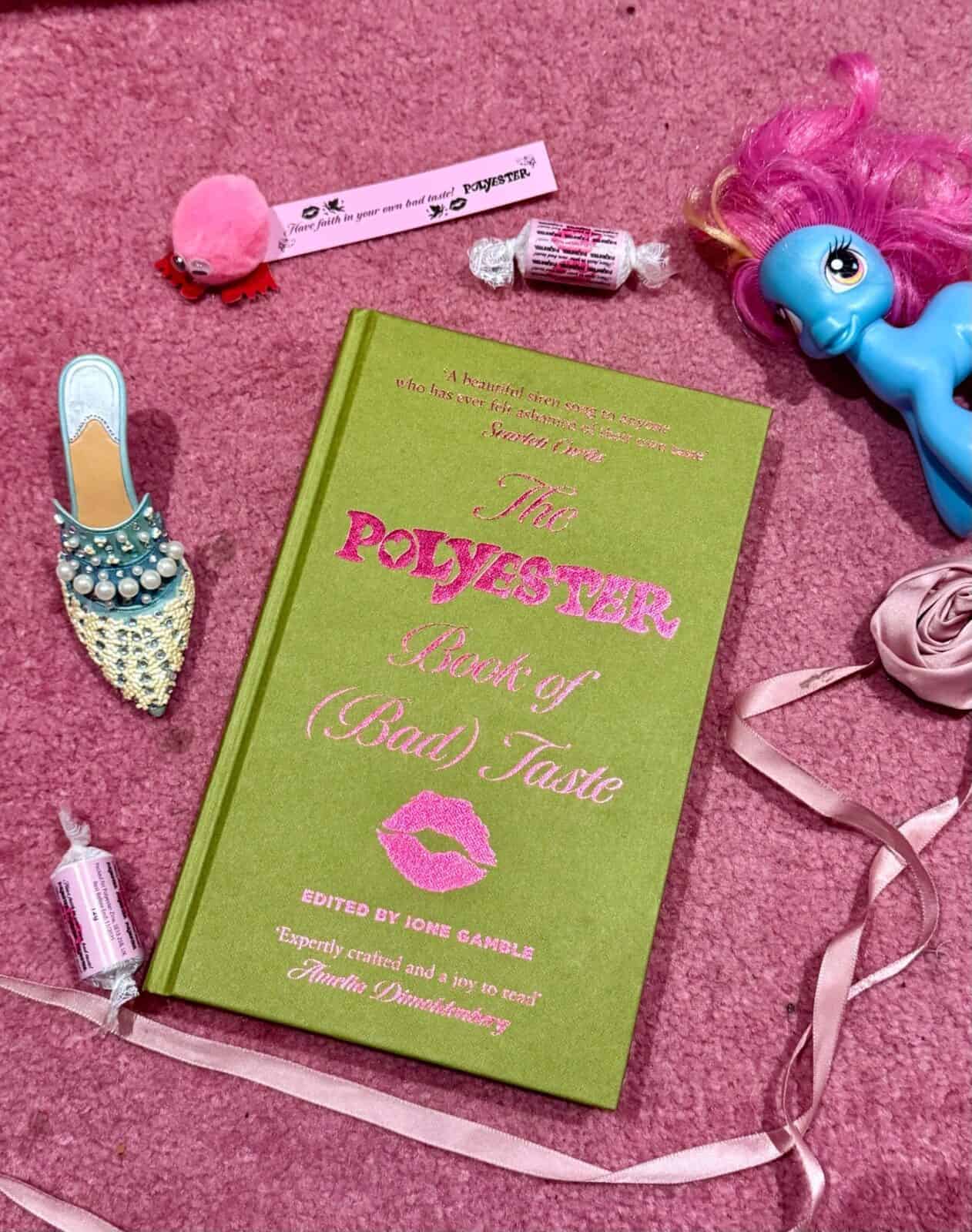
Polyester Zine has been pushing the kitsch agenda since it launched in 2014, encouraging readers to “Have faith in your own bad taste” – a motto derived from the king of camp himself, John Waters. Today, it released its manifesto The Polyester Book of Bad Taste.
With bows in pinks and purples and pixelated glitter hearts snipped right out of an early-2000s e-sticker pack, Polyester’s visual style has become synonymous with feminine maximalism and an ode to the early internet. And with cultural deep-dives on everything from The Real Housewives franchise, to the history of the tramp stamp, to the death of the body positivity movement, Polyester is both confectionary and complex.
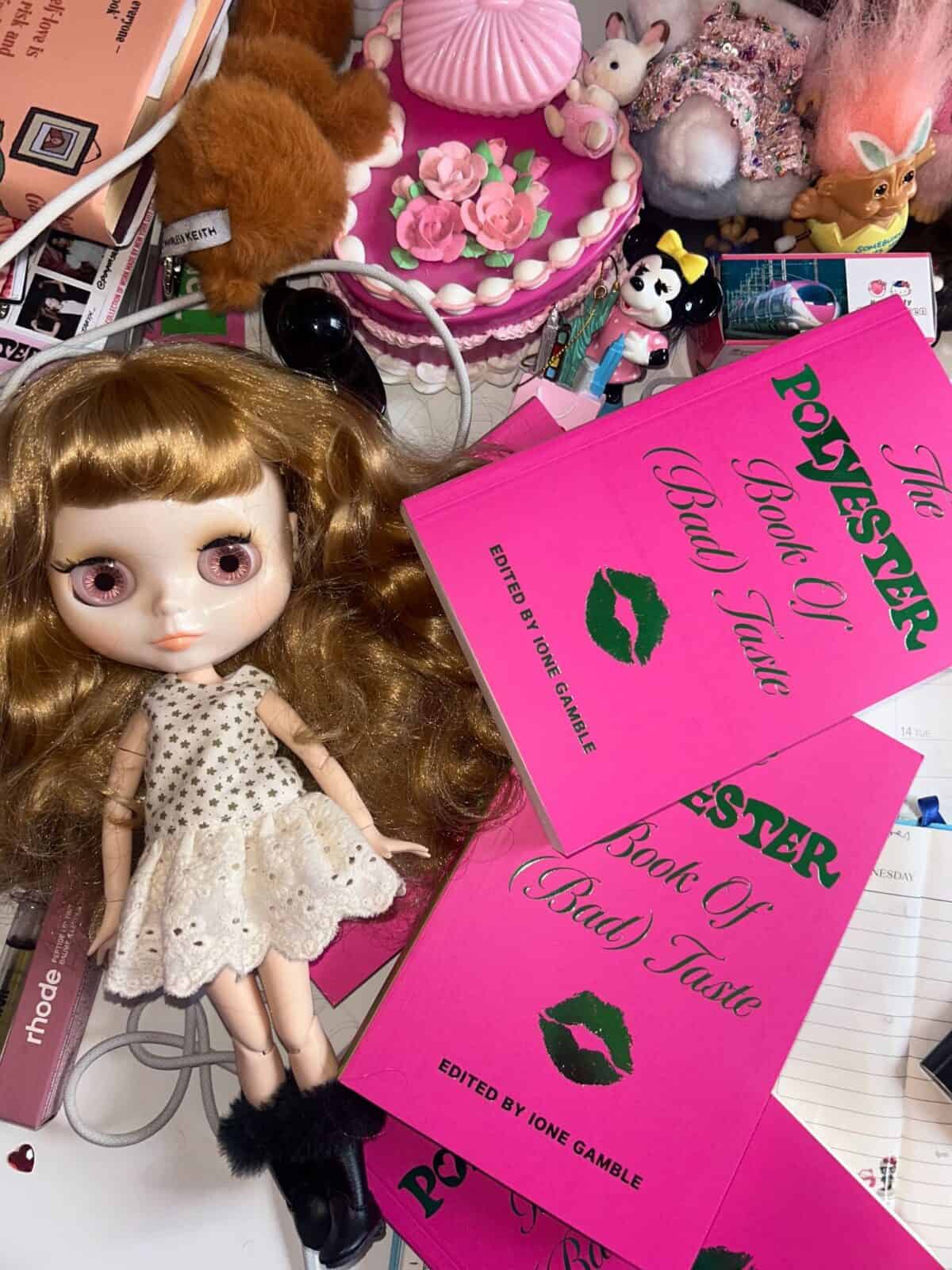
Edited by its founding editor-in-chief Ione Gamble, The Polyester Book of Bad Taste is essential reading on class, cringe and how discourse around “good taste” has become increasingly elitist online. Across a collection of essays from contributors to Polyester Zine, the book challenges you to question the hierarchies of cool and ask yourself, “Wait… do I really like Napoleon jackets, polka dots, butter yellow, or [insert microtrend here]?”
On the heels of its June 18 release, we sat down with Ione Gamble to discuss her journey with Polyester and what she hopes readers take away from the book.
The Cold Magazine (CM): Talk to me about the Polyester project. What inspired you to start the magazine?
Ione Gamble (IG): When I started Polyester, I was studying fashion journalism, and I found the way we were taught about “good” and “bad” taste was so deeply rooted in class.
Minimalism and expensive things were treated as intellectual, while things that were more accessible, or bright, or colourful, or feminine were seen as tasteless and dismissed as bad taste. This felt very elitist to me, which obviously isn’t surprising to anyone.
The media industry itself is also incredibly upper-class, especially in the UK, where we still have such a historically entrenched class system. So I think, in that sense, Polyester has always been about questioning the hierarchy in the media, how we interact with culture, and questioning why we are more likely to take something seriously if it comes from someone who is from a wealthy background.
CM: It’s so true. And you’ve had such success as a magazine, between online features, zines, the podcast, seasonal print editions. So why a book?
Ione Gamble (IG): So I did a personal collection of memoir essays in 2022 called Poor Little Sick Girls, and that was obviously much more personal. When I started thinking about a second book, I knew I wanted to explore taste.
I have always been very interested in taste. Polyester is an exploration of what constitutes good taste, what constitutes bad taste, and why we assign these markers of taste to certain culture artefacts. Taste is so changeable and personal and different for everyone that I thought the best way to approach it was as a group project. I wanted essays from different contributors with completely different perspectives.
I was lucky that the publisher was interested in the idea, and it kind of went from there.
CM: One thing I loved about the book is that it doesn’t feel like it’s pushing one singular thesis. It really feels like a collage of perspectives.
IG: Yeah, definitely. When I put together the contributors, I thought it would be much more interesting, and obviously honest, if we assembled the contributors first and asked what taste meant to them, rather than assigning each writer a certain topic or theme.
I think that really benefited the book. It does show a wide gamut of what taste means to different people, but how different writers approach the topic very differently in terms of tone. Some essays are funny and lighthearted, while others are analytical or deeply personal.
CM: Did working on the book change your own taste, or your concept of what taste is?
IG: I actually felt very affirmed by it. I talk about this in the introduction, that throughout the process of founding Polyester, being its Editor-in-Chief, I have had to question my own taste many times. When you exist in the world for long enough, it becomes easier to fall into a pattern where you stop questioning your own taste.
And sometimes questioning your taste can be good, right? Do you like something because it’s got the right marketing team around it, or because everyone else is posting about it, or because you love it?
And I think putting together the book just made me feel affirmed in my belief that taste is so complex and multifaceted. At its core, it’s about how we connect with the world and how we connect with other people, through shared likes or shared dislikes. Taste is a way to make sense of everything.
CM: This definition of taste seems very anti-influencer. On social media today, taste is all about following trends.
IG: I think that a lot of the online discourse around taste is based on this hierarchical idea of taste, where you can only learn good taste by acquiring it. You can only do this by subscribing to the right set of rules. And again, yeah, that’s so deeply rooted in basically every -ism going.
This way of thinking is extremely elitist and also just like anti-art and anti-curiosity – just gross, anyway. So I think the book really serves as a kind of rebuttal to the taste discourse that we’re having at the moment.
CM: Reading the book really made me think about how fast trends move online now – microtrends, recycled aesthetics, constantly shifting TikTok-core subcultures. It feels exhausting.
IG: For sure, yeah. In a lot of ways, being online now takes away a lot of our decision-making agency because we’re exposed to so much at such a relentless pace. Humans have never consumed this much imagery and information before.
It reminds me of when you’re at school and a trend would sweep, like suddenly everyone would have the same bag or the same shoes – except there was probably max, like 100 people in your year. Now we’re dealing with hundreds of thousands of people.
It becomes much harder to develop personal taste or a stable sense of self when you’re constantly being fed the same aesthetics over and over again, and often those trends are being engineered by brands.
CM: There’s also a growing analogue movement happening online right now – people buying flip phones, deleting social media, trying to disconnect. What do you make of that?
IG: I don’t know. I think it’s easy to say, “go outside, go touch grass”, but, ultimately, I love the internet. There’s a lot to hate about the internet, but if it wasn’t for early social media, I wouldn’t have my own sense of taste. Without the internet, I would have come to feminist texts a lot later. I would have come to films that I love a lot later.
I was able to be exposed to all of these things through platforms like Tumblr and early Instagram, so I think just being like “log off” closes us off to a lot of good things. The real problem lies in the fact that these platforms are not working to enrich us. They’re working to keep us looking at the same things, looking in the same loop.
With that said, I think a good internet does exist. The spirit of Tumblr exists in a lot of the girls I follow and the girls that contribute to Polyester, but it’s just not the dominant way we use the internet anymore. It’s important to question the internet, but I also don’t think it’s extremely realistic that we’ll all just go offline. Getting a dumb phone is not for me.
Plus, using film cameras or digicam, or MP3 players and vinyl records – it’s all stuff that teenagers and young people have been doing forever. I think it’s a part of taste-making that people will always try and seek out things that aren’t readily available.
CM: It does sometimes feel like even “logging off” has become its own performance online.
IG: Definitely. And a lot of these analogue interests – film cameras, vinyl, MP3 players – aren’t even new – it’s all stuff that teenagers and young people have been doing forever. I think it’s a part of taste-making that people will always try and seek out things that aren’t readily available.
CM: Tumblr comes up repeatedly in conversations around the book. Do you think younger audiences today have an equivalent space online?
IG: I hope that younger girls today will be able to discover Polyester and discover the book, and that it will offer them an alternative media form that feels enriching rather than oppressive.
But I do think it’s harder now. It’s easier for a teenager to discover Polyester than it would’ve been when I was fifteen, but at the same time they’re inundated with so much more content.
Tumblr felt different because it operated more like a magazine than a social media platform.
CM: One thing the book returns to a lot is the idea of cringe. How do you think cringe culture relates to bad taste?
IG: I think as we get older, we become less resilient to the fear that we’re not cool enough or that we’re doing the wrong thing. That fear teaches us not to trust our own taste. Maybe we start holding up the taste hierarchy ourselves.
Whereas, I think the people who manage to avoid these pressures, who are willing to risk being cringe, or who simply don’t care about coolness at all – are usually the ones making the most interesting things.
Even if you don’t personally like the work, at least they’re trying something. I think it’s far braver to try, even knowing that you might be misunderstood, than to not try at all.
CM: If Polyester had a kind of “hall of fame” of cultural references, who would be in it?
IG: Definitely John Waters. Probably Sofia Coppola. Nan Goldin for sure – she’s been so politically outspoken and has made amazing art across so many years. She’s always been so true to herself in that way.
Maybe Winona Ryder. Or Rihanna – someone who’s always felt completely herself.
And obviously Miss Piggy.

CM: Finally, what do you hope readers take away from The Polyester Book of Bad Taste?
IG: I hope they feel that they can be more themselves.
And I hope they understand more of the mechanisms of what taste is, how it’s constructed, and why it is important to disregard it and just like what you like.
The Polyester Book of Bad Taste, edited by Ione Gamble and published by Fourth Estate, was released in the UK on June 18, 2026.


