
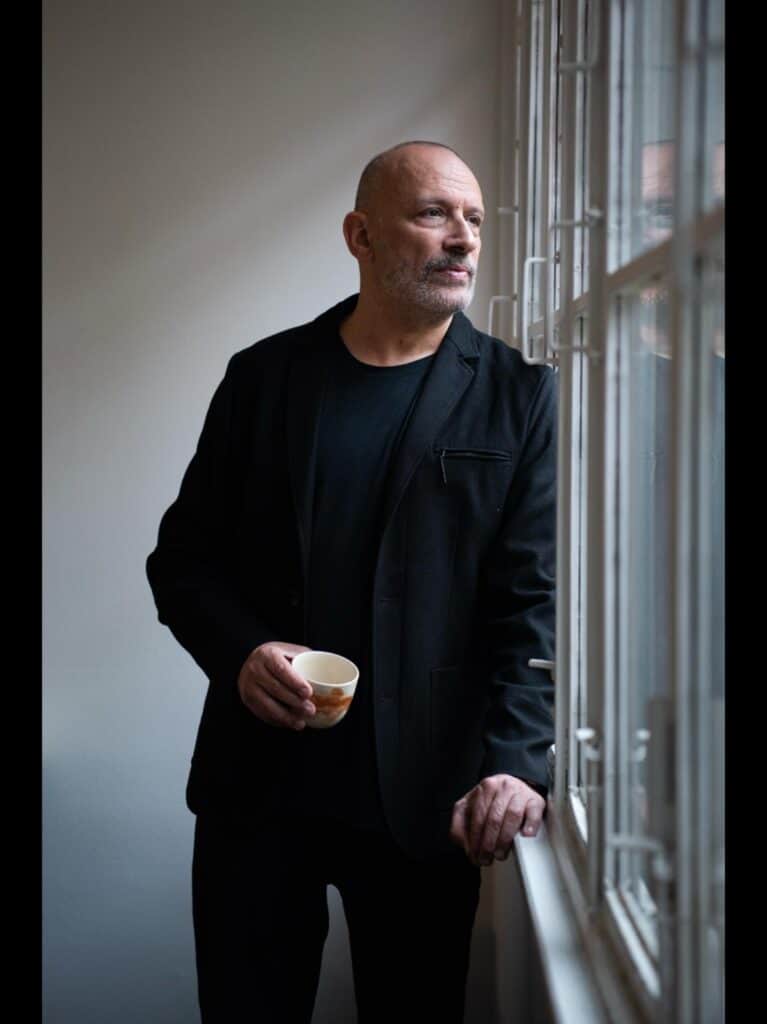
Recently, in London’s Shepherd Market, a space underwent transformation. The walls were painted black, not as superficial refurbishment, but as a way of rethinking the site and its story. This was the premise of the recent group exhibition at Gallery Marquess, A Silent Testimony of a Place: The Erasure and Reconstruction of Identity, curated by architect and designer Fahrettin Aykut.
The idea of the ‘black cube’ is not new. There have been many galleries who have dared to move away from the traditional white cube atmosphere, towards something more bold, more cinematic, one would say, even more psychological. A notable example would be Empty Gallery, a 4,500 square feet space located at Aberdeen Harbour in Hong Kong’s Tin Wan. In Brussels, Archiraar Gallery similarly runs a ‘black cube’ counterpart to its more traditional white space.
The “white cube,” now the default setting for many galleries—if not most—was a term coined by Brian O’Doherty in a series of essays for Artforum in 1976. He used it to describe what has since become the standard for contemporary art spaces: plain white walls, controlled lighting, and a minimal aesthetic designed to foreground the artwork. In this environment, distractions are stripped away, allowing not only the work itself but also its narrative to emerge with clarity.
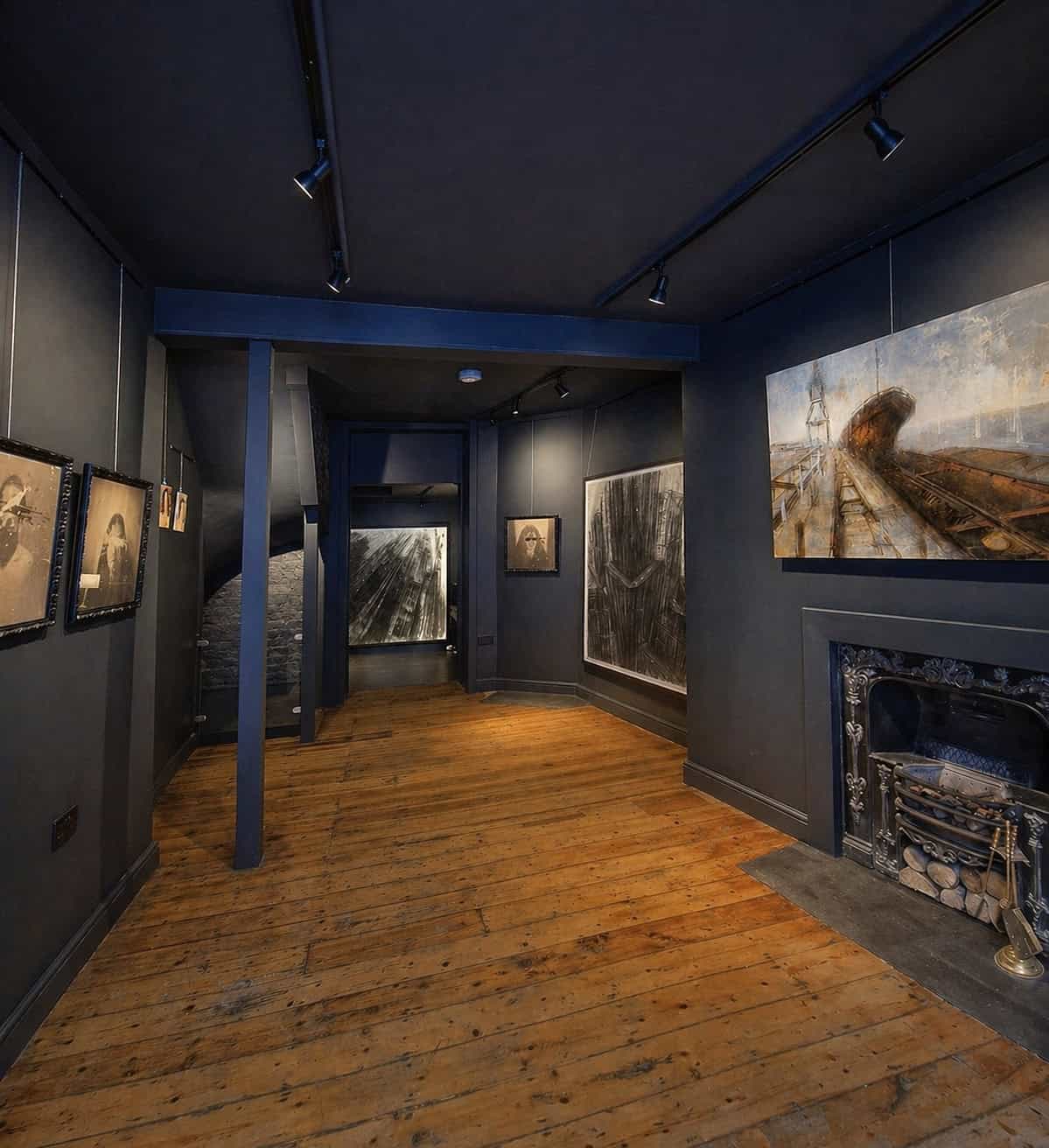
In contrast, Aykut noted that as they moved away from the traditional white wall formula, stripping the space of its historical traces and, a kind of resetting happened, “that allowed the viewer to encounter the artworks without attaching them to the past of the location,” – which has, by the way, endured as a discreet Mayfair gallery for more than a decade.
In April, three female artists presented works centred on womanhood. Ishilla Aleksandra’s paintings referenced nineteenth-century female representation, particularly the figure of sex workers in England, offering a deeper reading of women’s histories through thick, luscious strokes. Attuned to the space’s dark and moody atmosphere, Alessia Avellino presented large-scale charcoal works that moved between shipyard scenes in Spain and fragments of New York cityscapes. Ayşe Yenel, meanwhile, expressed memory and identity through poetic, monochrome images.
Through the works of the three artists, womanhood is read through multiple, distinct states within one space. The strength in Aleksandra’s, the ambition in Avellino’s, and the calm within Yenel’s—all different portraits of women coexisting within a darkened space. The point was to coexist with the noise—not mute it, but speak with it.
Aykut shares how he selected the artists for the exhibition: “When selecting the female artists in the space, I focused on bringing together three different approaches,” he explained. “I worked with practices that differ both technically and conceptually: a photographic practice, an abstract charcoal-on-paper approach, and a figurative oil painting practice.”
The aim, Aykut added, was to “bring together practices from different cultures and ways of seeing within the same environment, each carrying its own emotional register,” rather than establish a unified style or visual language.


