
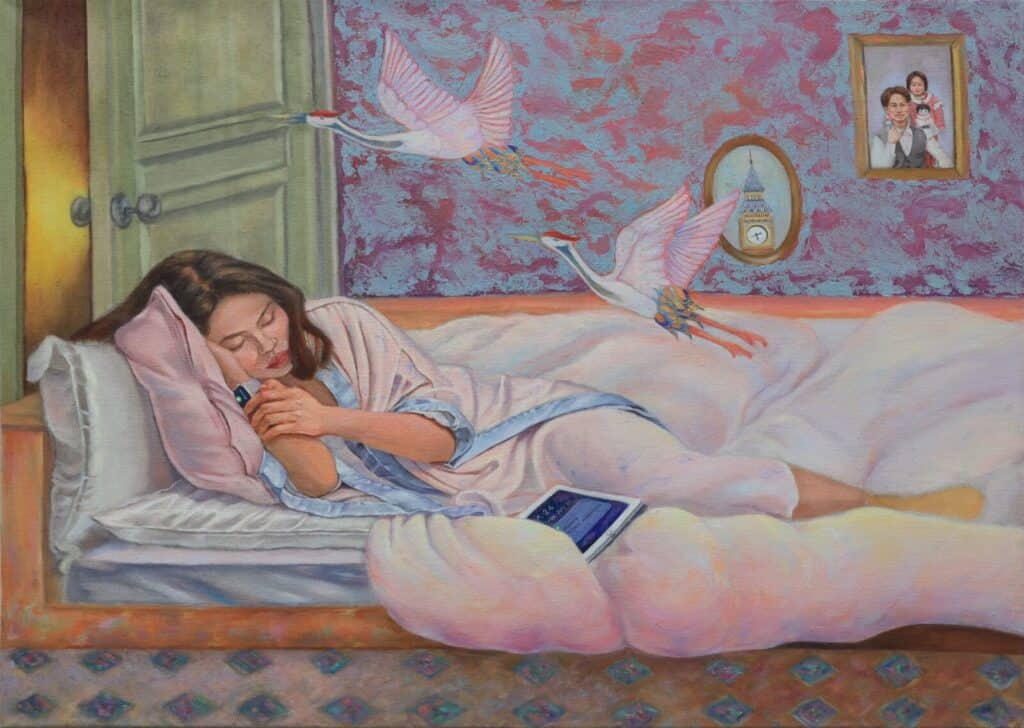
The central point between memory, identity, and cultural belonging is the crux of Xinan Yang’s artistic practice. Yang acquired her Doctor of Arts (Doctor of Professional Fine Art) in 2023 from the University of East London. This achievement followed after the attainment of her MFA and BA, cementing her academic track record against her creative practice more widely.

Yang’s work has been showcased as part of many exhibitions. Her most recent solo show on display at Orleans Gallery in London is entitled The First Letter Home in Spring. She had previously also received recognition for her show From Home at Laurderdale House, as well as Missing Place Missing Face at Taymour Grahne Projects, both which took place in London.
Yang creates as a means of understanding various subsections of identity as they influence and expand alongside narratives of home and interpersonal connection. This is especially apparent in her latest exhibition, The First Letter Home in Spring. The works themselves showcase Yang’s artistic interpretation of found and repurposed family objects. As well as artefacts representative of common space and home, in its many varied contexts.

Laid out in a segmented series of four chapters, this collection further extends subtle symbols of homeliness and domesticity. The shapes and forms that appear across her imagery are not easily reduced to that of a child, a bird, a shabbily made bed, or a living room chair. They instead showcase iterations of versions of home life and realities left wavering in the absent space of displacement. All the while, taking up room in changing notions of sedentary life. There is a distinct sense of dissection happening between lives once held, and lives currently known, clearly depicted across the works.
An air of whimsy and inherent mysticism circumvents the artists’ work. This is derived from the ways Yang leans on supernatural imagery, magical realism, contemporary (social media heavy) symbolism, and playful color ways. Each of which aims to represent the uncanny nature of knowing a home once existed, yet its physical representation of it is no longer accessible. The works themselves are not merely able to be reduced to geographical influence or general displacement, they reflect back outward, like a mirror. Indicative of the internal battle between knowing, and the ability to reach out and touch.
The viewer is presented with questions about what a home truly is and how we are to determine if it’s lost its original footing. Where do we go to find a place to hide, when the world crushes inward and we seek a guiding light? “There is no place like home”, says Dorothy in the Wizard of Oz, but what happens when the home we seek is completely upended, nothing left to cling to? Yang’s works become a regurgitation of the collective notion of home we all hold. Yet it exists at complete odds with itself throughout the exhibition. The viewer becomes privy to subtle juxtapositions and hinting at seemingly inside jokes (between the artist and the subject matter itself).
The collection is titled as such in an effort to blend notions of springtime and renewal with a shattering of the expectations of home life. More specifically, what the home can come to represent. In the first segment, Screens Between Us, we experience the confronting ways that social media has affected our ability to connect. More so than ever, we are able to keep tabs on everything and everyone we know. And yet, we couldn’t be more disconnected from a sense of community or home.

In segment two the artist positions us against the works, against her world. Entitled Remembering You, Imagining Me, this section of the exhibition showcases what it means to build narratives within family dynamics and homes you personally do not occupy. Yang has created a series of fictional narratives that tie back to family life, making it clear that identity and its overlapping edges shift and blur into a common language we all equally misinterpret, yet connect with.

The third section is entitled, The Letter Unsent, which focuses more heavily on graphite drawings, scribblings of partially formed thoughts and perspectives. Those which represent an awakening to the absence of transition, the not knowing what will come next. There, but light-touch, this part of the exhibition depicts the many ways we can become brittle to our circumstances, fading into the background of what was.
The final section, Returning Without Arrival, expertly pulls into question, notions of cultural belonging more deliberately. Tied in with the ways we must continually rebuild identity around our new and untraversed environments, spring as the subtext of the exhibition forces us to develop new senses of self against future beginnings. Home is a concept, a feeling, as much as it can be a physical place.
Yang expertly blends notions of the untouchable emotions which circumvent change and adjustment in one’s sense of home and the surrounding lives that touch it. All the while, she also pays a nod to the mundanity of these existences. This four-part exhibition is a clear pathway into the complexities that present when shifting between partially realized realities, always having to develop new senses of self.


